Summary
- Three solutions, not just one Mr Shirazi rejected the popular idea that stricter enforcement alone can fix Lahore’s traffic problem.
- He said that traffic management depends on three things working together: enforcement, road engineering, and education.
- Vehicle counts on these model roads showed that 60 percent of traffic is motorcycles, with between 100,000 and 200,000 vehicles passing through every 24 hours.
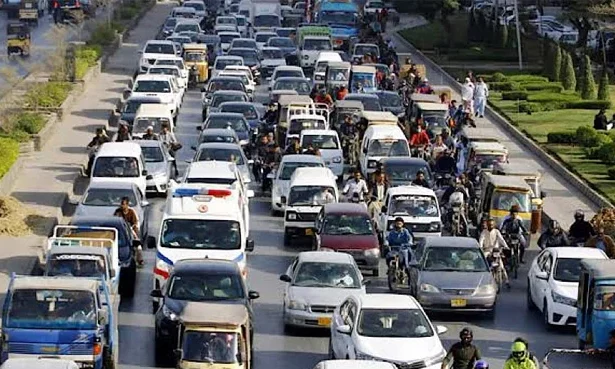
Lahore is one of the most congested cities in the world, and the man responsible for managing its traffic says the situation is getting worse every year, but there are real solutions if the city is willing to try them.
- City built for far fewer vehicles
- Three solutions, not just one
- Model roads and real results
- Fixing roads themselves
- Fines that hurt poor more than rich
Abdul Rahim Shirazi, chief traffic officer of Lahore, sat down with a group of journalists to explain exactly what is happening on the city’s roads, why it is happening, and what his team is doing about it.
City built for far fewer vehicles
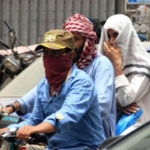
He said Lahore’s total road network stretches around 4,485 kilometres. But the number of registered vehicles has now crossed 8.1 million. Of those, a staggering 6.8 million are motorcycles. That means roughly 75 percent of all vehicles on Lahore’s roads are two-wheelers, a ratio you will not find in Delhi, Mumbai, Dhaka, or Ho Chi Minh City. Lahore is, in this sense, completely unique.
Every year, around 300,000 new vehicles and motorcycles are added to the city’s roads. The infrastructure, however, is not growing at the same speed. The result is gridlock.
Three solutions, not just one
Mr Shirazi rejected the popular idea that stricter enforcement alone can fix Lahore’s traffic problem. He said that traffic management depends on three things working together: enforcement, road engineering, and education. When you treat every problem like a nail, every solution looks like a hammer, and enforcement alone simply cannot solve what is fundamentally a space and design problem.
He said parking is a perfect example. Lahore has a massive commercial population, busy markets, and millions of vehicles, but almost no organised parking. The city’s one dedicated parking facility, LeParking, has only 254 spaces, and even that operates at just 155 spaces. Meanwhile, its operation costs run to Rs197million against a revenue recovery of only Rs200 million. The finances, Mr Shirazi said, tell their own story.
Model roads and real results
His team selected four model roads in the city and launched a focused experiment. They repainted lane markings, installed over 450 banners and flags with clear instructions, deployed a squad with loudspeakers to educate road users, and ran a massive public awareness campaign at key locations including Liberty Roundabout.
The results were measurable. Chalans, traffic violation tickets, issued for lane discipline violations jumped from 12 to 13 per day to 336 per day on those same roads. That is not just more enforcement. That is evidence that when roads speak clearly and people are educated, behaviour changes.
Vehicle counts on these model roads showed that 60 percent of traffic is motorcycles, with between 100,000 and 200,000 vehicles passing through every 24 hours.
Fixing roads themselves
Shirazi’s team is also working on road redesign. At one key intersection near Defence, the existing road is 26 feet wide while the city’s standard requires 33 feet. A U-turn sits awkwardly in the middle of the road. The plan is to redesign the lane layout, dedicating 18 to 22 feet to proper lanes, which would create four usable lanes and solve around 50 percent of the congestion problem at that point alone. Turning lane efficiency would improve by 15 percent, rear-end collisions would reduce, and traffic flow would become smoother.
Bus bays are another focus. Currently, when a bus stops, it blocks the third lane for 60 to 70 seconds, causing a ripple delay of around two minutes behind it. Six new bus bay redesigns have been proposed along key corridors to minimise this disruption.
Fines that hurt poor more than rich
In a candid moment, Shirazi acknowledged a painful reality of traffic enforcement in Pakistan. A Pakistani worker earning 1,500 riyals a month in Saudi Arabia was once fined 2,000 riyals by a traffic warden for a lane violation. The man nearly fainted. Meanwhile, wealthier drivers in Lahore often avoid fines through connections or bribes, while poorer road users bear the full weight of enforcement.
He compared this to traffic systems in Saudi Arabia, Dubai, and the United States — places where violations carry serious consequences regardless of who you are. In Georgia in the United States, certain traffic offences can land you in jail for a day. The lesson, he said, is not that Pakistan must copy the West blindly, but that consistent, fair enforcement — combined with proper road design and genuine public education — is the only combination that actually works.
We welcome your contributions! Submit your blogs, opinion pieces, press releases, news story pitches, and news features to [email protected] and [email protected]