

Summary
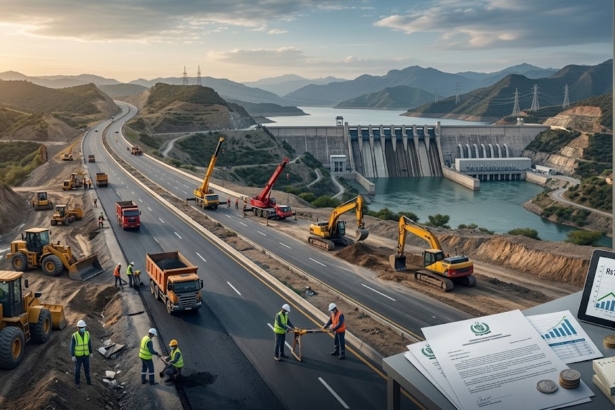
- ISLAMABAD: The government has approved 16 development projects with a combined estimated cost of around Rs1.15 trillion, including the controversial Lahore-Sahiwal-Bahawalnagar motorway and the fifth extension of the Tarbela hydropower project, whose cost has surged by nearly 282% from the original estimate.
- Road and infrastructure schemes The committee also approved the 48-kilometre Khwazakhela-Besham Expressway at a revised cost of Rs116.6 billion.
- Water projects in Sindh and Balochistan The Mazarani Dam project in Qambar Shahdadkot, Sindh, was approved at an estimated cost of Rs16.1 billion.
ISLAMABAD: The government has approved 16 development projects with a combined estimated cost of around Rs1.15 trillion, including the controversial Lahore-Sahiwal-Bahawalnagar motorway and the fifth extension of the Tarbela hydropower project, whose cost has surged by nearly 282% from the original estimate.
The decisions were taken by the Executive Committee of the National Economic Council (ECNEC), chaired by Deputy Prime Minister Ishaq Dar. Several of the projects had previously been considered by development forums and returned with revised costs following delays, changes in scope and rising construction expenses.
Of the total approved amount, approximately Rs320 billion represents additional expenditure linked to cost increases and delays, highlighting the financial pressures facing major public-sector development schemes.
The government, however, issued only a brief statement following the ECNEC meeting and did not provide a complete breakdown of all the projects and their financial details. The omission of the Lahore-Sahiwal-Bahawalnagar motorway from the official summary was particularly notable given the political controversy surrounding the scheme.
Lahore-Bahawalnagar motorway approved
The ECNEC approved the Rs407 billion Lahore-Sahiwal-Bahawalnagar Motorway project, retaining its original 295-kilometre alignment in accordance with a directive issued by Prime Minister Shehbaz Sharif earlier this year.
The first package, covering an 18.5-kilometre stretch from the Lahore Ring Road to Raja Jang Interchange, was approved at an estimated cost of Rs49 billion through federal financing.
The project has faced opposition from the Pakistan Peoples Party (PPP), which has raised objections to the scheme and its proposed alignment.
Given the heavy financial burden on the Public Sector Development Programme (PSDP), the ECNEC directed the National Highway Authority (NHA) to examine public-private partnership options for sections that could attract private investment.
For commercially viable portions, the NHA will arrange its contribution through its own revenues in the form of Viability Gap Funding. For sections that are considered financially unviable, alternative arrangements will be explored, including contributions from the Punjab government, loans or financing from international financial institutions and direct federal funding, subject to the availability of resources.
Tarbela extension faces major cost increase
One of the most significant approvals was the fifth extension of the Tarbela project, which received approval at a revised cost of Rs316 billion.
The project’s original estimated cost stood at approximately Rs82 billion, meaning its revised price tag represents an increase of about 282%.
The steep escalation has already attracted scrutiny from government officials. During the Central Development Working Party (CDWP) review, Planning Minister Ahsan Iqbal reportedly raised concerns over project management, transparency and oversight.
Questions were also raised regarding the technical capacity of personnel associated with the project. The Ministry of Water Resources had previously highlighted shortcomings in an inquiry into problems encountered during project implementation.
An inquiry into the failure of the downstream cofferdam reportedly concluded that the structural collapse was linked to design changes, inadequate supervision and delayed administrative action rather than flooding. The findings attributed the failure to the shift from roller-compacted concrete to a rock-fill structure, along with weaknesses in project oversight.
The incident resulted in delays and financial losses, adding to concerns over the project’s rising cost.
The Ministry of Finance also sought an explanation for the substantial increase in the project’s estimated cost. Since the scheme is being financed through international financial institutions, the ministry asked the Water and Power Development Authority (Wapda) to provide details regarding the mechanism for repayment.
Despite the concerns and requests for additional information, the ECNEC ultimately approved the revised project cost.
Road and infrastructure schemes
The committee also approved the 48-kilometre Khwazakhela-Besham Expressway at a revised cost of Rs116.6 billion. The new estimate is around 47% higher than the original cost.
Another interprovincial road scheme aimed at improving connectivity between Gilgit-Baltistan and Azad Jammu and Kashmir was approved at Rs29 billion, representing an increase of approximately Rs10 billion over its initial estimate.
The Rathoa Haryam Bridge over the reservoir channel on the Mirpur-Islamgarh Road also received approval at a revised cost of Rs10.8 billion. Its original estimate had been only Rs1.4 billion, reflecting a substantial increase over the initial projection.
The ECNEC further approved the Lahore Wastewater Treatment Plant at a cost of Rs56.6 billion, around Rs4.2 billion above the earlier estimate.
Poverty alleviation and education initiatives
The Southern Punjab Poverty Alleviation Project was approved at Rs29.7 billion and will cover 10 districts: Bahawalnagar, Bahawalpur, Bhakkar, Dera Ghazi Khan, Khushab, Layyah, Mianwali, Muzaffargarh, Rahim Yar Khan and Rajanpur.
The scheme includes an additional cost escalation of around Rs6.8 billion and is aimed at improving socioeconomic conditions and livelihood opportunities in some of the region’s less-developed areas.
The ECNEC also sanctioned Rs10.6 billion for the Fulbright scholarship programme, under which 816 scholarships are planned.
Of these, 550 MS and 141 PhD scholarships will be administered through the United States Educational Foundation in Pakistan (USEFP), while the Higher Education Commission (HEC) will provide funding for another 125 PhD scholarships through the PSDP.
Water projects in Sindh and Balochistan
The Mazarani Dam project in Qambar Shahdadkot, Sindh, was approved at an estimated cost of Rs16.1 billion.
The committee directed the provincial authorities to begin Command Area Development alongside construction of the main dam so that the project’s agricultural and economic benefits could be realised during its second phase.
The Winder Dam project was also approved at Rs21.6 billion, with the federal government expected to contribute Rs15.6 billion.
Meanwhile, the Mashkel Dam in Washuk, Balochistan, received approval at a cost of Rs41 billion. The project will be financed by the Balochistan government, while an environmental assessment report will be incorporated into the official project documentation.w
Power-sector efficiency projects
The ECNEC approved several schemes aimed at improving the performance of electricity distribution companies.
A Rs24 billion project for the Supply, Installation, Testing and Commissioning of Asset Performance Management Systems at Lahore Electric Supply Company (LESCO) was approved.
The committee also sanctioned Rs19 billion for the Electricity Distribution Efficiency Improvement Project of Hyderabad Electric Supply Company (HESCO).
A similar initiative for Peshawar Electric Supply Company (PESCO) was approved at Rs30.2 billion.
These projects are intended to improve asset management, operational efficiency and the overall reliability of electricity distribution networks.
Skills development project
The committee also approved the Rs28 billion Improving Workforce Readiness in Punjab Project.
The initiative is designed to modernise Punjab’s technical and vocational education and training system and improve the employability of young people by aligning workforce skills more closely with market requirements.
We welcome your contributions! Submit your blogs, opinion pieces, press releases, news story pitches, and news features to opinion@minutemirror.com.pk and minutemirrormail@gmail.com