Summary
- Before the talks, Vance said Washington aimed to make progress on Iran’s nuclear programme and a ceasefire arrangement related to Lebanon, describing them as priority issues for the negotiations.
- Officials noted that Pakistan will also hold bilateral meetings with participating delegations during the course of the talks.
- The negotiations come at a critical moment, with both sides under pressure to demonstrate progress on key issues, including Iran’s nuclear activities, regional security concerns, and stability in Lebanon.
High-level diplomatic engagement between the United States and Iran is underway in Switzerland, with Pakistan playing a key facilitative role in efforts to advance implementation of a recent understanding aimed at de-escalating regional tensions.
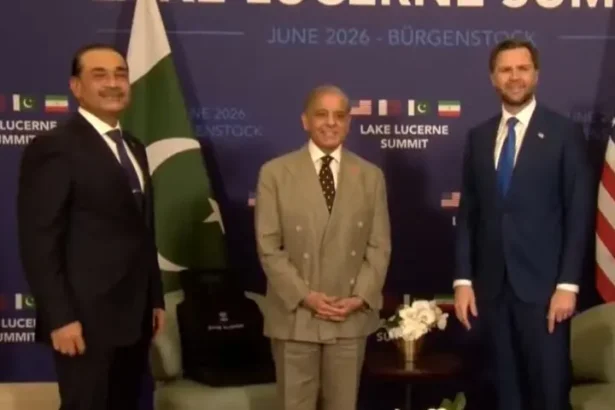
Prime Minister Shehbaz Sharif, accompanied by Chief of Defence Forces Field Marshal Asim Munir, held a bilateral meeting with the US negotiating team led by Vice President JD Vance ahead of the formal start of talks at the Burgenstock resort.
The Swiss-hosted discussions bring together delegations from the United States, Iran, Qatar, and Pakistan for technical-level negotiations focused on implementing the framework outlined in the Islamabad Memorandum of Understanding (MoU), signed earlier this month.
According to official statements, the agreement outlines steps to end hostilities, ease restrictions including the US blockade on Iran, and reopen key maritime routes such as the Strait of Hormuz. The current round of talks is intended to translate those commitments into actionable measures.
The US delegation is led by Vice President JD Vance, who is joined by senior officials including Jared Kushner and Steve Witkoff. Before the talks, Vance said Washington aimed to make progress on Iran’s nuclear programme and a ceasefire arrangement related to Lebanon, describing them as priority issues for the negotiations.
Iran’s delegation is headed by Parliament Speaker Mohammad Bagher Ghalibaf and includes Foreign Minister Abbas Araghchi, along with senior officials from security, economic, and energy sectors. Tehran has indicated it will push for full implementation of commitments made under the agreement and seek clarity on enforcement mechanisms.
Pakistan’s Foreign Office said Islamabad will continue to support the implementation process, emphasizing its role as a mediator that has previously facilitated dialogue between the two sides. Officials noted that Pakistan will also hold bilateral meetings with participating delegations during the course of the talks.
Qatar is also participating as a mediator, supporting diplomatic efforts aimed at sustaining regional de-escalation. Swiss authorities confirmed that discussions between delegations have begun, with no fixed timeframe announced, as negotiations may continue depending on progress.
Reports suggest the talks may extend beyond a single day, with both structured sessions and bilateral meetings planned between mediators and participating delegations. However, Iranian officials indicated the initial schedule envisions a one-day session with multiple phases.
The negotiations come at a critical moment, with both sides under pressure to demonstrate progress on key issues, including Iran’s nuclear activities, regional security concerns, and stability in Lebanon. Observers note that implementation remains the central challenge, with each side seeking assurances on compliance and enforcement.
We welcome your contributions! Submit your blogs, opinion pieces, press releases, news story pitches, and news features to opinion@minutemirror.com.pk and minutemirrormail@gmail.com