Summary
- After being stripped of education, employment, freedom of movement, political participation and countless other fundamental rights, Afghan women now face an even more disturbing reality: a society in which their names, too, are expected to remain hidden.Since the Taliban returned to power in August 2021, Afghan women have watched their freedoms disappear, restriction by restriction, until almost every aspect of their lives has come under male control.
- Even healthcare has become harder to access, particularly as restrictions on women’s education have reduced the availability of female medical professionals.The question is no longer how many rights Afghan women have lost, but how many more can be taken away before the world recognises the scale of this injustice.
- Last year, Afghan women had taken to the streets to demand rights that should never have been taken from them.
A name is the first legacy bestowed upon us at birth and the one that outlives us after death. It is more than a word: it represents our identity, the legacy we leave. Yet, for millions of women in Afghanistan, even this basic expression of identity is becoming another privilege denied to them. After being stripped of education, employment, freedom of movement, political participation and countless other fundamental rights, Afghan women now face an even more disturbing reality: a society in which their names, too, are expected to remain hidden.Since the Taliban returned to power in August 2021, Afghan women have watched their freedoms disappear, restriction by restriction, until almost every aspect of their lives has come under male control. Girls are prohibited from studying beyond the sixth grade, women are excluded from universities and most employment, and travelling independently is severely restricted by the requirement of a male guardian. Their opportunities to participate in politics, establish businesses, make independent decisions about marriage and divorce, and contribute to public life have been systematically undermined. Even healthcare has become harder to access, particularly as restrictions on women’s education have reduced the availability of female medical professionals.The question is no longer how many rights Afghan women have lost, but how many more can be taken away before the world recognises the scale of this injustice. As if these restrictions were not enough, reports about the treatment of women’s names reveal another disturbing dimension of their erasure. In parts of Afghanistan, Balkh province, some regard calling a woman by her name as an affront to male honour. Women are often identified through their relationships with men rather than as individuals. On wedding invitations, tombstones and in everyday references, they may be described as someone’s wife, mother, daughter or sister. Instead of their names, terms such as Bibi, meaning lady, or even words referring to animals have reportedly been used. Their identities are reduced to family relationships, as though a woman cannot exist independently of the men around her. But its persistence alongside the Taliban’s institutional restrictions makes it alarming. Reports that women’s names are excluded from official records and medical documentation raise serious concerns about whether their individual identities are recognised. Erasing a woman’s name from public life is not simply denying her a word. It denies her visibility, individuality and dignity.If a woman’s name does not appear in society’s records, whose story will be remembered? If she is not recognised as an individual, how can she claim property, establish her rights or seek justice when wronged? When her identity is replaced by her relationship to a man, her experiences and the injustices committed against her can become easier to overlook. Activist Lali Osmani has described this practice as part of a systematic process of dehumanisation, reducing women to biological beings or the property of men.The Taliban’s treatment of women is not a collection of isolated restrictions. It is a system of control designed to push women out of education, employment, public spaces and social life. The 2024 Law on the Propagation of Virtue and Prevention of Vice further strengthened morality officials’ powers to monitor and enforce restrictions on public behaviour. Its impact is clear: an atmosphere of fear in which women must consider what they wear, where they go, what they say and whether their presence might invite punishment. Afghan women’s accounts convey a reality more suffocating than the phrase “restricted freedom” can express. A woman described life under these conditions as feeling like a dead body moving around, unable to speak or act, where even breathing becomes difficult. This is what happens when an entire section of society is denied the chance to live with dignity. It is more than an open-air prison; it is an existence in which ordinary human activities become obstacles. And where are the protests? Where are the marches and demonstrations in our universities, Junior Common Rooms and Senior Common Rooms? Where are the voices of student unions, human rights organisations and international feminist movements? Last year, Afghan women had taken to the streets to demand rights that should never have been taken from them. They risked arrest, violence and humiliation to make their voices heard. Protesters had reportedly been beaten, dragged away, insulted and detained. Despite their courage, international concern has not become the sustained public pressure this crisis demands.Where is the outrage? Where is the condemnation? Where is the collective determination to challenge a regime systematically dismantling the lives of women and girls? UN Women and other international organisations have repeatedly documented and condemned these violations. But statements and reports must be accompanied by sustained diplomatic pressure, accountability and meaningful support for Afghan women. The world cannot allow itself to become accustomed to their suffering. For those who still question why feminism matters, Afghanistan offers one of the most devastating answers. Feminism is not about giving women superiority over men; it is about recognising their equal humanity. It means defending their right to study, work, travel, speak, participate, make choices and exist as individuals. To deny a woman her name is to deny her dignity and recognition. To deny her education is to silence her future. To deny her freedom is to confine her life within boundaries imposed by others. The struggle for women’s rights does not end at national borders. Freedom cannot be considered complete while millions of women remain trapped by discrimination and institutionalised oppression. Afghan women need more than the world’s sympathy: they need solidarity, recognition, protection and action. They deserve to be seen, heard, educated, employed and remembered. They deserve more than being known only as someone’s wife, daughter or mother. They deserve to be recognised by their own names. A woman whose identity is denied is a woman whose existence society is trying to erase. No regime, tradition or claim of male honour should have the authority to decide whether a woman deserves to be remembered.
NO WOMAN IS FREE UNTIL EVERY WOMAN IS FREE.
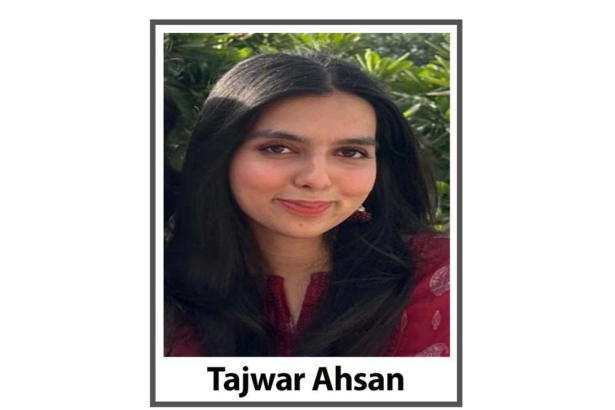
The writer is a law student and a human rights activist.
We welcome your contributions! Submit your blogs, opinion pieces, press releases, news story pitches, and news features to opinion@minutemirror.com.pk and minutemirrormail@gmail.com