Summary
- Pakistan’s military has defended the state’s handling of unrest in Azad Jammu and Kashmir (AJK) and the security situation in Balochistan, saying the government is exercising restraint while remaining committed to constitutional governance, counterterrorism efforts and national stability.
- Good governance key to national security Responding to questions about governance reforms, the military spokesperson said effective administration was essential for ensuring peace and long-term stability.
- Balochistan challenges linked to governance and propaganda Discussing Balochistan, the military spokesperson said the province’s security challenges stemmed from a combination of militancy, organized crime, entrenched elite interests and external interference.
Pakistan’s military has defended the state’s handling of unrest in Azad Jammu and Kashmir (AJK) and the security situation in Balochistan, saying the government is exercising restraint while remaining committed to constitutional governance, counterterrorism efforts and national stability.
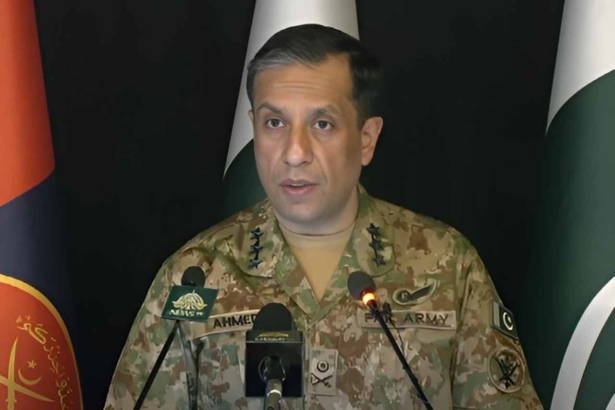
Addressing a detailed press conference on Friday, Director General of Inter-Services Public Relations (ISPR) Lieutenant General Ahmed Sharif Chaudhry said political issues should be resolved through democratic and constitutional means, while security challenges require strong governance and public support.
State urges constitutional path in AJK
The military spokesperson said the state had acted with restraint in dealing with recent unrest in AJK, adding that the electoral process would continue without disruption. He stressed that the will of the people should be reflected through democratic institutions and that all individuals would be held accountable under the Constitution and the law.
He said Pakistan remained committed to its long-standing position on Kashmir, describing the region as central to the country’s national policy. He also rejected claims that the Pakistan Army was an occupying force in AJK, saying security matters in the region were being handled by the AJK government, police and civilian law enforcement agencies.
The DG ISPR alleged that India was attempting to fuel instability inside Pakistan through proxy campaigns and misinformation, while reaffirming Pakistan’s support for the Kashmiri people’s right to self-determination under United Nations resolutions.
Good governance key to national security
Responding to questions about governance reforms, the military spokesperson said effective administration was essential for ensuring peace and long-term stability. He noted that Pakistan’s rapidly growing population required a review of administrative structures and said reforms should be debated and implemented through constitutional and democratic processes.
He said an administrative reset could be considered if it helped improve governance, but emphasized that any changes must reflect the will of the people and remain within the legal framework.
Referring to the National Action Plan, he said most of its objectives—including countering extremist narratives, stopping terror financing, improving institutional capacity and tackling smuggling—depended on strong governance rather than military action alone.
Security operations intensify against terrorism
The DG ISPR said security forces had significantly increased intelligence-based operations across the country during 2026, conducting thousands of operations aimed at dismantling terrorist networks. According to him, more than 2,000 militants had been killed this year, while hundreds of security personnel and civilians had embraced martyrdom.
He said the majority of recent suicide bombers were Afghan nationals and accused militant groups linked to the Afghan Taliban of supporting cross-border terrorism against Pakistan.
He maintained that the rise in security incidents reflected a more aggressive counterterrorism strategy, with intelligence-led operations forcing militants into direct confrontation with security forces.
Balochistan challenges linked to governance and propaganda
Discussing Balochistan, the military spokesperson said the province’s security challenges stemmed from a combination of militancy, organized crime, entrenched elite interests and external interference. He argued that some influential groups resisted reforms to preserve their political and economic influence, while terrorist organizations exploited local grievances through propaganda.
He highlighted ongoing development projects, including investments in education, healthcare, transport infrastructure and Gwadar’s development, saying the government had allocated substantial resources to the province. He also referred to data from the Commission of Inquiry on Enforced Disappearances, stating that most reported cases had already been resolved while investigations into the remaining cases were continuing.
We welcome your contributions! Submit your blogs, opinion pieces, press releases, news story pitches, and news features to opinion@minutemirror.com.pk and minutemirrormail@gmail.com