Summary
- The Tax Expenditure Report 2026 estimates revenue forgone during fiscal year 2024–25 through income tax, sales tax and customs concessions at approximately Rs.
- Replacing sales tax on petroleum products with an ever-increasing levy therefore does more than alter the method of collection.
- Revenue is collected through banks, employers, utility companies, registrars, import authorities and businesses without requiring the tax administration to investigate actual income.
The third part of this series demonstrated that tax policy is never politically neutral. Every exemption, rate differential, withholding provision and collection mechanism determines who will bear the burden, who will receive protection and who will remain outside effective enforcement.
The next question is unavoidable. Why do reforms that appear technically sound on paper repeatedly fail in Pakistan? The usual explanation is weak implementation. Successive governments announce that the policy was correct, while administrative capacity, political resistance or taxpayer behaviour prevented its success. This distinction between sound design and deficient execution is comforting because it preserves confidence in the original prescription. It also conceals an important reality: implementation is not external to policy. It is part of policy.
A reform designed without considering the incentives of legislators, administrators, affected sectors and enforcement institutions is not technically sound. It is technically incomplete. Pakistan’s fiscal history is filled with such incompleteness. Broad-based taxation is announced, followed by exemptions.
Documentation is promised, followed by presumptive and final taxation. Value added taxation is introduced, followed by reduced rates, fixed taxes, special procedures and restrictions on input adjustment. Taxpayer facilitation is proclaimed, followed by additional withholding obligations, automated demands, coercive recovery and delayed refunds.
Each deviation is described as temporary. Temporary arrangements acquire permanent beneficiaries and eventually become defining features of the system. The problem cannot be explained simply by lack of expertise. Pakistan has received technical assistance from the International Monetary Fund, World Bank, Asian Development Bank and other institutions for decades.
Numerous committees, commissions and task forces have recommended broadening the base, reducing exemptions, simplifying rates, improving audits, integrating data and strengthening administration. The present IMF programme again calls for base broadening, rationalisation of tax expenditures, digital invoicing, risk-based audits and improved revenue administration.
The prescriptions remain familiar because the institutional incentives producing the original distortions remain largely unchanged. Consider value added taxation. A genuine VAT is collected at successive stages of production and distribution, with tax paid on inputs allowed against tax charged on outputs. The mechanism creates a documentary chain because each registered purchaser has an interest in obtaining an invoice. Exemptions, fixed regimes and blocked input credits break that chain.
Pakistan has retained the name of sales tax while repeatedly undermining its value added character. Multiple schedules, special rates, exemptions, extra taxes, further taxes, minimum value addition requirements and restrictions on input adjustment have converted a potentially coherent instrument into an intricate system of revenue extraction.
The resulting complexity is then blamed upon taxpayers. Pakistan’s “innovation” has been to combine high statutory rates with a fragmented base, extensive concessions and aggressive collection from those already documented. The system punishes formalisation while expecting formalisation to expand voluntarily.
The Tax Expenditure Report 2026 estimates revenue forgone during fiscal year 2024–25 through income tax, sales tax and customs concessions at approximately Rs. 2.353 trillion. This figure excludes the larger constitutional controversy created by keeping petroleum products outside the sales tax chain and collecting petroleum levy instead since March 2024. Sales tax concessions accounted for about Rs. 1.274 trillion, income tax concessions for Rs. 579.70 billion and customs concessions for Rs. 499.14 billion.
The treatment of petroleum products reveals how implementation can defeat both tax design and constitutional distribution. Sales tax forms part of the divisible pool under Article 160 of the Constitution. Petroleum levy is a non-tax federal receipt outside that pool. Replacing sales tax on petroleum products with an ever-increasing levy therefore does more than alter the method of collection. It changes the distribution of fiscal resources between the Federation and provinces.
A measure presented as revenue policy consequently modifies the federal bargain without formally amending the Constitution. Income taxation displays the same institutional pattern. A normal income tax determines taxable income after allowing legitimate expenses and then applies the appropriate rate. Pakistan increasingly taxes transactions, turnover and gross receipts without establishing real income.
Withholding taxes, advance taxes, minimum taxes, final taxes and presumptive liabilities were initially justified as responses to weak enforcement. They gradually became substitutes for enforcement. The Revenue Division Year Book 2024–25 confirms the continuing centrality of withholding and advance collection within direct taxes.
This model is administratively attractive. Revenue is collected through banks, employers, utility companies, registrars, import authorities and businesses without requiring the tax administration to investigate actual income. It also creates impressive collection figures before returns are filed and liabilities determined.
The constitutional cost is rarely measured. Taxpayers become liable because they undertake transactions rather than because they earn taxable income. Private persons become unpaid collection agents. Refunds and adjustments remain blocked or delayed. Documented businesses carry the state’s administrative burden, while powerful informal sectors continue bargaining for concessions.
Pakistan has even institutionalised the category of the “non-filer”. Instead of identifying income, making assessments and enforcing payment, the law imposes higher transaction-based rates upon persons whose names do not appear on the Active Taxpayers’ List. Non-compliance is monetised rather than eliminated.
This is presented as behavioural taxation: higher deductions will supposedly encourage return filing. The state simultaneously acquires a fiscal interest in retaining non-filers because they yield higher collections. The instrument designed to eliminate a category becomes dependent upon its continued existence. No conventional textbook could have anticipated such an innovation.
Retailer taxation provides another illustration. Every government announces that traders will be brought into the tax net. Every scheme begins with declarations of equality and documentation. Political resistance follows, negotiations commence, liability is diluted, and the final arrangement bears little relationship to actual income or turnover. The administration then turns to those who cannot collectively bargain: salaried persons, incorporated businesses, importers, banks, telecom users and consumers of electricity, fuel and essential goods.
Agricultural income taxation has travelled a similar path. The Constitution assigns this field to the provinces. Provincial laws exist, returns may be filed and declarations may be recorded. Effective collection, verification and enforcement remain modest in comparison with the sector’s economic and political significance. The failure is not the absence of legal authority. It reflects the distribution of political power within provincial legislatures and administrations. A reform cannot succeed where those expected to legislate and enforce it are drawn from, dependent upon or accountable to its principal beneficiaries.
Digitalisation is now offered as the universal solution. Pakistan possesses identity records, banking information, property data, travel records, utility consumption, vehicle registrations and corporate databases. Digital invoicing, production monitoring and risk-based audit systems are being expanded under the current reform programme.
Technology can identify discrepancies. It cannot decide whether discrepancies involving powerful persons will be pursued. It cannot prevent selective notices, arbitrary assessments or misuse of data. It cannot create constitutional accountability where institutional incentives reward revenue targets rather than fair determination of liability. Digitising an unequal system may merely automate inequality.
The obsession with annual revenue targets reinforces this behaviour. Tax officers are evaluated primarily by collection. Governments require immediate resources to service debt and meet programme conditions. The resulting incentives favour advance collection, withholding, blocked refunds and easily accessible taxpayers over patient audits, dispute reduction and long-term base development.
A rupee collected through excessive deduction counts immediately. A new taxpayer cultivated through credible administration may produce revenue only later. Institutions under short-term pressure predictably choose the former.
Constitutional Political Economy rejects the convenient separation between formulation and implementation. The true design of a reform includes the political process through which it will be altered, the bureaucracy through which it will be administered, the courts and tribunals through which it will be contested, and the interest groups that will seek exceptions.
A technically serious proposal must answer more than economic questions. Who has an incentive to implement it? Who can obstruct it? Who will monitor enforcement? What remedies are available against abuse? Will the rules apply equally to those who make them? Can the beneficiaries of the existing system capture the reform process?
Abu Yusuf recognised this problem more than twelve centuries ago. His discussion of public revenue did not stop at rates and classifications. It addressed the conduct of collectors, the danger of oppression, preservation of productive capacity and responsibility of the ruler for the manner in which taxes were administered.
Ibn Khaldun later explained that excessive fiscal burdens could weaken incentives, contract economic activity and eventually reduce revenue. Arthur Laffer acknowledged that the proposition later associated with the Laffer Curve was not his original discovery and expressly referred to Ibn Khaldun among its intellectual antecedents.
The enduring lesson is broader than the relationship between rates and receipts. A state cannot continuously extract from productive activity while protecting privilege and expect prosperity to follow. Revenue depends upon legitimacy, incentives and confidence in institutions.
Pakistan does not lack tax reforms. It lacks a constitutional and institutional structure capable of preventing reforms from being captured, diluted or redirected. The central challenge is not how to design another technically impressive measure. It is how to create rules under which sound measures survive the political process, apply equally and remain subject to public accountability. Without that transformation, every reform will begin with promises of broadening the base and end by increasing the burden upon those already trapped within it.
In the next part, we shall examine Pakistan’s rent-based political economy and how geopolitical assistance, privileges, exemptions and access to state power have discouraged productive transformation.
[To be continued]
____________________________________________________________________
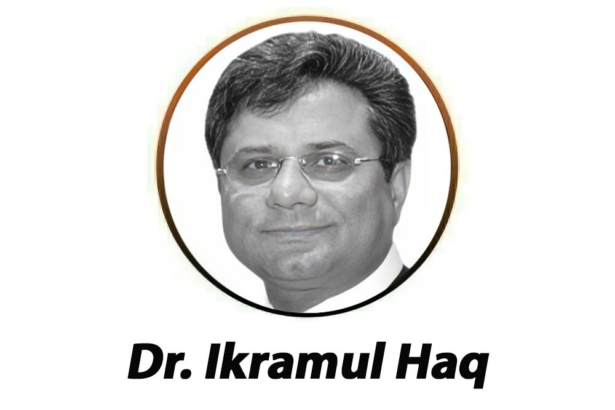
Dr. Ikramul Haq, Advocate Supreme Court, Adjunct Faculty at Lahore University of Management Sciences (LUMS), member Advisory Board and Visiting Senior Fellow of Pakistan Institute of Development Economics (PIDE), holds an LLD in tax laws. He was full-time journalist from 1979 to 1984 with Viewpoint and Dawn. He also served Civil Services of Pakistan from 1984 to 1996.
We welcome your contributions! Submit your blogs, opinion pieces, press releases, news story pitches, and news features to opinion@minutemirror.com.pk and minutemirrormail@gmail.com