Summary
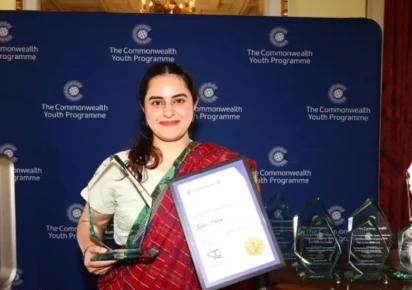
- Pakistan’s fight for menstrual justice has reached a major milestone after Bushra Mahnoor, founder of the period education and welfare group Mahwari Justice, was named the winner of the 2026 Commonwealth Youth Award for Asia.
- Alongside legal activists Mahnoor Omer and Alisha Shabbir, Mahnoor played a central role in the campaign against luxury taxes on feminine hygiene products, helping mobilise more than 10,000 citizens to sign a national petition demanding their removal.
- Through her work dismantling social taboos, expanding access to health education for marginalised groups, and helping shape national policy, Mahnoor continues to push for menstrual care to be recognised as what it fundamentally is: a basic human right.
Pakistan’s fight for menstrual justice has reached a major milestone after Bushra Mahnoor, founder of the period education and welfare group Mahwari Justice, was named the winner of the 2026 Commonwealth Youth Award for Asia.
The award, presented annually, recognises young changemakers under the age of 30 who are creating meaningful change in their communities. Standing out among nearly 1,000 entries from 56 countries, Mahnoor became only the fourth Pakistani, and the second Pakistani woman, to ever receive the honour, ending a six year gap since a Pakistani last won the award. Alongside the recognition, she received a 3,000 pound grant to help expand her organisation’s work.
Mahnoor founded Mahwari Justice in 2022 during the devastating floods that swept across Pakistan, recognising that periods do not stop in a climate crisis. She began assembling and distributing emergency feminine hygiene kits to women trapped in flood hit and cut off areas. What started as an emergency response has since grown into a nationwide movement, reaching more than 175,000 people across the country.
A defining feature of Mahnoor’s work has been her commitment to inclusivity. She led the creation of a first of its kind disability inclusive guide on menstruation, ensuring that visually impaired and hearing impaired individuals have access to essential health education. The guide has been translated into braille, and a sign language version is currently in production.
Her global recognition follows closely on the heels of a significant policy win at home. Alongside legal activists Mahnoor Omer and Alisha Shabbir, Mahnoor played a central role in the campaign against luxury taxes on feminine hygiene products, helping mobilise more than 10,000 citizens to sign a national petition demanding their removal. The government subsequently withdrew the taxes on sanitary pads in the Federal Budget 2026 to 2027.
Through her work dismantling social taboos, expanding access to health education for marginalised groups, and helping shape national policy, Mahnoor continues to push for menstrual care to be recognised as what it fundamentally is: a basic human right.