Summary
- Chief of Defence Forces and Chief of Army Staff Field Marshal Asim Munir has stressed the need for sustained diplomatic engagement, mutual trust and close coordination between Pakistan and Iran to strengthen regional peace and stability.
- Munir’s latest engagement with Iranian leadership comes amid Pakistan’s continuing diplomatic efforts to reduce regional tensions and facilitate negotiations between Tehran and Washington.
- Last month, Munir visited Tehran under the Makkah Defence Pact, where representatives from Pakistan, Saudi Arabia and Turkiye held discussions with Iranian leaders on regional security.
Chief of Defence Forces and Chief of Army Staff Field Marshal Asim Munir has stressed the need for sustained diplomatic engagement, mutual trust and close coordination between Pakistan and Iran to strengthen regional peace and stability.
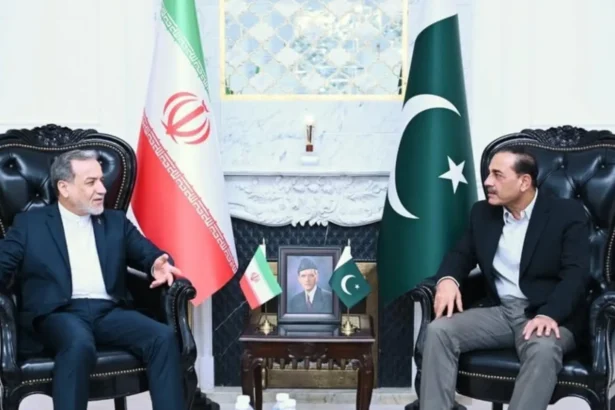
He made the remarks during a meeting with Iranian Foreign Minister Abbas Araghchi in Rawalpindi on Monday, according to a statement issued by the Inter-Services Public Relations (ISPR) on Tuesday.
The meeting focused on matters of mutual interest, regional security and evolving geopolitical developments. Both sides also discussed possible ways to address shared security challenges and strengthen cooperation between the neighbouring countries.
Araghchi appreciated Pakistan’s constructive role in promoting regional peace and stability. He also expressed Iran’s desire to further strengthen bilateral relations with Islamabad, the military’s media wing said.
The meeting followed Araghchi’s participation in the 30th meeting of the Economic Cooperation Organisation (ECO) Council of Foreign Ministers in Islamabad, where he called for a reliable and sustainable regional energy mechanism.
He said such an arrangement was necessary to protect energy flows, maintain stable supplies and reduce regional vulnerabilities amid disruptions to major fuel supply routes.
Commenting on the conflict involving the United States and Iran, Araghchi reiterated Tehran’s commitment to diplomatic engagement and peaceful solutions. However, he accused Washington of pursuing policies based on aggression, threats and economic pressure.
The Iranian foreign minister also said Tehran had no inherent dispute with other countries in the region. He stressed that their territories, airspace and facilities should not be used to launch attacks against neighbouring states.
Munir’s latest engagement with Iranian leadership comes amid Pakistan’s continuing diplomatic efforts to reduce regional tensions and facilitate negotiations between Tehran and Washington.
Last month, Munir visited Tehran under the Makkah Defence Pact, where representatives from Pakistan, Saudi Arabia and Turkiye held discussions with Iranian leaders on regional security.
During the visit, Iranian President Masoud Pezeshkian called for greater regional unity and urged Muslim countries to develop a coordinated response to threats against Islamic nations.
Munir also travelled to Iran on October 21, when Iranian officials conveyed that the United States would need to take initial steps to rebuild trust. Tehran also indicated that its seven-point proposal could provide a basis for renewed negotiations.
Earlier, on August 24, Munir met Pezeshkian, Iranian Parliament Speaker Mohammad Bagher Ghalibaf, Araghchi and other senior officials during another visit to Tehran. The discussions focused on regional security and restoring stability.
Pakistan has remained actively involved in diplomatic efforts to end the conflict between the United States and Iran, which began following US and Israeli strikes on Iranian territory in February.
Islamabad brokered a ceasefire between the two sides on April 8 and subsequently hosted direct negotiations between Washington and Tehran on April 11 and 12.
The diplomatic initiative also resulted in the signing of the Islamabad Memorandum of Understanding (MoU) in Geneva on June 17. The agreement established a framework for moving towards a permanent end to the conflict.
We welcome your contributions! Submit your blogs, opinion pieces, press releases, news story pitches, and news features to opinion@minutemirror.com.pk and minutemirrormail@gmail.com