Summary
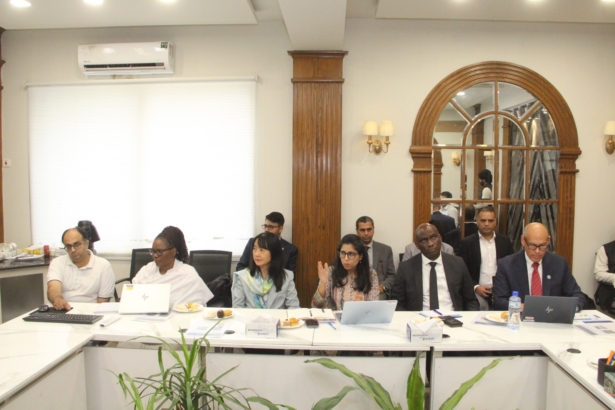
- Food and Agriculture Organization of the United Nations (FAO) and the Government of Punjab reaffirmed their strategic partnership to advance climate-resilient agriculture, climate information services and sustainable water management during a high-level strategic meeting held at the Planning and Development Board, Government of Punjab, Lahore.
- The project is strengthening Punjab’s capacity to plan and act on climate risks through many interconnected areas like climate-resilient agriculture (CRA) practices, farmer field schools, CRA demonstration plots, improving climate and water information services, building on-farm resilience among smallholder farmers, and creating an enabling environment for long-term transformation in agriculture and water management.
- Through this partnership, FAO and the Government of Punjab are helping build a stronger foundation for climate adaptation in agriculture, improving the resilience of vulnerable farming communities and contributing to Pakistan’s broader goals of food security, sustainable water management and resilient rural development.
Food and Agriculture Organization of the United Nations (FAO) and the Government of Punjab reaffirmed their strategic partnership to advance climate-resilient agriculture, climate information services and sustainable water management during a high-level strategic meeting held at the Planning and Development Board, Government of Punjab, Lahore.
The meeting was chaired by Mr. Rafaqat Ali, Secretary, Planning and Development Board, and attended by Mr. Aslam Javed, Member Agriculture, along with senior representatives from the Planning and Development Board, Agriculture Department, Irrigation Department, and other relevant public institutions.
The discussions focused on the Green Climate Fund-supported and Government of Punjab and Government of Sindh co-financed project “Transforming the Indus Basin with Climate Resilient Agriculture and Water Management.” In Punjab, the project is being implemented in Khanewal, Multan, Muzaffargarh, Dera Ghazi Khan and Lodhran, supporting government institutions and farming communities to respond more effectively to climate risks affecting agriculture and water resources.
The high-level FAO mission was led by Mr. Robert Simpson, Deputy Regional Representative for Asia and the Pacific / FAO Representative ad interim in Pakistan, accompanied by Ms. HangThiThanh Pham, Senior Resilience Officer and Lead Technical Officer. The FAO delegation also included Mr. James Okoth, Officer in Charge, FAO Pakistan, Ms. Amina Bajwa, Assistant FAO Representative Programme, Ms. Emelda Berejena, Technical Adviser and Project Manager, Tousif Bhatti, Senior Ground Water Management Specialist , Mr. Mudasir Maqsood, Senior Water Management Expert, Mr. Mr. Waleed Ahmad, Provincial Coordinator Punjab, and Mr. Shahnawaz Arif, Communications Specialist.
The project is strengthening Punjab’s capacity to plan and act on climate risks through many interconnected areas like climate-resilient agriculture (CRA) practices, farmer field schools, CRA demonstration plots, improving climate and water information services, building on-farm resilience among smallholder farmers, and creating an enabling environment for long-term transformation in agriculture and water management.
In Punjab, the project has supported installation of 15 automatic weather stations and two flux towers, along with groundwater and surface-flow sensors to support improved climate and water information for planning and advisory services. The project has also supported water accounting, WaPOR-based evapotranspiration monitoring, groundwater assessments in Khanewal and Dera Ghazi Khan, and draft aquifer management plans for both districts.
At the field level, the project is helping farmers adopt climate-resilient agriculture and on-farm water management through farmer learning platforms, demonstration plots, Women Open Schools, field days and community-based extension support. By building the capacities of extension staff and Farmer Facilitators, the project is transferring practical, locally relevant knowledge to farming communities, helping farmers make better decisions, improve resource use, reduce climate-related risks and move towards more resilient farming systems.
The project is also strengthening the enabling environment for wider adoption through awareness campaigns, farmer advisories, training materials and digital outreach. By engaging financial institutions, it is helping link farming communities with services and financing opportunities needed to scale climate-resilient practices.
Speaking on the occasion, Mr. Rafaqat Ali, Secretary, Planning and Development Board, said:
“Climate-resilient agriculture and sustainable water management are central to Punjab’s development priorities. The Government of Punjab values its partnership with FAO under this important initiative, which is strengthening institutional capacity, improving climate-informed planning and supporting practical solutions for farmers. The progress achieved so far provides a strong basis to deepen impact in the target districts and align project results with provincial priorities for food security, water efficiency and rural resilience.”
The chair further emphasized on strengthening coordination among government stakeholders and with FAO to expedite the project.
He directed to hold steering committee meetings frequently to remove any bottlenecks.
Mr. Robert Simpson appreciated the Government of Punjab’s leadership and continued collaboration.
“FAO deeply values its partnership with the Government of Punjab. This project demonstrates how climate science, water management, extension services and farmer-focused solutions can come together to support more resilient agricultural systems. Our shared priority is to ensure that technical investments translate into practical benefits for farming communities, especially smallholders facing increasing climate and water-related risks,” he said.
The meeting emphasized the importance of continued coordination among planning, agriculture, irrigation, meteorology, research, and extension institutions.
Participants discussed priorities for strengthening the use of climate data, improving water productivity, expanding farmer learning systems, supporting women farmers, and ensuring that field-level innovations are linked with government planning, policy and service delivery.
Through this partnership, FAO and the Government of Punjab are helping build a stronger foundation for climate adaptation in agriculture, improving the resilience of vulnerable farming communities and contributing to Pakistan’s broader goals of food security, sustainable water management and resilient rural development.
We welcome your contributions! Submit your blogs, opinion pieces, press releases, news story pitches, and news features to opinion@minutemirror.com.pk and minutemirrormail@gmail.com