Summary
- Jamiat Ulema-e-Islam-Fazl (JUI-F) chief Maulana Fazlur Rehman has urged the federal government to address the ongoing unrest in Azad Jammu and Kashmir (AJK) through dialogue, stressing that reconciliation is the only path to a lasting solution.
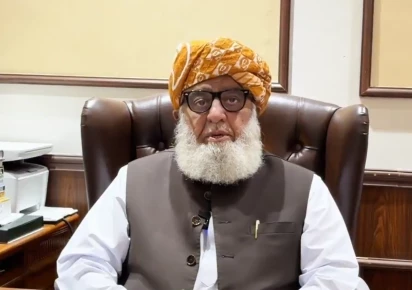
- In a video message shared on the party’s X account on Saturday, Fazlur Rehman called on the government and state institutions to recognise the seriousness of the situation instead of responding with force.
- Despite the violence, Fazlur Rehman appealed to the JAAC leadership and protesters to remain peaceful and avoid any action that could worsen the situation.
Jamiat Ulema-e-Islam-Fazl (JUI-F) chief Maulana Fazlur Rehman has urged the federal government to address the ongoing unrest in Azad Jammu and Kashmir (AJK) through dialogue, stressing that reconciliation is the only path to a lasting solution.
In a video message shared on the party’s X account on Saturday, Fazlur Rehman called on the government and state institutions to recognise the seriousness of the situation instead of responding with force. He said authorities should work to restore peace and stability rather than allowing further bloodshed.
“The government and state institutions must understand the gravity of the crisis. Instead of turning our homeland into a place of violence, they should focus on healing divisions through meaningful dialogue,” he said.
His remarks came after violent clashes were reported in Rawalakot between law enforcement personnel and protesters affiliated with the banned Jammu and Kashmir Awami Action Committee (JAAC). Reports circulating on social media claimed multiple casualties and injuries, with both security officials and the JAAC alleging loss of lives.
Fazlur Rehman said the JAAC’s sit-in had continued for more than two months. He recalled that after tensions intensified on June 5, the committee had formally requested him to mediate between the protesters and the government. According to him, he accepted the role and remained in contact with both sides through JUI-F AJK chief Maulana Saeed Yousaf Khan and Sardar Kamran Azam Khan.
The JUI-F chief expressed concern over the situation faced by residents of AJK, saying people expect their government to protect them rather than leave them living in fear. He alleged that women, children and families had endured months of insecurity while the authorities failed to address their concerns.
He further claimed that force had been used against unarmed protesters and alleged that, according to the information available to him, the death toll had reached around 80 people. However, no official confirmation has been issued regarding that figure.
Despite the violence, Fazlur Rehman appealed to the JAAC leadership and protesters to remain peaceful and avoid any action that could worsen the situation. He urged them to allow more time for mediation efforts, expressing hope that a fair and lasting political settlement could still be achieved.
He also criticised the government’s approach, claiming that although the protesters had shown confidence in his mediation efforts, the authorities had not taken the initiative seriously and had instead relied on force rather than negotiations.
Warning of wider implications, Fazlur Rehman said the movement had gained support across Kashmir as well as among Pakistanis and the Kashmiri diaspora, particularly in Europe.
The recent violence has drawn condemnation from political parties and human rights organisations. The Human Rights Commission of Pakistan (HRCP) expressed deep concern over reports of deaths and injuries, stressing that maintaining law and order should never come at the expense of the right to life or the freedoms of peaceful assembly and expression. The commission called for a prompt, impartial and independent investigation into the incidents.
Opposition parties, including PTI, also demanded an independent judicial inquiry into the clashes, while other political groups criticised what they described as the excessive use of force against protesters.
The current dispute is linked to long-standing demands by the JAAC, which has been seeking constitutional and governance reforms in AJK. Among its key demands are the abolition of 12 reserved seats in the AJK Legislative Assembly allocated to Kashmiri refugees and the removal of the existing quota system. Although the government and the JAAC reached an agreement after protests last year to establish a high-level committee to review the issue of refugee seats, negotiations have since stalled. The JAAC continues to insist on abolishing the reserved seats, while the government remains opposed to the proposal.
We welcome your contributions! Submit your blogs, opinion pieces, press releases, news story pitches, and news features to opinion@minutemirror.com.pk and minutemirrormail@gmail.com