Summary
- His legacy, however, continues through Hamdard Laboratories, Madinat-ul-Hikmah and Hamdard University, institutions established to preserve Unani medicine while advancing its education, research and clinical practice.
- Hakim Abdul Hannan, director of the Clinical Science Division and former vice chancellor of Hamdard University, has played a significant role in developing formal education in Eastern medicine.
- India began formal education in Ayurveda in 1929, while Hamdard University established Pakistan’s first formal degree programme in Eastern medicine in 1995, according to Hannan.
On October 17, 1998, Pakistan lost Hakim Mohammed Said, a pioneering physician and advocate of Eastern medicine. His legacy, however, continues through Hamdard Laboratories, Madinat-ul-Hikmah and Hamdard University, institutions established to preserve Unani medicine while advancing its education, research and clinical practice.
Hakim Said believed that traditional Eastern medicine was not a relic of the past but an important part of Pakistan’s heritage. At a time when modern healthcare was increasingly shaped by synthetic pharmaceuticals, he sought to give Unani medicine a stronger institutional foundation through education, scientific research and professional training.
His vision continues under the leadership of his daughter, Sadia Rashid, president of Hamdard Foundation Pakistan, chairperson of Hamdard Pakistan and chancellor of Hamdard University. Raised with her father’s belief that Hamdard was an amanat — a trust rather than personal property — she has worked to protect his mission and strengthen the institution’s role in traditional medicine.
Building a modern foundation for Unani medicine
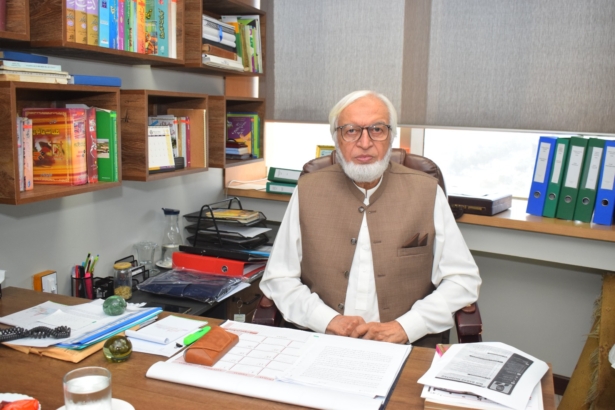
Prof. Dr. Hakim Abdul Hannan, director of the Clinical Science Division and former vice chancellor of Hamdard University, has played a significant role in developing formal education in Eastern medicine.
After completing his bachelor’s degree in Unani Medicine and Surgery from Aligarh Muslim University in 1966, he moved to Pakistan in 1970 and joined Hamdard. He recalled that Hakim Said welcomed him with the words, “Idare ko aap jese logon ki zaroorat hai” — the institution needs people like you.
Hannan subsequently helped develop Hamdard’s academic structure, contributing to the establishment and expansion of its Tibb College and the integration of Eastern medicine into university-level education. He served as vice principal and later dean of the faculty as the institution expanded its five-year degree programme.
He was also part of the committee that designed the curriculum covering basic sciences and Unani Tibb, which was later approved by the Higher Education Commission. In 2012, he was appointed vice chancellor of Hamdard University.
His achievements include recognition for a paper on alternative medicine at the 2025 Traditional and Alternative Medicine Congress in Japan. He also received the Shaheed Hakim Mohammed Said Award in 2025, becoming the first tabib to receive the distinction, according to the account provided.
Unani medicine and the changing healthcare landscape
Hannan said Hakim Said had advocated the integration of traditional medicine into healthcare decades before the 1978 International Conference on Primary Health Care in Alma-Ata highlighted the importance of traditional and alternative approaches.
He pointed to the historical influence of Unani medicine, including the work of Ibn Sina, whose Al-Qanun fi al-Tibb (The Canon of Medicine) shaped medical education in Europe for centuries.
According to Hannan, growing international interest in traditional medicine presents an opportunity for Pakistan to strengthen its own system. He cited China, India and Bangladesh as examples of countries that have developed policies, educational institutions and healthcare structures to support their traditional medical practices.
He acknowledged that modern medicine has made major advances in diagnostics, emergency treatment and surgery. However, he argued that Unani medicine could contribute to the management of certain chronic and lifestyle-related conditions, provided its use is supported by appropriate research, quality standards and clinical evidence.
He also highlighted the difference in institutional development between India and Pakistan. India began formal education in Ayurveda in 1929, while Hamdard University established Pakistan’s first formal degree programme in Eastern medicine in 1995, according to Hannan.
Strengthening education and clinical training
Hamdard has continued to develop its five-year Eastern medicine degree programme, combining traditional medical education with clinical exposure in modern hospitals.
Hannan said house-job training allows graduates to gain practical experience in patient treatment and management rather than relying solely on classroom learning. The university also offers scholarships to deserving students to improve access to education.
In addition, Hamdard has developed a network of franchise matabs across Pakistan, where qualified practitioners provide Unani healthcare. The initiative aims to expand access to trained practitioners while promoting consistent professional standards.
Government support and export potential
Hannan called for stronger government support, a dedicated policy framework and appropriate regulation for Unani and herbal medicines. He contrasted Pakistan’s arrangements with India’s Ministry of AYUSH, which oversees traditional systems including Ayurveda, Yoga, Unani, Siddha and Homoeopathy.
He welcomed the engagement of Federal Health Minister Mustafa Kamal with concerns raised by the Eastern medicine sector, saying greater attention to the industry’s needs could help address longstanding challenges.
Hannan also highlighted Hamdard Laboratories’ quality-control and research and product-development departments. He said the company continuously works to improve its medicines and that its products are approved by the Drug Regulatory Authority of Pakistan.
He cited products including Icterene, Safi and Migrix as examples of Hamdard’s established portfolio, while arguing that Pakistan could develop a stronger export industry around traditional and herbal medicines.
For that potential to be realised, he said, policymakers must create conditions that encourage research, quality manufacturing and international recognition.
Hamdard’s work, from university education and clinical training to medicine production and community-based services, reflects an effort to carry Hakim Mohammed Said’s vision into the future. Yet its leaders believe the wider development of Unani medicine will require sustained investment, credible scientific evaluation and stronger institutional backing.
With appropriate support, Pakistan’s traditional medical heritage could play a greater role in domestic healthcare while creating opportunities for the country’s herbal medicine industry in international markets.
We welcome your contributions! Submit your blogs, opinion pieces, press releases, news story pitches, and news features to opinion@minutemirror.com.pk and minutemirrormail@gmail.com