Summary
- Rembrandt produced 25 delicate drawings depicting Mughal emperors and religious scholars Between 1656 and 1661.
- The scholars believe that the book contained Mughal miniatures that captured his imagination.
- In the latter, he repurposed the relaxed seating arrangements of Mughal scholars to illustrate an important biblical motif.
Art lovers typically look upon dramatic chiaroscuro oil paintings, European portraiture, or biblical scenes while thinking about Rembrandt. Yet, buried within historical records and private collections lies a lesser-known chapter of the legendary master’s life. A profound fascination with South Asian art that inspired a unique series of fine Indian-style portraits. Rembrandt produced 25 delicate drawings depicting Mughal emperors and religious scholars Between 1656 and 1661. These works reveal an artist expanding his creativity through an encounter with Islamic and Indian aesthetic traditions half a world away.
During the 17th century, Amsterdam was a booming node in global trade. The locality was largely powered by the Dutch East India Company (VOC). Ships arriving at Dutch ports carried exotic commodities such as raw silk, muslin, spices, and fine craftsmanship straight from Surat in western India. There were original miniature paintings and sketches produced by imperial Mughal ateliers among these goods.
Rembrandt was an avid collector who frequently spent beyond his means on art and curiosities from abroad. He acquired dozens of foreign items. An official inventory compiled by municipal authorities during his 18th-century bankruptcy proceedings recorded a slim book labeled item No. 203. The scholars believe that the book contained Mughal miniatures that captured his imagination.
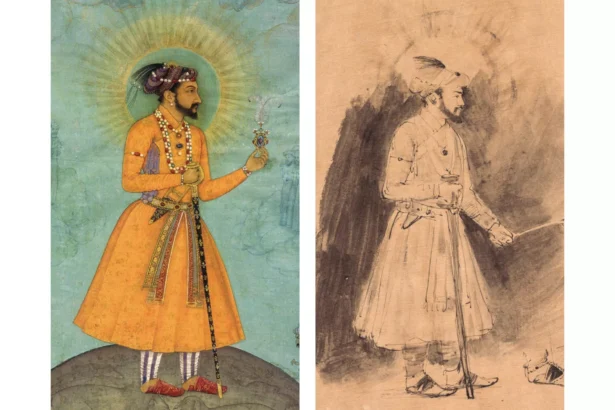
Rembrandt’s Mughal series represented a striking departure from his thick, layered oil technique. Instead of broad canvas strokes, he utilized fine brown ink, delicate wash, and subtle chalk accents to carefully document the distinctive attire and posture of Mughal royalty. He repeatedly portrayed Emperor Shah Jahan, builder of the Taj Mahal. That too alongside his sons and predecessor Emperor Jahangir. Every sketch rendered precise details of traditional jamas (stitched coats), elaborate patkas (sashes), turbans, and sarpech ornamentations with remarkable fidelity. Rembrandt drew exclusively on imported Torinoko paper. This paper was seemingly a smooth Japanese paper sourced through East Asian maritime networks.
“Copying was his way of learning about another style of making portraits… show[ing] him working in a much more refined manner than he is known for.” Stephanie Schrader, Curator of Drawings at the J. Paul Getty Museum.
Rembrandt didn’t copy images mechanically. He adapted Mughal compositions into his own artistic vision. For instance, in his study titled Four Mullahs Seated Under a Tree, he altered the background and surroundings from the original Indian painting. This exercise directly influenced his later print Abraham Entertaining the Angels (1656). In the latter, he repurposed the relaxed seating arrangements of Mughal scholars to illustrate an important biblical motif. The subtle colors and calm poses he absorbed during this phase continued to echo in his late-career oil paintings.
Rembrandt never set foot outside Europe. However, his engagement with Mughal miniatures demonstrates a spirit of cross-cultural curiosity during the Dutch Golden Age. He studied them diligently as an intellectual equal. He discovered new ways to capture human expression and line.
We welcome your contributions! Submit your blogs, opinion pieces, press releases, news story pitches, and news features to opinion@minutemirror.com.pk and minutemirrormail@gmail.com