
Summary
- WASHINGTON: The International Atomic Energy Agency (IAEA) is preparing to launch a new initiative aimed at expanding the use of civilian nuclear technology at sea, a move that could open new possibilities for powering ships, offshore facilities and remote communities.
- The initiative, known as Atomic Technologies Licensed for Applications at Sea (ATLAS), is designed to help countries and industry explore the potential of civilian nuclear applications in maritime environments.
- “Delighted to be with @ENERGY Secretary Wright in Washington DC ahead of tomorrow’s launch of ATLAS,” Grossi said in a post on X, expressing appreciation for US support for the initiative.
WASHINGTON: The International Atomic Energy Agency (IAEA) is preparing to launch a new initiative aimed at expanding the use of civilian nuclear technology at sea, a move that could open new possibilities for powering ships, offshore facilities and remote communities.
IAEA Director General Rafael Grossi announced the initiative after meeting US Energy Secretary Chris Wright in Washington ahead of the programme’s formal unveiling.
The initiative, known as Atomic Technologies Licensed for Applications at Sea (ATLAS), is designed to help countries and industry explore the potential of civilian nuclear applications in maritime environments.
Grossi said the programme could support global trade while helping provide reliable energy to remote communities and industrial operations that are difficult to connect to conventional power networks.
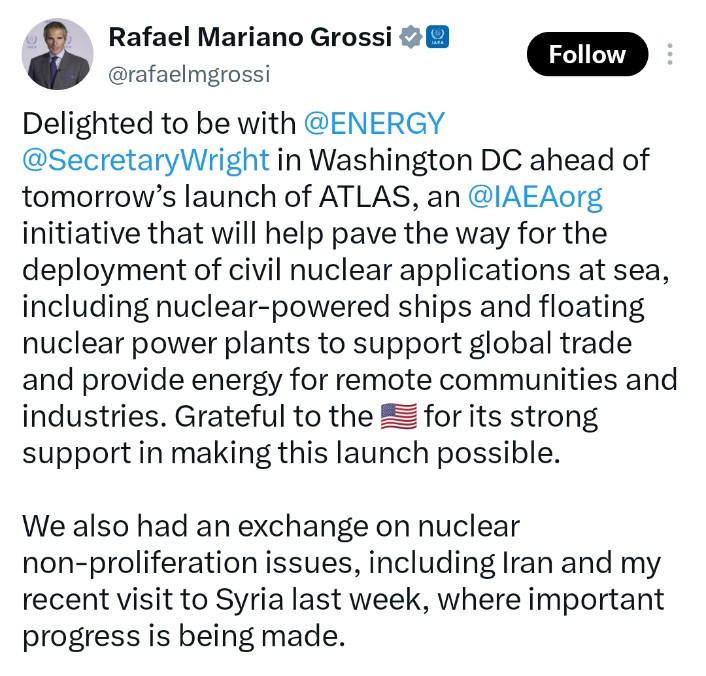
“Delighted to be with @ENERGY Secretary Wright in Washington DC ahead of tomorrow’s launch of ATLAS,” Grossi said in a post on X, expressing appreciation for US support for the initiative.
The programme is expected to examine regulatory, safety and non-proliferation considerations surrounding nuclear technology used at sea. Among the potential applications are nuclear-powered commercial vessels and floating nuclear power plants, technologies that supporters say could provide long-term, low-carbon energy without relying on frequent fuel deliveries.
The initiative comes as countries and energy companies explore alternative ways to meet growing electricity demand while reducing dependence on fossil fuels. Floating nuclear facilities, in particular, could potentially supply power to isolated coastal communities and energy-intensive industries.
However, the use of nuclear technology at sea also presents complex questions surrounding safety, emergency response, waste management, security and international regulation. The IAEA’s role will therefore be important in helping establish common standards and safeguards as the technology develops.


Grossi’s discussions with Wright also covered broader nuclear issues, including non-proliferation and Iran’s nuclear programme. The IAEA chief has been closely involved in international efforts to monitor nuclear activities and maintain dialogue over nuclear safeguards.
He also discussed his recent visit to Syria, saying that “important progress” was being made there.
The ATLAS initiative will be formally unveiled during an IAEA ministerial-level event hosted by the United States in Washington on August 26 and 27.
The launch comes at a time when interest in advanced nuclear technology is growing worldwide. While nuclear power has traditionally been associated with land-based reactors, floating and maritime applications could represent a new frontier for the industry.
For the IAEA, the challenge will be to ensure that innovation at sea develops alongside strong safety and non-proliferation safeguards. If successful, ATLAS could help shape international rules for a technology that may play a larger role in the future of global shipping and energy.
We welcome your contributions! Submit your blogs, opinion pieces, press releases, news story pitches, and news features to opinion@minutemirror.com.pk and minutemirrormail@gmail.com