Summary
- Indian digital rights activists and student leaders are challenging Prime Minister Narendra Modi’s government in the Delhi High Court over the deployment of artificial intelligence-powered mass surveillance during recent youth protests in New Delhi.
- Student activist Aishe Ghosh filed a petition with the Delhi High Court seeking to declare the police’s mass surveillance of demonstrators unconstitutional.
- The lawsuit requests the immediate destruction of all personal and biometric data collected during the demonstrations and asks the court to establish clear binding guidelines governing the use of surveillance technologies at public gatherings.
Indian digital rights activists and student leaders are challenging Prime Minister Narendra Modi’s government in the Delhi High Court over the deployment of artificial intelligence-powered mass surveillance during recent youth protests in New Delhi.
Student activist Aishe Ghosh filed a petition with the Delhi High Court seeking to declare the police’s mass surveillance of demonstrators unconstitutional. The lawsuit requests the immediate destruction of all personal and biometric data collected during the demonstrations and asks the court to establish clear binding guidelines governing the use of surveillance technologies at public gatherings.
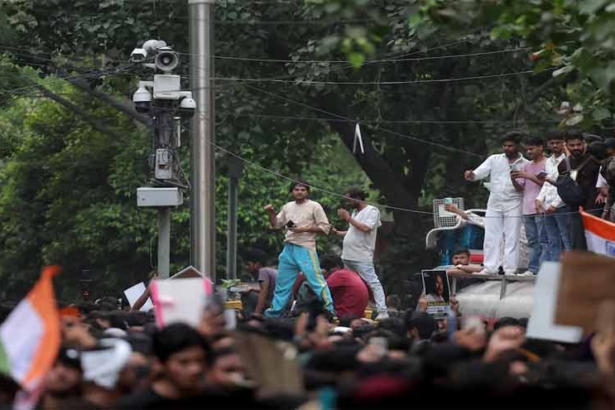
The controversy intensified after photographs circulated showing a mobile police surveillance unit, branded “Ikshana” and developed alongside security firm CP Plus, deployed at the main protest site. The vehicle featured telescopic masts providing 360-degree coverage, AI-powered cameras, and real-time facial recognition capabilities that displayed face accuracy metrics to match attendees against law enforcement databases.
Furthermore, police officers were documented recording the social media handles of arriving participants. Digital rights organisations, including the Internet Freedom Foundation, have formally requested the Delhi Police Commissioner to delete all biometric data gathered during the events.
Advocates emphasise that India currently lacks a dedicated legal framework governing police deployment of facial recognition systems, making such intrusive measures disproportionate and illegal.
During court proceedings, Solicitor General Tushar Mehta defended law enforcement actions, arguing that expectations of privacy at a public gathering were misplaced and asserting that the security measures were absolutely necessary in the interest of public order.
Delhi Police maintained that the technology was used solely to identify individuals with criminal histories and count crowd size without restricting freedoms.
The court challenge continues despite the end of the student demonstrations, which were triggered by widespread examination paper leaks in national competitive tests.
The protests culminated in the resignation of Union Education Minister Dharmendra Pradhan and the announcement of a government panel tasked with overhauling the national examination system.
We welcome your contributions! Submit your blogs, opinion pieces, press releases, news story pitches, and news features to opinion@minutemirror.com.pk and minutemirrormail@gmail.com