Summary
- A new generation of Indonesian artisans, designers, and environmentalists is taking up leaf weaving.
- Beyond aesthetic innovation, the youth-driven resurgence of leaf weaving is rooted in environmental activism.
- Now, there’s a promotion of leaf weaving to structural art and luxury event design.
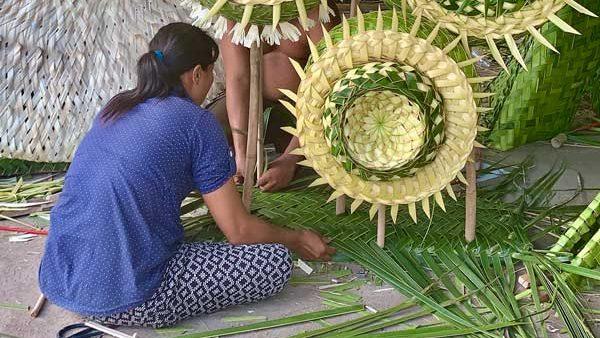
Across the tropical islands of Java and Bali, coconut and palm leaves have bound together daily life and spiritual practice for centuries. They include janur (young, pale yellow coconut fronds) and slepan (mature green fronds). These pliable natural fibers have traditionally been folded, sliced, and pinned into delicate ritual offerings. They are a part of canang sari, ornate wedding arches, and festive penjor poles that line village streets.
For decades, this intricate craft was widely viewed as a transient household chore or a necessity of ceremonial duty. It was something crafted quickly, admired briefly, and discarded once dried. As younger generations moved toward urban centers and sought modern corporate or tech jobs, the deep knowledge of palm foliage design faced the quiet threat of stagnation.
Today, a vibrant revival is underway. A new generation of Indonesian artisans, designers, and environmentalists is taking up leaf weaving. These crafties are reimagining this ancestral skill not merely as a folk tradition, but as a medium for sustainable architecture. The shift began when forward-thinking young crafters began asking a simple question.
What if the humble palm leaf could transcend its flat, two-dimensional boundaries?
Artisans such as Balinese weaver Ida Bagus Gede Ari Artana (famously known as Gus Ari) began pushing the physical limits of palm leaves. He experimented with twisting, interlacing, and tension-weaving techniques. Crafters transformed flat sheets (klangsah) into expansive 3D installations. As a result, collaborations like Make a Scene Bali, co-founded by Gus Ari and British stage designer Chloe Quinn happened. They brought international theatrical design principles into harmony with native Javanese and Balinese weaving traditions.
Instead of tiny ritual baskets, young weavers are now constructing colossal mythological creatures, archways, floating pavilion interiors, stage backdrops, and even high-fashion wearable art and jewelry crafted from dried lontar leaves. These breathtaking installations have graced international platforms. For instance, the G20 Summit held in Bali, where sustainable leaf sculptures of native sea turtles and dragons greeted world leaders. Beyond aesthetic innovation, the youth-driven resurgence of leaf weaving is rooted in environmental activism. Over recent decades, the event and hospitality industries in Southeast Asia grew increasingly dependent on single-use plastics, styrofoam, and non-recyclable synthetic decorations.
The movement to revive leaf weaving offers a completely biodegradable, zero-waste alternative. Young coconut fronds are harvested sustainably from local trees without harming the palm. The raw material is renewable, abundant, and locally sourced. Once an event or exhibition concludes, the entire installation can be composted back into the soil. The activism embodies a circular design ethos that resonates with modern eco-conscious consumers and international art curators alike.
Perhaps the most significant impact of this movement is economic and cultural. Historically, local crafters have struggled to command fair compensation for traditional foliage work because the raw material was viewed as inexpensive. Now, there’s a promotion of leaf weaving to structural art and luxury event design. Young creative studios are proving that the value resides in the artisan’s vision, precision, and hours of practiced labor. This shift has boosted local earning potential and inspired young men and women across rural communities to remain in their homelands. They are earning sustainable livings while keeping their heritage alive.
The palm frond art captures global attention. Alongside, Indonesia’s younger generation is demonstrating that tradition does not have to be frozen in a museum. Rather, it can grow, adapt, and weave a sustainable future for art and community.
We welcome your contributions! Submit your blogs, opinion pieces, press releases, news story pitches, and news features to opinion@minutemirror.com.pk and minutemirrormail@gmail.com