Summary
- Iran has warned that the strategically vital Strait of Hormuz will remain closed until the United States meets a series of conditions under a June memorandum of understanding, raising fresh concerns about the future of a conflict that has already disrupted global energy markets.
- According to Iranian state media, Ghalibaf said the blockade must first be lifted, Iran’s frozen assets released, oil sanctions removed and military threats and operations on all fronts brought to an end.
- Speaking at an event, Araghchi said Iran had resisted sustained military pressure before entering negotiations.
Iran has warned that the strategically vital Strait of Hormuz will remain closed until the United States meets a series of conditions under a June memorandum of understanding, raising fresh concerns about the future of a conflict that has already disrupted global energy markets.
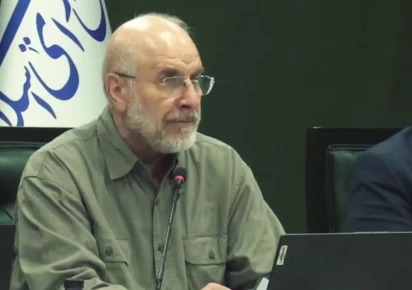
Iranian Parliament Speaker Mohammad Bagher Ghalibaf said on Tuesday that Tehran would not reopen the waterway until what he described as the full terms of the agreement had been implemented.
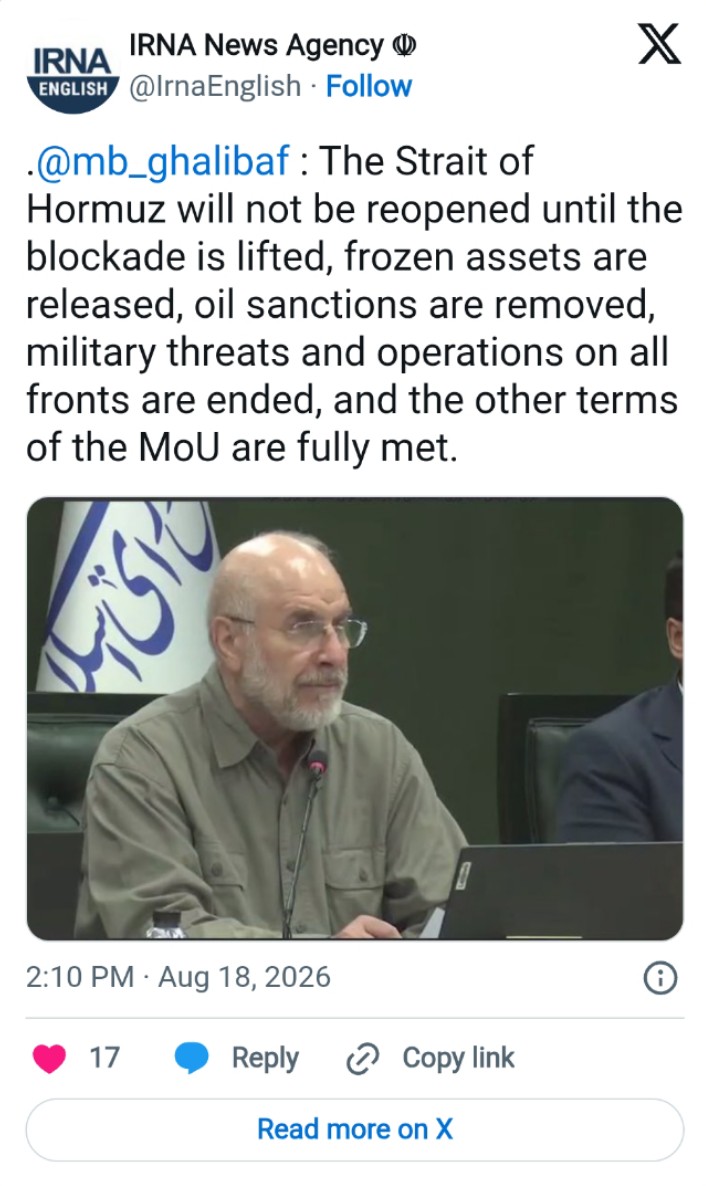
According to Iranian state media, Ghalibaf said the blockade must first be lifted, Iran’s frozen assets released, oil sanctions removed and military threats and operations on all fronts brought to an end. He also insisted that other provisions of the memorandum must be fully implemented.
“Iran is prepared to impose a heavier defeat on the enemy than before,” Ghalibaf said, warning that Tehran’s response would depend on the actions and aggression of its opponents.
The statement came as diplomatic efforts to secure a permanent end to the Iran-US conflict appeared increasingly fragile.
Iran Claims Victory in War and Diplomacy
Iranian Foreign Minister Abbas Araghchi separately declared that Tehran had won both the military confrontation and the diplomatic battle.
Speaking at an event, Araghchi said Iran had resisted sustained military pressure before entering negotiations. He claimed that those who initially demanded Iran’s unconditional surrender later sought talks with Tehran.
“We fought with strength, and we negotiated with strength,” Araghchi said, according to Iranian media.
Araghchi also accused Israel of undermining efforts to implement the June memorandum, saying it had worked to prevent the agreement from being reached and subsequently obstructed its implementation.
His comments followed US President Donald Trump’s call for Iran to surrender and “raise the white flag”, further highlighting the sharp divide between Washington and Tehran.
Hormuz Becomes Central Dispute
The Strait of Hormuz has emerged as one of the most important points of disagreement between the two sides. The narrow waterway links the Persian Gulf with the Gulf of Oman and is a crucial route for global oil and liquefied natural gas shipments.
Shipping activity has already fallen dramatically during the conflict. Reuters reported that only a handful of commodity vessels crossed the strait over the weekend, compared with more than 130 daily ship transits before the war began.
Iran says provisions of the June memorandum give it authority to manage parts of the waterway, while Washington rejects that interpretation.
The disagreement has contributed to renewed tensions after an earlier ceasefire failed to produce a lasting settlement.
Vessel Hit by Unknown Projectile
The latest tensions were accompanied by another maritime incident.
The UK Maritime Trade Operations centre said a vessel travelling outbound through the Strait of Hormuz was struck by an unknown projectile. The impact damaged the ship’s engine room and caused a crew casualty.
The remaining crew members were assisted by the Omani Coast Guard, while authorities began investigating the incident. No environmental impact was reported.
UKMTO urged vessels operating in the area to exercise caution and report suspicious activity.
Back-Channel Diplomacy Continues
Despite the increasingly hostile rhetoric, reports indicate that Washington and Tehran have continued exploring indirect channels.
Media reports said the Trump administration had established a back channel involving figures connected to Iran’s Islamic Revolutionary Guard Corps. The reported effort reflected US concerns over whether Iranian negotiators had sufficient authority to deliver an agreement acceptable to the country’s powerful security establishment.
US special envoy Jared Kushner also indicated that discussions between Washington and different parts of the Iranian government were more extensive than publicly acknowledged.
The developments suggest that diplomacy has not completely collapsed, even as official statements from both sides remain confrontational.
Iran Faces Economic Pressure
Iran’s leaders also face significant economic challenges. The conflict has added pressure to an economy already struggling with inflation, sanctions, currency weakness, energy shortages and structural problems.
Disrupted trade, damaged infrastructure and lost production have increased the financial burden of the war, while prolonged restrictions on shipping through Hormuz threaten Iran’s ability to generate export revenue.
Global markets have also felt the impact. Brent crude rose sharply during the conflict, reaching a peak of $126 a barrel before later easing. The prolonged disruption has raised concerns over fuel prices and inflation in countries dependent on Gulf energy supplies.
Ghalibaf Heads to Iraq
Against this backdrop, Ghalibaf is expected to travel to Iraq for talks on regional developments and bilateral cooperation.
His discussions are expected to cover security, border management, counterterrorism, economic cooperation and implementation of existing agreements between Tehran and Baghdad.
The visit comes after a drone attack targeted the residence and private office of Iraqi Kurdish Regional Government Prime Minister Masrour Barzani. Iran denied involvement and condemned the incident.

Araghchi said nothing justified the attack and warned against attempts to create divisions between Iran, Iraq and the Kurdish region.
With the Strait of Hormuz still at the centre of the dispute, the coming days could prove crucial. Tehran’s insistence on sanctions relief, the release of frozen assets and an end to military threats leaves little room for compromise unless Washington and its allies are prepared to make substantial concessions.
For now, the strategic waterway remains a powerful bargaining tool for Iran — and a major source of uncertainty for the global economy.
We welcome your contributions! Submit your blogs, opinion pieces, press releases, news story pitches, and news features to opinion@minutemirror.com.pk and minutemirrormail@gmail.com