Summary
- Maleki also warned that Iran had military capabilities that had not yet been publicly revealed and said Tehran had shifted from a defensive posture toward what he described as “active and offensive deterrence.” Meanwhile, a report by the Financial Times claimed that Iran had considered potential attacks on US military assets in parts of Europe if Washington escalated its military campaign.
- The UAE also said its air-defence systems had detected two ballistic missiles launched from Iran toward the Gulf state.
- US President Donald Trump said no talks with Tehran were currently taking place, while Iranian officials have insisted that Washington must first honour previous commitments before negotiations can resume.
TEHRAN: Iran has warned that any US use of nuclear weapons against the country would trigger a response in kind, as tensions between Tehran and Washington continue to deepen and fears grow that the conflict could spread beyond the Middle East.
Iranian lawmaker Fada Hossein Maleki, a member of parliament’s National Security and Foreign Policy Commission, said Tehran would respond according to the nature of any weapon used against it. He cautioned that a US nuclear strike could push the world into a dangerous wider war.
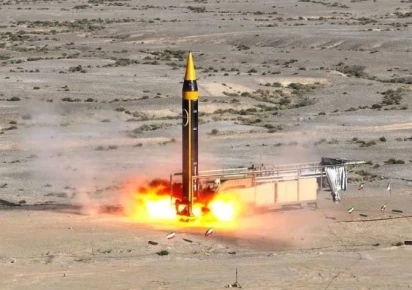
Maleki also warned that Iran had military capabilities that had not yet been publicly revealed and said Tehran had shifted from a defensive posture toward what he described as “active and offensive deterrence.”
Meanwhile, a report by the Financial Times claimed that Iran had considered potential attacks on US military assets in parts of Europe if Washington escalated its military campaign. The report said southeastern European locations, including Bulgaria and Cyprus, had been assessed as possible targets. Iranian forces were also reportedly examining options involving subsea communications infrastructure around the Strait of Hormuz.
NATO responded by saying it was prepared to address any threat and would take necessary measures to protect its members. A NATO official pointed to the alliance’s air-defence capabilities, saying ballistic missiles heading toward Türkiye from Iran had previously been intercepted on several occasions.
Iran’s armed forces also issued a warning to Gulf states, saying countries that provide assistance or facilities to US military forces could be considered participants in American military operations.
Amid the growing tensions, former Iranian President Mohammad Khatami called for caution and rejected arguments that Iran’s interests could be served through an expanded war with the United States. He said national policy should be based on the country’s long-term interests rather than emotion.
The regional situation has also strained relations between Iran and the United Arab Emirates. Abu Dhabi recently announced the suspension of trade, commercial exchanges and financial transactions with Tehran, citing regional instability. UAE officials denied reports that the country was providing financial facilities to Iran and described such claims as misinformation.
The UAE also said its air-defence systems had detected two ballistic missiles launched from Iran toward the Gulf state. According to Emirati authorities, both missiles fell into the sea. Iran rejected the claim as baseless.
Meanwhile, shipping traffic through the strategically important Strait of Hormuz has slowed sharply as uncertainty continues over the security and future of the waterway. Data showed fewer commodity vessels crossing the strait, while several major shipping companies have kept tankers away from the route because of security concerns.
The Strait of Hormuz is one of the world’s most important energy corridors, carrying a significant share of global crude oil and liquefied natural gas shipments. Prolonged disruption could therefore place further pressure on international energy markets and global trade.
Diplomatic efforts have also shown little progress. US President Donald Trump said no talks with Tehran were currently taking place, while Iranian officials have insisted that Washington must first honour previous commitments before negotiations can resume.
Iranian Parliament Speaker Mohammad Bagher Ghalibaf meanwhile arrived in Baghdad for talks with Iraqi officials, with discussions expected to cover political, economic, cultural and security cooperation between Iran and Iraq.
Washington and Abu Dhabi have also discussed regional security and the importance of maintaining freedom of navigation through the Strait of Hormuz. US Secretary of State Marco Rubio spoke with UAE National Security Adviser Sheikh Tahnoon bin Zayed Al Nahyan as concerns over Iran’s activities and regional security continued to mount.
Elsewhere, maritime security remained tense near Yemen. The UK Maritime Trade Operations centre reported that a cargo vessel was struck by multiple unidentified projectiles off Yemen’s western coast. The unmanned vessel suffered severe damage and was declared a constructive total loss.
With diplomatic channels stalled, military warnings intensifying and shipping disruptions continuing, the Iran-US confrontation is increasingly raising concerns that any further escalation could draw in Gulf states, European targets and major international trade routes.
We welcome your contributions! Submit your blogs, opinion pieces, press releases, news story pitches, and news features to opinion@minutemirror.com.pk and minutemirrormail@gmail.com