Summary
- The veteran lyricist and screenwriter argued that the internet and its algorithms have created a culture of creative fear, one in which people are no longer willing to take the risk of doing something that has not already been done before.
- “The echo chambers created by the internet have made most people afraid to do something for the first time,” he said.
- “The real loss is not in reading something trivial but in not reading at all,” he said.
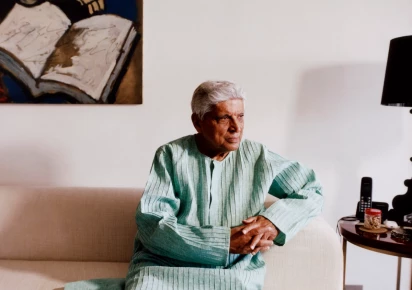
Javed Akhtar has been writing words that endure for more than five decades, and in a candid conversation with Vogue India, he turned his gaze toward what he believes is happening to creativity in the digital age. What he found does not reassure him.
The veteran lyricist and screenwriter argued that the internet and its algorithms have created a culture of creative fear, one in which people are no longer willing to take the risk of doing something that has not already been done before. “The echo chambers created by the internet have made most people afraid to do something for the first time,” he said. “Once someone else does it, they’re fine to follow in their footsteps.”
He extended that observation into a broader concern about how people engage with ideas and the world around them. “People no longer want to pause, think, analyse or sit with an idea. They are living happily, so why would they bother to think about this universe or the vastness of nature? For them, it is a waste of time.”
For Akhtar, this impatience is incompatible with the kind of work that lasts. “Meaningful creation requires time, discomfort and reflection,” he said, adding that his own willingness to question dominant voices and widely accepted ideologies has always come from exactly that kind of sustained engagement with ideas.
He was particularly pointed about the music industry and the way commercial priorities have pushed the role of lyrics to the margins. “Today, words have become less important because the marketing team has decided that slow music won’t trend,” he said. The result, in his view, is an industry that remixes old material with inferior new writing rather than producing something genuinely fresh. “But then they take those same songs, edit the mukhras and remix them with some inferiorly written antaras. There was a time when writers had more space. Today, other forces dictate what music gets made. And yet, songs that are decades old still endure, while many recent ones have a short shelf life.”
His advice to young writers was direct and unglamorous. Read more. Not only classical literature and celebrated authors, but light reading too. “The real loss is not in reading something trivial but in not reading at all,” he said.
On the creative process itself, Akhtar drew a distinction that cuts to the heart of what separates craft from genuine art. “All arts can be divided into two parts. On one hand, there’s imagination, passion, fantasy and romance, and on the other, there is craft. You can learn the craft in a crash course. But imagining, fantasising and romanticising cannot be learned. There are no courses for yearning.”
He closed with a lesson passed down from his father that has stayed with him throughout his career. “It is very easy to write in difficult language, but very difficult to write in easy language. When you write simply, there is no space for your idea to hide behind big words. Only if you are totally convinced of what you are writing can you afford to use transparent language.” It is a principle that has shaped some of Hindi cinema’s most enduring words, and one that no algorithm is likely to teach.