Summary
- Karachi’s coastline is losing a natural defence against flooding and erosion as mangrove forests and tidal creeks give way to reclaimed land and urban development, raising concerns about the city’s vulnerability to climate change.
- Satellite images from 2000 and 2025 show mangroves near Mai Kolachi replaced by reclaimed land.—Courtesy Suparco The images show areas once covered by mangroves and natural tidal channels increasingly converted into reclaimed land and urban plots, highlighting the environmental costs of changing Karachi’s coastline.
- Experts Warn of Wider Environmental Damage Climate policy specialist Mohammad Saleem Shaikh called for urgent action to prevent further destruction of mangrove forests and natural tidal creeks, warning that their loss threatens communities, livelihoods and economic stability.
Karachi’s coastline is losing a natural defence against flooding and erosion as mangrove forests and tidal creeks give way to reclaimed land and urban development, raising concerns about the city’s vulnerability to climate change.
New satellite images released by Pakistan’s Space and Upper Atmosphere Research Commission (Suparco) reveal a significant transformation along the coastal zone near the Mai Kolachi Bypass between 2000 and 2025.
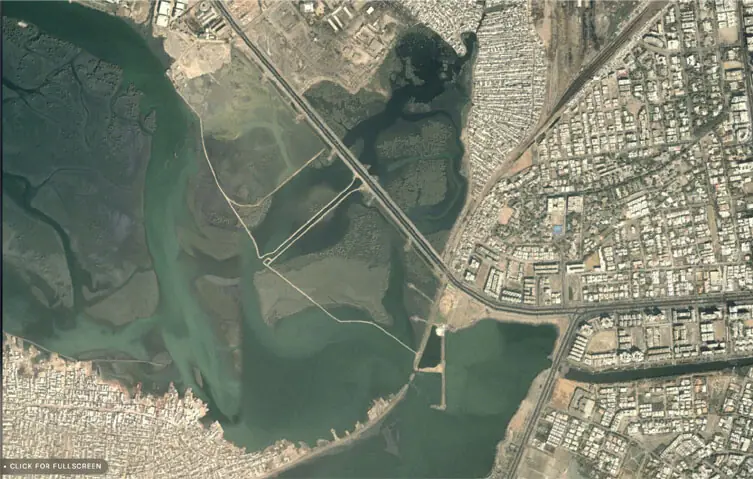
The images show areas once covered by mangroves and natural tidal channels increasingly converted into reclaimed land and urban plots, highlighting the environmental costs of changing Karachi’s coastline.
In its assessment, Suparco warned that the removal of mangroves weakens the coast’s ability to withstand climate-related pressures, including rising sea levels and extreme weather events.
Mangroves play a crucial role in coastal protection by trapping sediments, regulating local temperatures and absorbing carbon dioxide. Their roots also help stabilise shorelines and support the natural movement of water through tidal channels.
According to Suparco, clearing these forests disrupts the coastal ecosystem, increases surface runoff and alters tidal flows. Over time, these changes can raise the risk of localised flooding, shoreline instability and land subsidence.
The agency noted that, unlike conventional infrastructure, mangrove ecosystems can regenerate and strengthen over time, providing a natural form of protection against environmental threats.
Replacing wetlands with built-up land, however, could transfer climate risks directly to urban infrastructure and coastal communities.
Experts Warn of Wider Environmental Damage
Climate policy specialist Mohammad Saleem Shaikh called for urgent action to prevent further destruction of mangrove forests and natural tidal creeks, warning that their loss threatens communities, livelihoods and economic stability.
He said mangroves help reduce coastal erosion, weaken storm surges and sustain fisheries and biodiversity. Their destruction could leave Karachi’s coastline and the Indus Delta increasingly exposed to rising seas, cyclones and other climate-related hazards.
Shaikh urged the federal and Sindh governments to strengthen environmental enforcement, prevent encroachment and ensure that coastal development projects undergo comprehensive environmental assessments.
He also called for transparent satellite monitoring, greater community participation and scientifically planned restoration using native mangrove species.
Mangroves, he stressed, should be recognised as natural climate infrastructure rather than treated as expendable land.
Karachi Mayor Murtaza Wahab did not respond to messages seeking comment, while Senator Sherry Rehman, chairperson of the Senate Standing Committee on Climate Change, declined to comment.
Satellite Data Shows Hope for Restoration
Despite the concerns along Karachi’s coast, Suparco satellite imagery also indicates progress in mangrove restoration elsewhere in Sindh.
Analysis of 19 areas of interest in the Shah Bandar region of Sujawal showed a 115 per cent increase in mangrove forest cover compared with the 2019 baseline of 116.46 hectares.
Newly established mangrove vegetation covered 151.24 hectares, representing approximately 6.5 per cent of the total 2,321.8-hectare study area.
The contrasting findings highlight the importance of protecting existing coastal forests while expanding restoration efforts.
As climate pressures intensify, experts warn that decisions about coastal development could determine how effectively Karachi and surrounding communities withstand future floods, erosion and rising sea levels.
We welcome your contributions! Submit your blogs, opinion pieces, press releases, news story pitches, and news features to opinion@minutemirror.com.pk and minutemirrormail@gmail.com