Summary
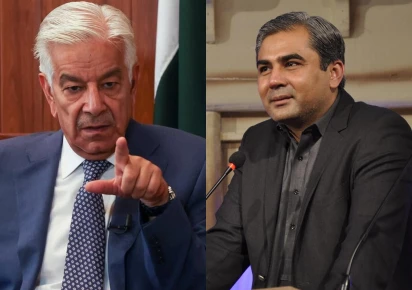
- Defence Minister Khawaja Asif has advised Interior Minister Mohsin Naqvi to avoid threatening language against fellow politicians, stressing that political disagreements should be addressed through criticism rather than intimidation.
- On the proposed referendum concerning the creation of new provinces, Asif said he remained hopeful that political parties would reach an understanding early next year despite the current tensions.
- He accused the interior minister of mishandling the debate over new provinces and said the issue should be discussed in parliament to develop political consensus.
Defence Minister Khawaja Asif has advised Interior Minister Mohsin Naqvi to avoid threatening language against fellow politicians, stressing that political disagreements should be addressed through criticism rather than intimidation.
His remarks came amid an escalating dispute between Naqvi and Pakistan Muslim League-Nawaz (PML-N) leader Rana Sanaullah. Prime Minister Shehbaz Sharif has also intervened, urging members of the federal cabinet to end public exchanges and resolve their differences through mutual understanding and consensus.
Speaking on a private television programme, Asif said that harsh criticism was part of politics, but issuing threats was unacceptable. He acknowledged that politicians often faced strong language from their opponents but maintained that personal threats had no place in political debate.
Addressing Naqvi directly, the defence minister urged him to respond to criticism through political arguments instead of threatening those who disagreed with him. He said ministers and political leaders should remain open to criticism, even when it was repeated.
Asif also defended Sanaullah, describing him as a respected political colleague who had endured considerable hardships during the governments of former military ruler Pervez Musharraf and former prime minister Imran Khan. He said he had personally witnessed the difficulties faced by the PML-N leader throughout his political career.
The defence minister further stressed that proximity to positions of power did not give anyone the authority to disregard others or undermine their contributions to politics.
Commenting on Pakistan Peoples Party (PPP) Chairman Bilawal Bhutto-Zardari’s claim that the 27th Constitutional Amendment had been passed under pressure, Asif rejected the assertion. He questioned the allegation of coercion, arguing that President Asif Ali Zardari had emerged as the amendment’s biggest beneficiary because of the lifetime immunity granted to him.
On the proposed referendum concerning the creation of new provinces, Asif said he remained hopeful that political parties would reach an understanding early next year despite the current tensions. He expressed confidence that compromises could be made to find a solution in the country’s interest.
He also agreed with Sanaullah that the prevailing political situation had created unease among different parties but described disagreements as a normal feature of political life. He said political challenges required negotiations and practical solutions.
The dispute between Naqvi and Sanaullah dates back to July, when the interior minister questioned the effectiveness of the country’s existing governance structure and called for administrative restructuring during the Pakistan Economic Summit in Islamabad.
Sanaullah subsequently criticised the remarks, arguing that discussions about major administrative changes should have started in parliament rather than at an economic gathering.
The disagreement intensified over the weekend when Naqvi warned, without naming Sanaullah, that a cabinet colleague who had repeatedly criticised him would be unable to show his face if he decided to respond.
Sanaullah later acknowledged that the remarks were directed at him and challenged Naqvi to respond. He accused the interior minister of mishandling the debate over new provinces and said the issue should be discussed in parliament to develop political consensus.
The proposal has also exposed differences among political parties. The PPP has strongly opposed dividing Sindh, while the Muttahida Qaumi Movement-Pakistan (MQM-P) continues to advocate additional provinces, particularly in Sindh. On September 4, the Sindh Assembly adopted a resolution rejecting any attempt to divide the province or change its geographical boundaries.
Asif, meanwhile, has backed the creation of as many as 12 provinces, arguing that smaller administrative units could improve governance and public service delivery.
Demands for new provinces have remained part of Pakistan’s political debate for years, particularly in South Punjab, Bahawalpur and Hazara. Supporters argue that separate provincial status could improve administrative efficiency, political representation and development in underserved regions.
The Punjab Assembly had also adopted resolutions in 2012 supporting the creation of South Punjab and the restoration of Bahawalpur province. However, neither proposal has resulted in constitutional changes.
We welcome your contributions! Submit your blogs, opinion pieces, press releases, news story pitches, and news features to opinion@minutemirror.com.pk and minutemirrormail@gmail.com