Summary
- North Korean leader Kim Jong Un has called for expanding the deployment of tactical nuclear weapons across multiple military domains, reaffirming his country’s commitment to strengthening its nuclear capabilities.
- According to North Korean state media, Kim made the remarks on Thursday while inspecting facilities involved in nuclear material production and weapons research.
- He also declared that North Korea’s status as a nuclear weapons state was non-negotiable and could not be reversed.
North Korean leader Kim Jong Un has called for expanding the deployment of tactical nuclear weapons across multiple military domains, reaffirming his country’s commitment to strengthening its nuclear capabilities.
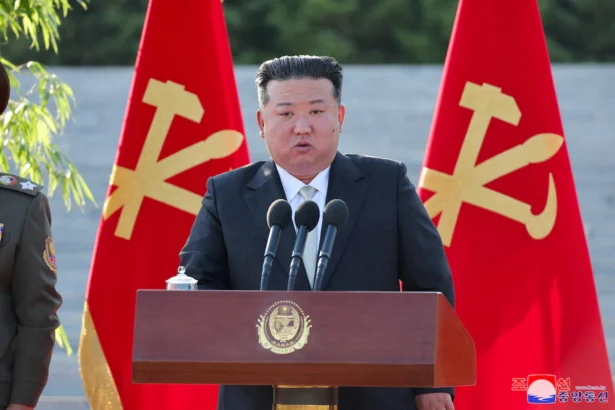
According to North Korean state media, Kim made the remarks on Thursday while inspecting facilities involved in nuclear material production and weapons research. The visit took place on Wednesday, although authorities did not disclose the locations or identities of the facilities.
During the inspection, Kim said North Korea’s capacity to produce nuclear materials was being systematically expanded. He described the country’s nuclear weapons programme as a major achievement and stressed the need to develop tactical weapons for different military missions.
“Our nuclear capability is now a reality,” Kim was quoted as saying by the Korean Central News Agency (KCNA).
He also declared that North Korea’s status as a nuclear weapons state was non-negotiable and could not be reversed. Kim warned that any attempt to deny Pyongyang’s nuclear status would amount to an “open declaration of war”.
North Korea formally incorporated its nuclear weapons status into its constitution in 2023. Kim argued that maintaining the country’s nuclear arsenal was necessary as long as hostile forces continued to use nuclear weapons to pursue their strategic interests.
The latest inspection highlights Pyongyang’s efforts to expand and diversify its nuclear programme despite international pressure and repeated calls for denuclearisation.
Photographs released by KCNA showed Kim examining equipment and weapons-related materials alongside senior officials. Analysts said some of the equipment appeared to include gas centrifuges used for uranium enrichment, as well as miniaturised tactical nuclear warheads.
In 2023, North Korean media released images of what it identified as the Hwasan-31 tactical nuclear warhead, claiming that the device could be fitted to different delivery systems, including short-range missiles.
Tactical nuclear weapons generally have lower explosive yields than strategic nuclear weapons and are designed for battlefield use rather than long-range attacks.
Kim defended the expansion of North Korea’s nuclear programme by accusing the United States and its regional allies of increasing military pressure on Pyongyang.
He criticised Washington’s security partnerships and accused it of encouraging countries in the region to develop nuclear-powered submarines.
Kim also referred to the AUKUS security partnership between the United States, Britain and Australia, arguing that it had created a dangerous precedent for nuclear proliferation in Northeast Asia.
His comments come as South Korea pursues plans to acquire nuclear-powered submarines following approval from US President Donald Trump in October 2025. The possibility has also been discussed in Japan.
The inspection is being viewed by analysts as a message to Washington amid speculation about the possibility of renewed diplomatic engagement between the two countries.
Lim Eul-chul, a professor at South Korea’s Kyungnam University, said Kim’s statements did not necessarily mean Pyongyang was permanently rejecting dialogue with Washington.
He suggested that North Korea was seeking to change the terms of any future negotiations, making clear that it would no longer consider talks based on denuclearisation but would instead seek engagement as an established nuclear weapons state.
Meanwhile, Shin Jong-woo, secretary-general of the Korea Defence and Security Forum, said Kim’s reference to deploying tactical nuclear weapons across multiple domains could indicate ambitions extending beyond the Korean Peninsula, potentially including targets on the US mainland.
North Korea has conducted six nuclear tests since 2006, with its most recent and powerful test taking place in 2017.
South Korea’s defence minister estimated in August that Pyongyang could possess between 80 and 120 nuclear warheads. However, he clarified that the figure was based on assessments by private research organisations and had not been officially verified.
We welcome your contributions! Submit your blogs, opinion pieces, press releases, news story pitches, and news features to opinion@minutemirror.com.pk and minutemirrormail@gmail.com