Summary
- The project has been given the China National Quality Engineering Gold Award, which the company says no other overseas transmission project of State Grid has won before.
- PMLTC says 11 engineers from the National Grid Company have also gone through advanced HVDC training there.
- Those answers would have to come from PMLTC, the National Grid Company or the power ministry.
Pakistan’s first high-voltage direct current power line has now been running commercially for five years, and its operator says it has carried more than 73.5 billion units of electricity in that time.
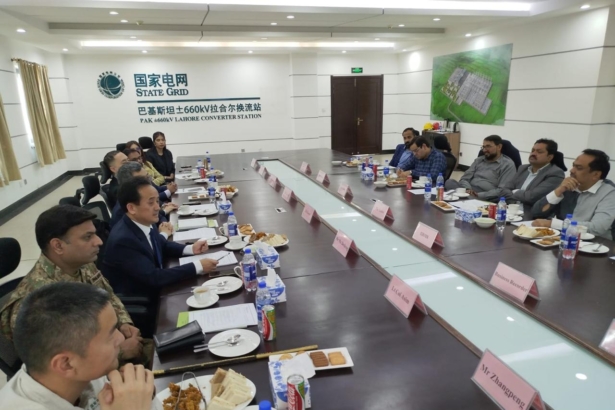
The line, known as the Matiari-Lahore HVDC project, moves power about 886 kilometres from Matiari in Sindh to Lahore in Punjab, at a rated capacity of 4,000 megawatts. Ma Desheng, deputy chief executive of the Pak Matiari-Lahore Transmission Company (PMLTC), laid out the record at a briefing in Lahore. He said the equipment has been available about 99.65 per cent of the time. Both figures come from the company, and we have not been able to check them independently.
The line was built under the China-Pakistan Economic Corridor, and it was the first of its kind in the country. Rather than sending alternating current down the wire the whole way, an HVDC link converts it to direct current at the starting station and back again at the far end. Engineers favour that design for long hauls because less power is typically lost along the way and operators can steer the flow more precisely. The converter technology comes from China’s State Grid Corporation, which PMLTC credits for the line’s ability to carry large volumes of power across such a distance while helping steady the national grid.
PMLTC also pointed to recognition from Beijing. The project has been given the China National Quality Engineering Gold Award, which the company says no other overseas transmission project of State Grid has won before.
Much of the briefing was about people. The company says building the line gave work to about 7,000 people, and that more than 1,000 have held jobs on it since it started operating. Staff from both converter stations have been sent to State Grid’s training centre in China for instruction in running the equipment, inspecting it and handling its control and protection systems. Some Pakistani professionals also attended a Belt and Road training course in China on smart grids, HVDC and the use of artificial intelligence in energy. PMLTC says 11 engineers from the National Grid Company have also gone through advanced HVDC training there.
Closer to home, the company has set up scholarships for engineering students at two Pakistani universities, UET Lahore and Mehran University in Jamshoro. Twenty-five students received awards last year and 25 more this year, so 50 in total. PMLTC says the idea is to help capable students who might otherwise struggle to afford a degree, and to feed more trained engineers into the energy sector.
Away from the grid, the company reports planting over 50,000 trees. It also lists a string of local honours: five years in a row for social responsibility, four for environmental performance, and an award for fire safety.
It helps to be careful about what the figures actually say. A line that is “available” 99.65 per cent of the time is ready to work almost all the time, but that says nothing about how hard it was worked. A rough calculation of our own gives some sense of scale: at full load, a 4,000MW line would move around 175 billion units over five years, so the reported 73.5 billion is roughly 42 per cent of that ceiling. It is only an estimate, since it assumes five full years of service and since a line’s rated capacity is a maximum, not a target. How much power travels along it on any day depends on what the grid needs.
The briefing left several things unanswered. It did not say how heavily the line is used on a typical day, whether it has made electricity cheaper for households and businesses, or how much it has relieved congestion in the south. Those answers would have to come from PMLTC, the National Grid Company or the power ministry.
Still, the basic case for the line is clear. A large share of Pakistan’s generation sits far from the cities that use most of the power, and a link that can move electricity north reliably matters to the whole system. After five years, the more telling question is how well it is used as new plants connect and demand keeps rising.
PMLTC described the anniversary as proof of what Chinese and Pakistani professionals can do together, and said it would keep working on safe, dependable operation and on Pakistan’s energy security.
We welcome your contributions! Submit your blogs, opinion pieces, press releases, news story pitches, and news features to opinion@minutemirror.com.pk and minutemirrormail@gmail.com