Summary
- Pakistan also appreciated efforts by the United States, European Union and United Kingdom to ease economic sanctions on Syria, saying the measures could support investment and reconstruction.
- It also welcomed the roadmap agreed by Syria, Jordan and the United States to address the situation in Suwaidah.
- Pakistan also welcomed an October 28 joint statement by Syria and Jordan announcing plans for a joint security committee to investigate recent incidents and improve coordination against terrorist threats.
Pakistan has strongly condemned Israel’s continued military attacks and incursions into Syrian territory, demanding an immediate halt to the violations and the withdrawal of Israeli forces from occupied areas.
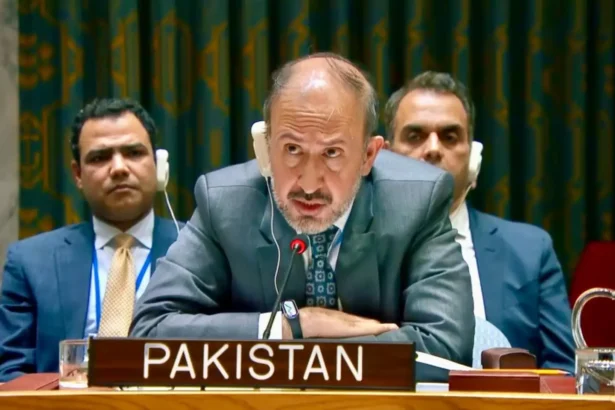
Pakistan’s Permanent Representative to the United Nations, Ambassador Syed Haider Shah, conveyed Islamabad’s position during a United Nations Security Council briefing on Syria’s political and humanitarian situation on Tuesday.
He stressed that the occupied Golan Heights remained Syrian territory under international law. He also urged Israel to respect the 1974 Disengagement Agreement and relevant Security Council resolutions.
Shah warned that Israel’s continued actions were undermining Syria’s security and creating further obstacles to the country’s recovery. He reaffirmed Pakistan’s support for Syria’s political transition, institutional rebuilding and efforts to restore stability.
The Pakistani envoy said Syria had made progress despite serious domestic challenges and a complicated regional situation. He welcomed the Syrian government’s efforts to strengthen national institutions, advance political reforms and improve relations with regional and international partners.
He emphasised that maintaining this progress would require sustained diplomatic engagement, economic opportunities and a secure environment. Pakistan also appreciated efforts by the United States, European Union and United Kingdom to ease economic sanctions on Syria, saying the measures could support investment and reconstruction.
Shah called for continued international assistance to help Syria rebuild essential infrastructure and improve living conditions. He stressed that humanitarian support must remain consistent and coordinated with the Syrian government.
On security matters, Pakistan supported the implementation of the January 29 agreement aimed at integrating security and administrative structures in northeastern Syria into national institutions. It also welcomed the roadmap agreed by Syria, Jordan and the United States to address the situation in Suwaidah.
The ambassador cautioned that Daesh, other militant organisations and foreign terrorist fighters continued to threaten Syria’s stability. He called for stronger international cooperation against terrorism in line with international law.
Pakistan also welcomed an October 28 joint statement by Syria and Jordan announcing plans for a joint security committee to investigate recent incidents and improve coordination against terrorist threats. Shah expressed regret over civilian casualties and appreciated both countries’ efforts to maintain bilateral relations.
During the briefing, UN Assistant Secretary-General for Humanitarian Affairs Mohamed Yahya highlighted the dangers facing civilians returning to their homes after years of conflict.
He told the Security Council that landmines and unexploded weapons had killed at least 30 people, including 19 children, over the past month. More than 80 others, among them 35 children, had also sustained injuries.
Yahya warned that returning families remained exposed to explosive remnants of war, while shortages of winter supplies and funding constraints were making humanitarian operations increasingly difficult.
Nearly four million Syrians have voluntarily returned to their homes since December 2024. Since October, approximately 60,000 internally displaced people and 18,000 refugees have also returned. However, more than 730,000 people continue to live in camps.
Humanitarian organisations cleared over 700,000 square metres of contaminated land during the first six months of this year. However, recent flash floods have reportedly moved explosive materials into areas previously considered safe.
The UN estimates that 2.4 million people will require additional assistance during the coming winter. Its winter response plan, which aims to support more than 970,000 vulnerable people, has received only 40 per cent of the required funding.
Around 200,000 displaced people and returnees are living in damaged shelters, further increasing concerns ahead of the winter season.
The humanitarian situation has also been affected by the detection of poliovirus in two children in Deir Ez Zor. With the UN humanitarian appeal receiving only one-third of its required funding, the World Food Programme is reducing its food assistance by half, while the UN Population Fund has shut down 28 health facilities.
UN Deputy Special Envoy for Syria Claudio Cordone welcomed the recent submission of a draft transitional justice law, stressing that accountability must apply equally to all perpetrators, regardless of their identity or the victims involved.
He also called for clear timelines and inclusive processes for preparing a permanent constitution and holding credible elections.
Cordone cited World Bank estimates that rebuilding Syria’s damaged physical assets alone would cost approximately $216 billion. He stressed the need for sustained international support to help the war-torn country recover.
We welcome your contributions! Submit your blogs, opinion pieces, press releases, news story pitches, and news features to opinion@minutemirror.com.pk and minutemirrormail@gmail.com