Summary
- Pakistan has unveiled plans to strengthen its Buddhist heritage tourism and promote ancient Gandhara civilisation internationally, with proposals including a dedicated Buddhist visa category, meditation centres and improved facilities for religious visitors.
- He said the dialogue would help shape the implementation of the government’s Gandhara strategy and strengthen Pakistan’s position as an international destination for Buddhist heritage and scholarship.
- During the event, curator Elli Takagaki unveiled Colours of Pakistan: Gandhara Edition, a publication highlighting Gandharan heritage sites, Buddhist monastics and international engagement.
Pakistan has unveiled plans to strengthen its Buddhist heritage tourism and promote ancient Gandhara civilisation internationally, with proposals including a dedicated Buddhist visa category, meditation centres and improved facilities for religious visitors.
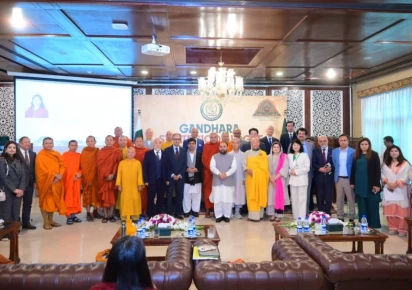
The proposals were discussed at the Gandhara Strategic Dialogue 2026, held at the Ministry of Foreign Affairs in Islamabad under the theme “Towards a Shared Future”. The event brought together senior Buddhist monks from eight countries, international experts, diplomats, parliamentarians and government officials to discuss the preservation and global recognition of Gandhara heritage.
Federal Minister for National Heritage and Culture Aurangzeb Khan Khichi said Gandhara had been one of the region’s most prominent centres of Buddhist education, philosophy, art and culture.
He said Pakistan considered the protection of this heritage a shared responsibility towards the international community and future generations.
Khichi reaffirmed the government’s commitment to expanding cultural and academic cooperation with countries that share historical and spiritual links with Gandhara. He said the dialogue would help shape the implementation of the government’s Gandhara strategy and strengthen Pakistan’s position as an international destination for Buddhist heritage and scholarship.
Foreign Secretary Ambassador Asim Iftikhar Ahmad welcomed the visiting Buddhist leaders and delegates, describing Gandhara as a shared heritage of humanity and a bridge between different civilisations.
He said Gandhara’s significance extended beyond archaeological remains, as its legacy also represented lasting relationships between communities and a message of peace.
Highlighting common values in Buddhism and Islam, including compassion, tolerance, non-violence, justice and respect for humanity, the foreign secretary said these principles could provide a foundation for greater interfaith understanding.
Referring to historic Buddhist centres such as Taxila, Takht-e-Bahi and Swat, he stressed the need to preserve these sites and make them more accessible to Buddhist communities and international visitors.
He also called for organised pilgrimage programmes, improved access to heritage locations, joint archaeological research and stronger cooperation between universities, museums, scholars and monastic communities.
Presenting the strategic vision of the Prime Minister’s Task Force on Gandhara, its coordinator Imran Shauket said Pakistan wanted to restore Gandhara’s position as a significant spiritual destination for Buddhists worldwide.
He emphasised that the country viewed itself as the custodian of this heritage and wanted Buddhist communities to play an active role in its preservation and promotion.
Shauket said the strategy also aimed to ensure that local communities benefited economically through tourism-related employment, hospitality services, handicrafts and other business opportunities.
He highlighted Gandhara’s historical importance as a meeting point of the Theravada, Mahayana and Vajrayana Buddhist traditions.
Among the proposals presented were a separate Buddhist visa category, long-term multiple-entry visas for ordained monks, simplified No Objection Certificate procedures and the establishment of meditation facilities near important heritage sites.
The plan also includes international Gandhara exhibitions, hospitality training, greater private-sector investment and cooperation with international organisations.
Shauket further proposed allocating land near major Buddhist heritage sites for meditation halls and centres of learning. He also suggested establishing a dedicated Buddhist heritage zone in Taxila or another suitable location in Punjab or Khyber-Pakhtunkhwa.
He said the task force wanted to seek guidance from international Buddhist leaders before moving ahead with infrastructure development and other initiatives.
International delegates welcomed the proposals and expressed interest in supporting Pakistan’s efforts.
Thailand’s Dr Phra Anil Sakya appreciated the initiative and offered his support for implementing the proposed strategy. He said Pakistan possessed valuable Buddhist heritage and historical collections that remained insufficiently recognised internationally.
He also observed that Pakistani museums and galleries had significant potential to attract international visitors if their historical importance was promoted effectively.
Vietnamese monk Thích Minh Quang called for suitable land to establish a meditation hall, while Japanese monastic Junsei Terasawa offered to visit Pakistan and engage with local communities once land was allocated for Buddhist activities.
Terasawa also proposed holding a Gandhara Peace Convention next year and pledged his support for the initiative.
Cambodian Buddhist representative Dr Yon Seng Yeath expressed interest in establishing Gandhara Corners at two Pakistani universities, saying discussions on the proposal had already taken place with Shauket.
Raja Devashish Roy, a prominent representative of Bangladesh’s Chakma Buddhist community, also expressed support for the proposals.
Other Buddhist leaders emphasised the need for stronger cooperation in heritage conservation, research, education and academic exchanges. They also called for better transport, reliable visitor information, security arrangements and facilities that accommodate the religious requirements of Buddhist monks and pilgrims.
Representatives of UNESCO and the World Bank appreciated Pakistan’s broader vision, noting that the initiative offered an opportunity to develop a comprehensive strategy through consultation and cooperation among different stakeholders.
During the event, curator Elli Takagaki unveiled Colours of Pakistan: Gandhara Edition, a publication highlighting Gandharan heritage sites, Buddhist monastics and international engagement.
The dialogue will continue with discussions on pilgrimage facilities, regulatory coordination, heritage conservation, international promotion, research partnerships, the translation and preservation of Buddhist manuscripts, tourism infrastructure and community development.
The concluding session is scheduled to take place at the Ministry of National Heritage and Culture Division on November 20.
We welcome your contributions! Submit your blogs, opinion pieces, press releases, news story pitches, and news features to opinion@minutemirror.com.pk and minutemirrormail@gmail.com