Summary
- Turkish research vessel begins Pakistan offshore exploration mission The arrival of Oruç Reis marks a new phase in Pakistan-Türkiye energy cooperation, bringing Turkish technical expertise and advanced exploration technology into Pakistan’s maritime territory.
- Survey targets Indus and Makran offshore basins Speaking at the ceremony, Türkiye’s Minister of Energy and Natural Resources Alparslan Bayraktar said Oruç Reis would initially collect three-dimensional seismic data across 670 square kilometres in Pakistan’s Indus offshore basin.
- The deputy prime minister also outlined Pakistan’s ambition to establish a long-term energy partnership with Türkiye covering offshore exploration, mineral development and renewable energy.
Pakistan’s vast natural wealth could hold the key to transforming its struggling economy, with Deputy Prime Minister and Foreign Minister Ishaq Dar estimating that the country’s untapped natural resources, including minerals, hydrocarbons and gemstones, could be worth between $8 trillion and $10 trillion.
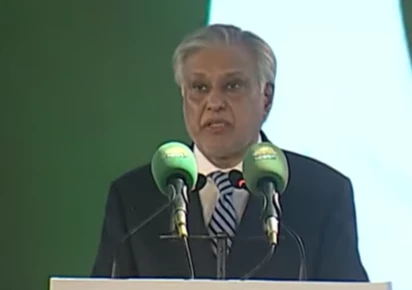
Dar made the remarks on Friday while welcoming Türkiye’s advanced seismic research vessel, Oruç Reis, at Karachi Port, marking a significant step towards strengthening Pakistan’s offshore oil and gas exploration capabilities through cooperation with its longstanding ally.
Addressing the ceremony, Dar challenged the perception that Pakistan was merely a heavily indebted country, arguing that its natural resource potential offered enormous economic opportunities if properly explored and developed.
“Sometimes people talk about Pakistan being a heavily indebted country or a debt-trap country. I always negate that,” he said.
Providing figures to support his argument, the deputy prime minister said the federal government’s total debt stood at approximately $100 billion. Including foreign exchange liabilities of private companies and public sector enterprises, the overall amount reached around $130 billion.
In contrast, he estimated that Pakistan’s mines, minerals, hydrocarbons, gemstones and other natural resources could collectively be worth as much as $10 trillion, even under conservative calculations.
However, unlocking this potential would require sustained investment, modern technology, scientific research and effective coordination among government institutions.
Turkish research vessel begins Pakistan offshore exploration mission
The arrival of Oruç Reis marks a new phase in Pakistan-Türkiye energy cooperation, bringing Turkish technical expertise and advanced exploration technology into Pakistan’s maritime territory.
Dar described the vessel’s arrival as a new chapter in scientific exploration and strategic cooperation between the two countries, emphasising that the partnership could help Pakistan better understand the geological structures beneath its seabed.
He said the seismic data collected during the mission would provide valuable information about potential offshore oil and gas reserves and help authorities make informed decisions about future exploration and drilling.
The deputy prime minister, however, acknowledged that offshore exploration involved considerable financial investment and uncertainty.
He cautioned that seismic surveys could not guarantee commercially viable discoveries, but stressed that exploration could not progress without first collecting reliable geological data.
Pakistan, he said, was taking this important step with confidence and responsibility.
Dar also highlighted the broader economic importance of the country’s maritime territory, describing it as an asset with considerable potential for energy production, shipping and fisheries.
He said developing a strong blue economy would require reliable scientific information, skilled professionals and appropriate environmental safeguards.
Survey targets Indus and Makran offshore basins
Speaking at the ceremony, Türkiye’s Minister of Energy and Natural Resources Alparslan Bayraktar said Oruç Reis would initially collect three-dimensional seismic data across 670 square kilometres in Pakistan’s Indus offshore basin.
The vessel will also conduct two-dimensional seismic surveys covering 2,353 kilometres of survey lines in the Makran offshore blocks.
According to Bayraktar, the mission aims to assess the hydrocarbon potential of both the Indus and Makran basins, with exploration operations in identified fields targeted for 2027.
The Turkish minister said the initiative followed agreements signed between Pakistan and Türkiye in Islamabad last year.
A partnership has also been established between Türkiye’s national oil company, Turkish Petroleum Corporation (TPAO), and Pakistan’s energy companies, including Oil and Gas Development Company Limited (OGDCL), Pakistan Petroleum Limited (PPL) and Mari Energies.
Licensing processes for five exploration blocks, comprising three offshore and two onshore blocks, have been completed, and operations have commenced.
Bayraktar expressed optimism that the seismic data would help identify promising geological formations and create opportunities for future drilling.
He also highlighted Türkiye’s experience in offshore exploration, particularly its major natural gas discovery in the Black Sea in 2020.
According to him, Türkiye currently produces approximately 10 million cubic metres of gas daily from those fields, supplying around four million households.
The country aims to increase production to 40 million cubic metres, which would be sufficient to meet the needs of approximately 14 million households.
Bayraktar said Türkiye was bringing the experience, engineering capabilities and technical expertise gained from its own offshore projects to Pakistan.
Dar promises faster approvals and investor facilitation
Emphasising the importance of effective government coordination, Dar said Prime Minister Shehbaz Sharif had instructed relevant federal ministries and institutions to accelerate work on strategically important projects.
He assured Turkish partners that the government would ensure such initiatives did not suffer because of institutional fragmentation, bureaucratic hurdles or unnecessary delays.
The deputy prime minister also outlined Pakistan’s ambition to establish a long-term energy partnership with Türkiye covering offshore exploration, mineral development and renewable energy.
He referred to three memorandums of understanding signed between relevant Pakistani and Turkish agencies, describing them as an important foundation for expanding bilateral cooperation.
Dar said Pakistani geologists, engineers, universities and research institutions should work closely with their Turkish counterparts to strengthen local expertise in marine science, geoscience and offshore engineering.
He further stressed that cooperation between the two countries should extend beyond traditional diplomatic and defence relations to deliver tangible economic benefits.
Referring to the recent meeting between Prime Minister Shehbaz Sharif and Turkish President Recep Tayyip Erdogan in Antalya, Dar said both leaders had reaffirmed their commitment to accelerating cooperation in trade, investment, defence, energy and regional connectivity.
He added that Pakistan welcomed international investors willing to bring capital, technical expertise and a long-term commitment to the country’s development.
The government, he said, was committed to transparency, policy continuity and economic reforms to strengthen investor confidence.
Dar also emphasised that offshore development must be balanced with environmental protection, describing Pakistan’s maritime resources as both an economic asset and a national trust.
Investment could reach $1 billion
Pakistan’s renewed offshore exploration drive comes after an 18-year gap in the country’s offshore bidding process.
The government launched the Offshore Bid Round 2025 in January last year, offering exploration licences for 40 offshore blocks in the Indus and Makran basins along the coasts of Sindh and Balochistan.
Türkiye’s TPAO secured a 25 per cent stake and operatorship in Offshore Block-C, reflecting growing international interest in Pakistan’s offshore hydrocarbon potential.
A basin assessment conducted by US-based consultancy DeGolyer and MacNaughton also indicated substantial unexplored hydrocarbon prospects in the country’s offshore regions.
Under the initial three-year licensing phase, participating companies have committed 4,427 work units and planned expenditure of approximately $80 million for geological and geophysical studies, seismic data collection and interpretation.
If the initial findings prove encouraging and exploration drilling moves forward, investment under the programme could increase to between $750 million and $1 billion, according to the Petroleum Division.
Pakistan hopes for its first major offshore discovery
Dar expressed hope that the Turkish research mission would eventually lead to Pakistan’s first successful offshore drilling and exploration project.
In a lighter moment during his address, he joked that he had told the Turkish energy minister that the seismic survey would take five to six months and that the Turkish team would not be allowed to leave without bringing good news of a discovery.
The remark drew attention to the government’s expectations from the ambitious exploration initiative.
Nevertheless, the actual results will depend on geological findings, subsequent drilling and whether any identified reserves prove commercially viable.
For Pakistan, the stakes extend far beyond a single exploration project. A successful offshore discovery could open new investment opportunities, strengthen domestic energy supplies, reduce reliance on imported fuels and create additional economic activity.
While the estimated $8 trillion to $10 trillion resource wealth represents enormous potential rather than confirmed recoverable reserves, the arrival of Oruç Reis offers Pakistan an opportunity to take a more scientific and investment-driven approach towards exploring its natural resources.
The coming months could therefore prove important in determining whether the country’s largely unexplored offshore territory can become a meaningful contributor to its long-term energy security and economic growth.
We welcome your contributions! Submit your blogs, opinion pieces, press releases, news story pitches, and news features to opinion@minutemirror.com.pk and minutemirrormail@gmail.com