Summary
- At Viewpoint, where I worked with him from 1979 to 1984 under Mazhar Ali Khan, Amin Mughal taught us that editing was ethical work.
- Amin Mughal carried exile because conscience allowed him no lighter luggage.
- The question is not why Amin Mughal received no medal.
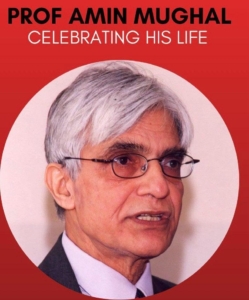
Arundhati Roy, renowned Indian writer and intellectual had a state award to return. Professor Amin Mughal, doyen of progressive and humanist thinking in Pakistan, died in London on August 12, 2026, was spared that administrative complication.
Roy won India’s National Film Award for Best Screenplay in 1989. In 2015, she returned it during the award wapsi protest against attacks on writers, rationalists and minorities. In June 2024, the Delhi lieutenant governor sanctioned her prosecution under the Unlawful Activities (Prevention) Act for remarks made at a conference in 2010.
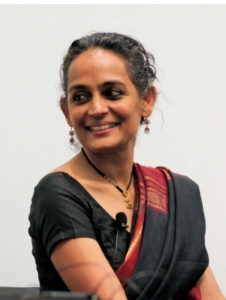
PEN International condemned the use of counterterrorism legislation against peaceful expression. The file had taken fourteen years to ripen. Dissent, unlike justice, apparently improves with prolonged government storage.
Roy remains in India, but outside the officially approved boundaries of patriotism: an internal exile. Against Amin Mughal, military regimes adopted the geographical method. They dismissed him from Islamia College for trade-union activity, imprisoned him for his politics and eventually forced him into exile during General Ziaul Haq’s dictatorship. From 1984 until his death in London, Pakistan remained his unfinished argument.
This is a postcolonial habit shared across the Radcliffe Line. Both states inherited the British filing system for dangerous thoughts. Independence changed the portraits in public offices, but not the suspicion of anyone asking whether freedom had reached workers, peasants, women, minorities or occupied margins.
The acceptable intellectual asks difficult questions about rival governments. The troublesome one asks them about the government arranging the chairs. The first may receive a medal. The second receives a file, summons, sedition allegation, anti-terror charge or, when administrative imagination is exhausted, a passport stamped for departure.
South Asia consequently maintains two honours lists. The official one is announced on Independence or Republic Day. The unofficial one is preserved in prison registers, banned books, dismissed teachers, censored newspapers and airport records.
The relationship between these lists can be comic. Faiz Ahmed Faiz was imprisoned and forced into exile; Pakistan awarded him Nishan-e-Imtiaz six years after his death. Ahmad Faraz was arrested, spent years in self-exile and returned his Hilal-e-Imtiaz in 2006 to protest General Pervez Musharraf’s rule.
The state subsequently conferred another honour posthumously. Dead dissenters make wonderfully disciplined medal recipients. They neither return the decoration nor criticise the citation.
Fahmida Riaz faced sedition charges and spent nearly seven years in exile in India before receiving Pakistan’s Pride of Performance. India produced the reverse paradox. M.F. Husain received three of India’s highest civilian honours, but neither medals nor international renown could secure his return after threats, vandalism and criminal complaints. He died in London. A state may decorate an artist’s past while making his present unlivable.
This does not make every recipient undeserving. Many have rendered exceptional service. The problem is opacity: patronage can borrow the vocabulary of merit. In Pakistan, a Senate committee expressed dismay over the lack of merit and transparency in nominations.
Critics have questioned awards to media voices whose principal distinction appears to be discovering, on schedule, the wisdom of whichever government is in office. In India, Padma selections are routinely analysed for electoral geography and political outreach. A medal should conclude an argument about merit; too often, it begins an inquiry into access.
In an earlier article “Intellectuals’ Anguish”, an effort was made to brought together Shiv Kumar Batalvi’s image of “slow suicide”, Aasim Sajjad Akhtar’s contrast between intellectual commitment and state-sanctioned medals, and Qayyum Nizami’s reflections on the loneliness of principled politics. Amin Mughal belongs to that continuum, but he answered suffocation with organisation, teaching and humour.
When the state removed him from Islamia College, he helped establish Shah Hussain College. The government lost a troublesome lecturer and accidentally acquired an institution of resistance.
At Viewpoint, where I worked with him from 1979 to 1984 under Mazhar Ali Khan, Amin Mughal taught us that editing was ethical work. Power was not entitled to euphemism; a weak argument could not claim protection merely because its author was a comrade. When Mazhar Ali Khan, I.A. Rehman and Amin Mughal were arrested in 1981, Viewpoint still appeared. Dictators greatly overestimate prison as an editorial instrument.
Amin Mughal’s humour made dogma uncomfortable. Pomposity could enter his conversation in ceremonial dress and leave searching for its trousers. He disagreed without diminishing the person before him, corrected without humiliation and resisted the professorial desire to manufacture disciples. His Marxism remained open to literature, culture, doubt and affection.
Exile enlarged rather than ended his world. He worked with Jang, edited Awaz and turned his Finchley home into a port of call for writers and activists from Pakistan and India. The state exported one dissident and received a transnational intellectual network in return. Another policy triumph.
Arundhati Roy returned a medal because conscience had made it too heavy. Amin Mughal carried exile because conscience allowed him no lighter luggage. Their journeys expose the same regional disorder: states decorate those who make power comfortable and despise, even punish, those who make society think.
The question is not why Amin Mughal received no medal. It is why our medals so frequently fail to recognise the courage, independence and humanism that made his life worth honouring.
________________________________________________________________
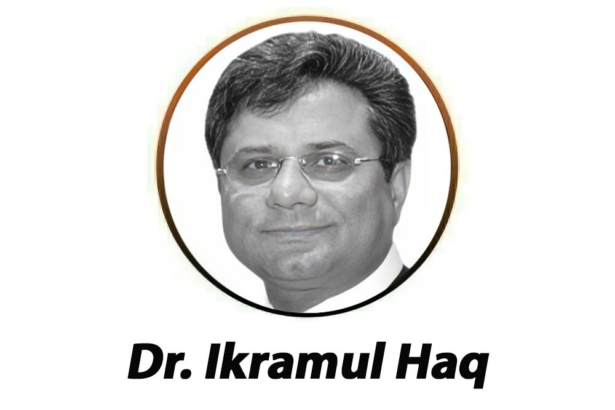
Dr. Ikramul Haq, Advocate Supreme Court, writer, literary critic, Adjunct Faculty at Lahore University of Management Sciences (LUMS), member Advisory Board and Visiting Senior Fellow of Pakistan Institute of Development Economics (PIDE), holds an LLD in tax laws. He was full-time journalist from 1979 to 1984 with Viewpoint and Dawn. He also served Civil Services of Pakistan from 1984 to 1996.
We welcome your contributions! Submit your blogs, opinion pieces, press releases, news story pitches, and news features to opinion@minutemirror.com.pk and minutemirrormail@gmail.com