Summary
- Veteran Pakistani actor Sania Saeed has opened up about her experience portraying Khushbakht in the drama Dar-e-Nijaat, discussing the character’s resilience, the importance of breaking generational trauma and the social expectations surrounding women and men.
- Sania also defended Zaryab, explaining that although she displayed materialistic and class-conscious behaviour, that did not automatically make her a bad person.
- Sania also called for more realistic portrayals of women in television dramas, arguing that female characters should be allowed to make independent decisions, including mistakes, without being denied love and acceptance.
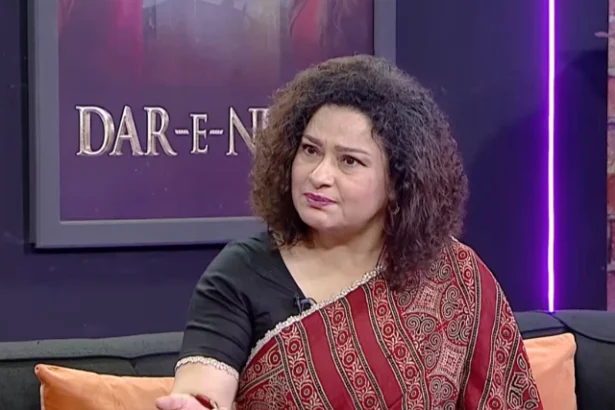
Veteran Pakistani actor Sania Saeed has opened up about her experience portraying Khushbakht in the drama Dar-e-Nijaat, discussing the character’s resilience, the importance of breaking generational trauma and the social expectations surrounding women and men.
In a recent interview, the actor shared her thoughts on the drama’s central characters and the broader social issues explored through their stories. She particularly highlighted themes of parenting, emotional struggles, women’s independence and society’s tendency to judge individuals according to traditional standards.
Discussing what attracted her to Khushbakht’s character, Sania described her as a strong woman who had endured numerous difficulties throughout her life. Despite facing illness, loneliness and the challenges of raising a child independently, Khushbakht remained committed to the values she had inherited from her own upbringing.
Sania appreciated the character’s determination to prevent her personal suffering from affecting the next generation. She explained that one of Khushbakht’s defining qualities was her decision to break the cycle of generational trauma.
“Khushbakht’s most important thought is that she breaks the cycle of the trauma being passed on across generations,” the actor said.
She further explained that Khushbakht wanted to ensure her daughter-in-law would not experience the same hardships she had faced. According to Sania, the character consciously decided not to pass her emotional pain on to younger family members.
The conversation also touched upon Abubakr’s character and the positive response he received from viewers. While acknowledging that certain aspects of his personality had been dramatised, Sania argued that he should be viewed as a decent human being rather than an extraordinary exception.
She explained that labelling him an angel could make ordinary kindness among men appear unusual. Sania also observed that many women demonstrated similar qualities but rarely received comparable appreciation.
According to the actor, society often overlooks women’s sacrifices and goodness because such behaviour is traditionally expected from them.
Discussing parenting, Sania emphasised that children develop values primarily by observing their parents’ actions rather than simply listening to their advice. She explained that parental presence and everyday behaviour play a significant role in shaping a child’s personality.
She used the drama’s characters to illustrate this point, noting how Zaryab’s parents’ absence influenced her upbringing, while Zamil’s parents appeared unaware of his emotional struggles. In contrast, Abubakr developed kindness and generosity by observing his mother’s involvement in social work and spiritual practices.
Sania also defended Zaryab, explaining that although she displayed materialistic and class-conscious behaviour, that did not automatically make her a bad person.
The actor further discussed women’s struggles with self-worth, suggesting that societal judgement often makes them question their professional achievements and personal identities, including their abilities as mothers, wives, friends and siblings.
Reflecting on Khushbakht, she noted that even after making difficult decisions, the character remained concerned about how society perceived her.
Sania also called for more realistic portrayals of women in television dramas, arguing that female characters should be allowed to make independent decisions, including mistakes, without being denied love and acceptance.
“There are intelligent and ambitious women who make mistakes and need people who can guide them,” she remarked.
Known for her powerful performances across television, theatre and film, Sania Saeed has consistently portrayed complex characters and socially relevant stories. Her recent projects include Aap Ki Izzat, Dil Manay Na and Sang-e-Mah.
We welcome your contributions! Submit your blogs, opinion pieces, press releases, news story pitches, and news features to opinion@minutemirror.com.pk and minutemirrormail@gmail.com