Summary
- ISLAMABAD: For the second consecutive time, the Kingdom of Saudi Arabia has appointed a career military veteran as its ambassador to Islamabad, inaugurating a compelling new chapter in Pakistan-Saudi defense diplomacy.
- Moreover, Saudi Arabia has extended its supportive hand to facilitate Pakistan’s major defense agreements with Somalia, further expanding Islamabad’s footprint in Riyadh’s sphere of influence.
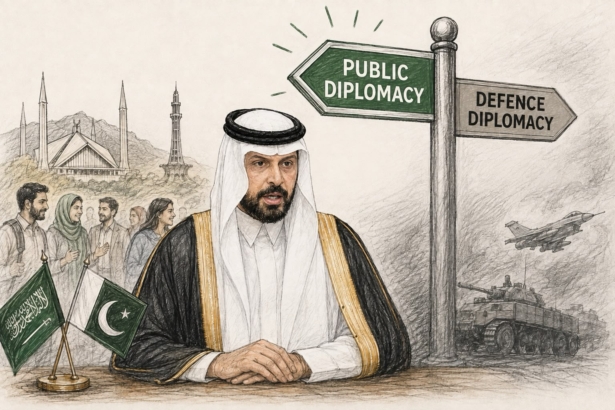
- For the new Saudi ambassador, public diplomacy will prove a formidable challenge.
ISLAMABAD: For the second consecutive time, the Kingdom of Saudi Arabia has appointed a career military veteran as its ambassador to Islamabad, inaugurating a compelling new chapter in Pakistan-Saudi defense diplomacy.
The recent designation of Major General (R) Dr. Rajih bin Tami Al-Baqami as the Saudi envoy comes at a pivotal geopolitical juncture. Smaller Gulf states like Qatar, Bahrain, and particularly Kuwait are increasingly turning their strategic gaze toward Riyadh for defense assurances. In response, Saudi Arabia has conspicuously integrated Pakistan into the its defensive calculus, both specifically within the Gulf and more broadly across the Middle East.
This deepening collaboration signifies the beginning of the end of an era characterized by blind, unilateral reliance on the United States for regional security. Whether through multinational maritime security coalitions or trilateral defense pacts, Riyadh has unequivocally positioned Islamabad as a trusted strategic partner.
Crucially, while Washington has not been entirely excluded from the new arrangements, the table that once seated only the US now accommodates Pakistan and Turkey’s president states that more seats will soon be filled. His hint is for Egypt. Turkey is playing a big game and Egypt is part of his plans for Sahel and Middle East.
Moreover, Saudi Arabia has extended its supportive hand to facilitate Pakistan’s major defense agreements with Somalia, further expanding Islamabad’s footprint in Riyadh’s sphere of influence.
This rapidly evolving landscape demands an exceptionally shrewd Saudi diplomat in Islamabad, given that intellectual powerhouses like the United States are unlikely to passively observe these seismic shifts in the affluent Gulf region.
One could argue that defense diplomacy has cycled back to the fervor of the 1970s but the stark difference is that the towering strategic minds of that era, such as Zulfikar Ali Bhutto, Ardeshir Zahedi, and Henry Kissinger, are no longer among us and on the other hand China of today is 100 times more important than China of 1970s.
However, Crown Prince Mohammed bin Salman has proven himself uniquely adept at this high-stakes game. Without jeopardizing ties with Washington, he has fortified relations with Beijing to an unprecedented degree; in fact, Riyadh is now expanding its commercial and strategic footprint with China more aggressively than with the US.
According to the Saudi Foreign Ministry, Dr. Al-Baqami is among eight newly appointed ambassadors who recently took their oath before the Crown Prince in Jeddah. Despite this formal announcement, frequent winner of government awards for his services in journalism, Saleh Zaafir, curiously attributed the news to his “sources.” Meanwhile, leading AI chatbots and search engines like ChatGPT, DeepSeek, and Gemini draw a blank regarding the nature of Dr. Al-Baqami’s specific postings in Saudi diplomatic missions London and Jordan, which strongly suggests a classified, defense-oriented portfolio.
Dr. Al-Baqami hails from the warrior Al-Baqami tribe, a lineage renowned for its formidable resilience and esprit de corps.
Yet, a note of caution is urgently warranted. Misleading and unrealistic commentary regarding Saudi-Pakistan defense pacts has become rife. These agreements will not automatically neutralize Pakistan’s internal existential threats, specifically, the escalating bureaucratic corruption and spiraling crime rates.
The historical precedent is sobering: the practice of deploying military officers to diplomatic roles is ancient, tracing back to the Roman and Byzantine empires, yet it has no inherent correlation with a nation’s prosperity or moral standing. Napoleon formalized this tradition in the pre-WWI era, but French military envoys failed to stave off famine and destitution in France.
Subsequently, professional foreign ministries emerged, and bureaucrats, much like termites, consumed diplomacy from the inside, burying interstate relations beneath classified files. When opacity became the norm, civil society rebelled, giving rise to digital media and public diplomacy, a trend recently taken to extremes by former US President Donald Trump.
For the new Saudi ambassador, public diplomacy will prove a formidable challenge. Although several Saudi-funded media outlets operate in Pakistan, they have largely been hijacked by populist scribes who have reduced them to ashes of sensationalism. Reclaiming these platforms from the clutches of journalistic mediocrity must be an immediate priority.
Dr. Al-Baqami’s predecessor, Nawaf bin Malik Al-Maliki, a retired Saudi Navy officer, remained in Islamabad for nearly twelve years. Pakistan’s navy has historically played a pivotal role in the formation and training of the Saudi Naval Forces. Al-Maliki initially arrived as defense attaché in 2014, the very year MBS ascended to a high office before being appointed Defense Minister in 2015. When MBS became Crown Prince in 2017, Al-Maliki assumed the ambassadorship. He retained this position for a decade indicating that he was a trusted confidant of the Crown Prince.
Intriguingly, Al-Maliki’s next posting is Algeria—a nation where military dominance permeates business and governance, ensnaring the country in poverty and bloodshed. As Algeria remains a Saudi ally, it is premature to forecast the trajectory of his new mission.
To conclude, one can only hope that Major General (Retd) Dr. Rajih Al-Baqami’s tenure in Pakistan transcends the narrow confines of defense diplomacy. The true test of his legacy will lie in revitalizing public diplomacy, fostering people-to-people connections, and navigating the intricate socio-political fabric of Pakistan with the same dexterity he brings to the strategic chessboard.
We welcome your contributions! Submit your blogs, opinion pieces, press releases, news story pitches, and news features to opinion@minutemirror.com.pk and minutemirrormail@gmail.com