


Summary
- While discussing her challenges, Khadija told me, without the support of Mohammad Haris and her in-laws, pursuing her dream to utilize her studies and continue her job would not have been possible.
- _”I have the support of my parents and in-laws, but there are hundreds of women who give up their goals and dreams just for children and home after marriage.”_ Likewise, I met Madiha Almas, who is a renowned anchor.
- But the challenge of doing a job honestly, and at the same time raising children and building a home — not a house — still remains the domain of women.
The Strength That Never Makes Noise
There is a kind of strength that never makes noise.
It does not stand on a stage. It does not ask for applause. It wakes up before everyone else in a house full of people, makes breakfast for a joint family, packs lunch for children, gets ready for work or university, and still smiles when someone says, _”Tum se nahi hoga.”_
Society has always underestimated such a woman. It calls her “just a housewife” when she is managing an entire household. It calls her “selfish” when she goes back to study. It calls her “neglectful” when she goes back to work. It forgets that she is not choosing between her family and her dreams — she is carrying both on her shoulders, at the same time.
Yet she continues.
She continues her job after marriage, after children, after sleepless nights. She continues her degree with a child in her lap and books in her bag. She lives in a big in-laws family where her every step is watched, her every decision is questioned — and still, she does not stop.
This is not just willpower. This is resilience. This is the quiet revolution of Pakistani women who refuse to disappear after marriage.
This feature is about them.
During my travel from Karachi to Kashmir, I came across such phenomenal women. Among them were Abida Farheen from Islamabad, Khadija Nazeer, Madiha Almas, Saba Bano from Lahore, Ayesha Inam Mazari from Multan — and the list goes on.
Abida Farheen: A Visionary Who Refused To Be Reduced
But the fact is, Abida was not new to me. She was my good buddy in Karachi, already an accomplished woman — a visionary leader, a journalist.
Maya Angelou once said, _”I can be changed by what happens to me. But I refuse to be reduced by it.”_ When I think of Abida, I think of this line.
She was the founding president of Baithak School for 10 years. Under Al-Khidmat, she built a vast network, a chain of schools for poor and deserving students. And then she gave the Working Women Welfare Trust a new life and a new direction, as its president for 8 years in Karachi.
And she did not stop there.
After shifting to Islamabad, with all the responsibilities of a new home and a new city, she did her MPhil in Media Sciences. And her thesis had a remarkable subject — Muslim Women in Media.
That is Abida.
After meeting her in Islamabad, I felt it was not a decade wasted. In fact, she did most of it in these ten years.
She became the Editor of the journal of Riphah International University, Islamabad. She produced women-related documentaries, among which the most prominent was _”Saudi Arabia Mein Women Rights Ki Tehreek.”_
Explaining her vision to portray women’s struggle and role in her work as sheroes, Abida said our dramas have stereotyped women by showing them as manipulative Saas, Nand and Bahu. Either victim or villain.
However, now the context has changed. Today, women have emerged as independent individuals who are IT experts, pilots, physicians, writers, entrepreneurs.
However, to correct the portrayal of women in media is a long fight, and the fight continues.
Talking about her struggle to materialize her vision in the form of Baithak School, Society for Education, and her other projects, she said her husband Rehan Hasan was the pillar of her strength after marriage.
But the courage, she said, she inherited genetically — from her father Nazeer-ur-Rehman, who always supported her to do what she dreams of. To pursue her goals in education, and after post-graduation, to do what she wants to do.
She said, _”If a woman finds the right support or the right organisation at the right time, she is able to show her potential and move mountains.”_
Khadija Nazeer: Believing She Could Do Both
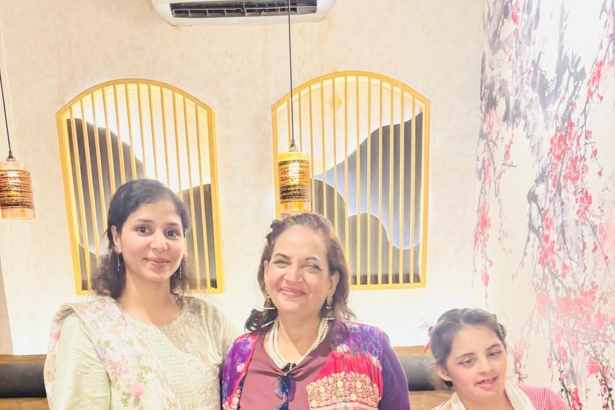
I met Khadija Nazeer in 2018 at Data Darbar, Lahore. She had completed her studies in pharmacy and joined the Punjab Institute of Cardiology, Lahore at that time.
That one-time meeting continued as a long-distance love relationship for almost 8 years. She remained in touch, and meanwhile got married in 2021, and became mother of two beautiful children — Hashir and Irha.
She and her better half, who was actually her best half, Mohammad Haris, cordially met us. And I was surprised to see a lean young girl managing two young children aged 6 and 3, a demanding job, and a joint family.
While Abida was a rough, tough, mature lady, Khadija was a young lady fighting for her dream — but building a home also.
As Oprah Winfrey says, _”You don’t become what you want, you become what you believe.”_ Khadija believed she could do both. And she is doing both.
While discussing her challenges, Khadija told me, without the support of Mohammad Haris and her in-laws, pursuing her dream to utilize her studies and continue her job would not have been possible.
In a very serious tone she said, sometimes handling Hashir’s studies and her little baby girl becomes a tedious job, and she thinks of giving up her job. Because mostly seniors are not as sensitized and cooperative in understanding the challenges of a toddler’s mother.
But then she thinks — she has crossed so many bridges, then why give up now? In a few years, children will grow up and she will be in a senior position.
Khadija emphasized that it is pertinent for organizations to establish spacious and well-equipped day care centres for working mothers. _”I have the support of my parents and in-laws, but there are hundreds of women who give up their goals and dreams just for children and home after marriage.”_
Likewise, I met Madiha Almas, who is a renowned anchor.
While I was discussing with her the LPC issues, I saw her worried to get home, since she had left her children since morning. But I could see the courage to pull through her duty as VP — a duty she had accepted.
That is the resilience of a woman.
As Michelle Obama says, _”There is no limit to what we, as women, can accomplish.”_ Madiha is living that line every day — torn between home and office, yet standing firm at both.
*Not For Money, For Identity*
While I met them and talked to them, I realised — none of them was working only to earn money. They were fighting to have their own identity. To utilize their potential. To show people what they are able to do, given the opportunity.
Yes, the support system in the shape of a good husband was there.
But the challenge of doing a job honestly, and at the same time raising children and building a home — not a house — still remains the domain of women.
Men still remain evasive of this duty, and our society allows them to be. _Not my monkey, not my circus._
That is why these women are phenomenal. Not because their lives are easy, but because they carry two worlds on their shoulders — and still refuse to put either one down.
What The Matchmaker Says: Switch The Roles
In this connection, I interviewed a matchmaker in Karachi, Mrs. Asra Shahbaz.
She stated that keeping in view today’s economic challenges, 80 percent of boys and their families are now looking for working women. Normally, 70 percent of girls want to continue their studies after marriage.
Mrs. Shahbaz urged — if boys want their wives to help in running financial affairs, then there is a great need to switch roles. Men should also be held responsible for running home affairs and raising children.
A Battle Fought More Than Once
Perhaps there is no conclusion of such pieces. As Margaret Thatcher said, _”You may have to fight a battle more than once to win it.”_
This is an ongoing battle, where a few fortunate ones find a support system, but many are fighting this battle on many fronts — where the husband is on the side of the front.
I remember too clearly, Abida Farheen wrote a few lines of poetry for me, for a convention where both of us were invited as speakers. Let me finish with it:
_Aey Jaan, agar tum saath na do,_
_Tou tanha mujh se kya hoga,_
_Main tanha bhi barh sakta hun,_
_Aur tanha barhta jaunga._
_Phir bhi main tum se kehta hun,_
_Tum saath raho tou behtar hai,_
_Aage ko barho tou behtar hai,_
_Peeche na raho tou behtar hai._
_Aey Jaan, agar tum saath na do,_
_Tou tanha mujh se kya hoga…_
Meet the author:
The writer is a senior journalist and columnist covering crime, law, social issues, governance, energy, health, literature, and women and children’s rights across Pakistan’s leading English media houses.
Feedback:* mediawomen2014@gmail.com









