Summary
- It recognized the democratic, educational and political significance of student unions, particularly their role in developing leadership, promoting representative participation and cultivating democratic values.
- Student unions must be restored as institutions of democratic education, constitutional development and political accountability.
- It remains to be seen whether Pakistan’s self-proclaimed democratic parties will demonstrate the political will to restore student unions or whether the Federal Constitutional Court will ultimately intervene to safeguard citizens’ constitutionally guaranteed fundamental rights.
By Muhammad Imran, Staff Member, SAHSOL-LUMS and Muhammad Yasin, Police Officer and Ph. D. (Scholar) and Maria Batool, Law Graduate-2025, SAHSOL-LUMS
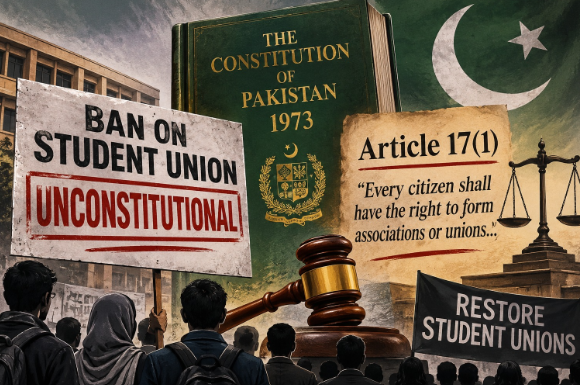
Introduction: Article 17(1), enshrined in the Fundamental Rights, Part-II, Chapter 1, of the Constitution of Pakistan, 1973, guarantees every citizen the right to form or join associations and unions, subject to reasonable restrictions imposed by law in the interests of Pakistan’s sovereignty, integrity, public order or morality. Such restrictions must satisfy the tests of legality, reasonableness and proportionality. Administrative convenience or apprehensions of disorder cannot justify the indefinite suspension of a constitutionally protected freedom.
Two petitions seeking the revival of student unions, initially instituted before the Supreme Court, have, following the 27th Constitutional Amendment, been transferred to the Federal Constitutional Court. The first was filed by Islami Jamiat-i-Talaba (IJT), through Barrister Zafarullah Khan, while the second was instituted by Hamza Khawaja, a LUMS Law graduate, through Barrister Umer Ijaz Gilani. Following the removal of preliminary objections, the Constitutional Bench had directed regular hearings and sought responses from the relevant federal and provincial authorities.
The petitioners have challenged the 1993 judgment in M. Ismail Qureshi v. Secretary General, Islami Jamiat-i-Talaba (1993 SCMR 1781) and questioned compulsory student affidavits prohibiting political activities, arguing that these restrictions lack legal justification and violate fundamental rights. The proceedings have reopened an important constitutional debate concerning freedom of association, political participation and the role of universities in nurturing democratic leadership. More fundamentally, they raise a question: can a state founded upon democratic constitutional principles deny young citizens meaningful opportunities to practise representative politics within their educational institutions?
The petitioners maintain that universities cannot arbitrarily curtail fundamental rights through administrative directives, institutional regulations or compulsory undertakings. They also contend that the circumstances which originally prompted the prohibition have substantially changed, weakening the justification for maintaining restrictions indefinitely.
The prohibition derives much of its judicial legitimacy from the Supreme Court’s 1993 judgment, which restricted the affiliation of student organisations with mainstream political parties and limited students’ participation in university statutory bodies. Although these restrictions were justified primarily on grounds of campus discipline and political violence, their prolonged continuation raises questions about their necessity, proportionality and constitutional sustainability. An additional constitutional inconsistency emerges from the reduction of the voting age to 18 years. Citizens aged 18 and above are eligible to participate in national and provincial elections, subject to prescribed qualifications. It is therefore difficult to justify a blanket prohibition on their participation in representative student organisations. Although the right to vote and the right to form associations are constitutionally distinct, restrictions on the latter must still be convincingly justified.
The Federal Constitutional Court must therefore confront a fundamental question: can maintaining discipline within educational institutions justify the indefinite suspension of representative student activity? Preventing violence is a legitimate responsibility of the state; suppressing constitutional freedoms, however, cannot become its preferred instrument.
The Historical Legacy of the Prohibition: The prohibition on student unions originated during General Zia-ul-Haq’s military regime, which banned student union activities through martial law orders in 1984. Although the restriction was subsequently lifted by the democratic government in 1989, student union elections were never restored through a sustainable national policy. This raises an uncomfortable question: why did successive elected governments fail to reverse a restriction introduced during military rule? The failure cannot be attributed exclusively to campus violence. Organized student representation can challenge political authority, mobilize public opinion and demand institutional accountability. Successive governments may therefore have viewed independent student organisations as competitors for political influence rather than legitimate democratic institutions.
Historically, student unions provided platforms for political debate, collective bargaining, peaceful dispute resolution and leadership development. They enabled young people from diverse socioeconomic backgrounds to enter representative politics without necessarily possessing financial resources or influential family connections. Their disappearance has arguably narrowed opportunities for political advancement and reinforced the dominance of established political elites.
Student unions also provided an institutional mechanism for challenging arbitrary tuition fee increases, discriminatory administrative decisions, and inadequate educational facilities. Their absence has consequently left university administrations with considerable authority without an adequately institutionalized system of student representation and accountability. The contradiction is particularly striking: political parties invoke democratic rights and representative government when seeking public support, yet successive governments have remained reluctant to extend these principles to university campuses. Students are expected to become responsible citizens and participate in democratic institutions but are denied opportunities to acquire these values through practical experience.
Nevertheless, it would be misleading to romanticise the historical experience of student politics. Certain organisations became involved in partisan rivalries, intimidation, ideological confrontations and violence. In some institutions, political affiliations overshadowed academic interests and undermined the democratic values student unions were supposed to cultivate.
The lesson is not that student unions should remain prohibited, but that their restoration must address the institutional weaknesses responsible for their deterioration. A blanket prohibition treats every student organisation as a potential source of violence. A democratic constitutional order requires individual accountability and proportionate regulation rather than collective punishment.
Parliamentary Resolutions – Consensus Without Implementation: The Sindh Assembly’s adoption of a resolution calling for the restoration of student union elections is a welcome development. The JI representative who moved the motion rightly recognized student unions as important institutions for nurturing democratic culture and safeguarding students’ constitutional rights.
An earlier parliamentary intervention came through Senate Resolution No. 335, unanimously adopted on 23 August 2017. It recognized the democratic, educational and political significance of student unions, particularly their role in developing leadership, promoting representative participation and cultivating democratic values.
However, nearly a decade later, the resolution raises a fundamental question: why does parliamentary consensus so frequently fail to produce institutional reform? Although it presents a persuasive case for restoring student unions, its recommendations remain stronger in aspiration than implementation. It provides no definite timetable, designated implementing authority or effective monitoring mechanism. Its unanimous adoption therefore demonstrates political agreement without necessarily establishing political commitment.
Three shortcomings deserve particular attention: First, the resolution correctly identifies student unions as institutions for acquiring practical experience of democratic governance. However, democracy cannot be reduced to periodic elections. It requires tolerance of dissent, protection of minority opinions, accountability of elected representatives and peaceful resolution of political disagreements. Restoring elections without ensuring transparency and internal accountability could reproduce the weaknesses of mainstream political institutions on university campuses.
Second, although Article 17 provides the principal constitutional foundation for restoring student unions, the resolution does not sufficiently address the limits of administrative discretion. Universities cannot use internal regulations and compulsory affidavits to effectively extinguish a fundamental right. This does not mean student organisations enjoy unrestricted freedom. The state may legitimately regulate violence, intimidation and disruption of academic activities. However, such regulation must not become a pretext for suppressing peaceful association.
The government must demonstrate why less restrictive alternatives, including enforceable codes of conduct, independent electoral supervision and impartial disciplinary mechanisms, would be insufficient.
Third, the resolution refers to the Supreme Court judgment reported as 1993 SCMR 1781 but does not adequately distinguish between student representation, political association and affiliation with mainstream political parties. These are related but legally distinct questions. The Supreme Court’s original concerns about campus discipline and political violence deserve consideration, but the judgment must also be examined against subsequent constitutional developments and changing institutional circumstances.
The present proceedings offer the Federal Constitutional Court an opportunity to clarify the constitutional boundaries of student political participation. The passage of time does not automatically invalidate a judicial decision; equally, an earlier judgment should not justify continuing restrictions without examining their constitutional necessity.
Campus Violence and the Need for Regulation: Campus violence remains the strongest argument advanced against restoring student unions. Historically, certain organisations became involved in armed confrontations, intimidation, political rivalries and disruption of academic activities. These developments seriously undermined the educational environment. However, the state’s response has largely been prohibitive rather than institutional. Instead of developing effective mechanisms to regulate political activities, successive governments have collectively excluded students from representative politics. This approach confuses the misuse of a democratic institution with the institution itself.
Political violence is not an inevitable consequence of student representation. It frequently reflects weak governance, political interference, inadequate accountability and failure to enforce existing rules. The appropriate response is therefore to regulate unlawful conduct rather than eliminate opportunities for peaceful political participation.
The restoration of student unions should be accompanied by a comprehensive regulatory framework incorporating:
- Transparent elections under independent supervision.
- Clear rules governing political affiliations and external interference by mainstream political parties.
- An unequivocal prohibition on weapons, intimidation and violent campaigning.
- Financial disclosure and accountability requirements for elected representatives.
- Independent disciplinary committees operating through fair procedures.
- Protection of minority groups and students holding dissenting political views.
- Effective mechanisms for resolving disputes between students and university administrations.
Disciplinary rules must apply equally to all organisations, irrespective of political influence, ideological orientation or institutional connections. Otherwise, student elections risk becoming instruments of political patronage, administrative favoritism and selective accountability.
Federalism and Provincial Responsibility: Following the Eighteenth Amendment, education has substantially become a provincial responsibility. Senate Resolution No. 335 accordingly recommends that the federal government restore student unions in educational institutions within Islamabad Capital Territory, while provincial governments should introduce corresponding arrangements within their jurisdictions.
This approach broadly reflects Pakistan’s federal structure. However, leaving restoration entirely dependent upon provincial political will carries institutional risks. Without minimum national standards, students in different provinces may enjoy unequal opportunities for political representation. The federal and provincial governments should therefore develop a coordinated framework establishing minimum standards for elections, fundamental rights protection and disciplinary safeguards while respecting provincial legislative autonomy.
The most significant weakness of Senate Resolution No. 335 is its failure to establish an effective implementation mechanism. A unanimous parliamentary resolution should have been followed by concrete legislative and administrative measures. Provincial governments should introduce appropriate legislation, universities should adopt standardized electoral regulations, and the Higher Education Commission should facilitate institutional coordination. Governments should also report periodically on implementation.
Otherwise, parliamentary unanimity risks remaining little more than political goodwill without institutional consequences.
The Way Forward: The prolonged prohibition of student unions exposes a deeper contradiction in Pakistan’s democratic development: the state expects young citizens to uphold democracy while denying them opportunities to practise it. Although the historical problems of violence, partisan interference and intimidation warrant regulation, they cannot justify the indefinite suspension of representative rights. The Federal Constitutional Court now has an opportunity to determine whether these decades-old restrictions remain consistent with Article 17. Parliament and provincial governments must also move beyond symbolic resolutions and establish a sustainable framework for student representation.
Universities must prepare citizens capable of questioning authority, defending constitutional rights and respecting opposing viewpoints. Pakistan cannot build a democratic future by keeping its younger generations politically voiceless. Student unions must be restored as institutions of democratic education, constitutional development and political accountability.
It remains to be seen whether Pakistan’s self-proclaimed democratic parties will demonstrate the political will to restore student unions or whether the Federal Constitutional Court will ultimately intervene to safeguard citizens’ constitutionally guaranteed fundamental rights.
We welcome your contributions! Submit your blogs, opinion pieces, press releases, news story pitches, and news features to opinion@minutemirror.com.pk and minutemirrormail@gmail.com