Summary
- Read alongside the applicable principles of Muslim personal law and the constitutional guarantees of dignity and equality, it raises a fundamental question: can the protection of marital rights be meaningful when the parties do not understand the legal consequences of the document they sign?
- Where the evidence establishes that property was promised to the wife, the legal consequences must be determined from the agreement and the applicable law, rather than assumptions about what the parties must have intended.
- Families should recognise that discussing dower, property and divorce rights before marriage is not an expression of distrust; it is an exercise in informed consent.
By Muhammad Imran, Staff Member, SAHSOL-LUMS Maria Batool, SAHSOL-LUMS Graduate, 2025 Ayesha Baloch, Law Student, SAHSOL-LUMS
Pakistan’s family-law framework recognises important marital rights, but their protection depends on informed consent, meaningful documentation and effective judicial enforcement.
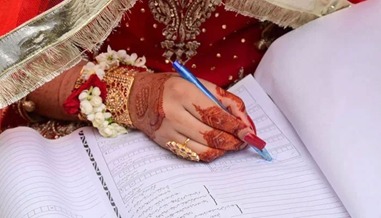
Marriage in Pakistan is frequently approached as a social and religious institution, while its contractual and legal dimensions receive insufficient attention. The Nikahnama is often signed amid elaborate ceremonies, with little discussion of the rights and obligations recorded in its columns. Yet those entries may determine a woman’s entitlement to property, dower, maintenance and divorce. The resulting paradox is difficult to ignore: rights formally recognised by law may remain practically inaccessible to the very people they are intended to protect.
The Muslim Family Laws Ordinance, 1961 (MFLO), regulates important aspects of Muslim marriage, including registration, subsequent marriages, divorce and dower. Its significance, however, extends beyond administrative regulation. Read alongside the applicable principles of Muslim personal law and the constitutional guarantees of dignity and equality, it raises a fundamental question: can the protection of marital rights be meaningful when the parties do not understand the legal consequences of the document they sign?
The answer must begin with the recognition that the Nikahnama is not merely evidence of a marriage ceremony. It is a legally consequential instrument recording the parties’ agreement. The Supreme Court made this particularly clear in Muhammad Yousaf v Huma Saeed and others, reported as 2024 SCMR 1078. The dispute concerned a plot of land entered in Column 17 of the Nikahnama. The husband argued that the entry merely contemplated the wife’s residence in a house to be constructed on the plot, rather than conferring a proprietary entitlement upon her.
The Supreme Court rejected an interpretation based merely on the printed heading of the column. It emphasised that the parties’ intention, the actual wording of the agreement and the circumstances surrounding its execution were central to interpreting the Nikahnama. The Court also underscored the importance of the bride’s free consent, informed understanding of her rights and freedom to negotiate the terms of the marriage contract, particularly in light of prevailing socio-cultural disadvantages.
The judgment carries an important message for family law: a husband cannot escape a contractual obligation simply by invoking the heading under which it was recorded. Nor should courts read into a marriage contract a limitation that its express language does not support. Where the evidence establishes that property was promised to the wife, the legal consequences must be determined from the agreement and the applicable law, rather than assumptions about what the parties must have intended.
This principle is especially significant for Columns 13–17, which deal with dower, payment arrangements, property and special conditions. Where land or a house is promised, the property should be identified precisely, its ownership and valuation established, and any necessary transfer formalities addressed. A promise of immovable property and a completed transfer of ownership are not invariably the same thing. The law must protect legitimate contractual expectations without dispensing with the legal requirements governing title and transfer.
The broader concern is that women may enter marriage without being afforded a genuine opportunity to understand or negotiate these terms. The Supreme Court’s reasoning in Muhammad Yousaf challenges the assumption that a signature necessarily proves informed agreement to every legal consequence. Although the judgment does not establish that every ambiguity must automatically be resolved in a wife’s favour in every case, it makes clear that her informed consent and actual freedom to negotiate cannot be ignored.
The same insistence on legal accountability is evident in the regulation of polygamy. Section 6 of the MFLO requires a man, during the subsistence of an existing marriage, to obtain prior written permission from the Arbitration Council before contracting another marriage. His application must disclose the reasons for the proposed marriage and whether the consent of his existing wife or wives has been obtained. The Council must follow the prescribed process and determine whether the proposed marriage is necessary and just.
In Ishtiaq Ahmad v State, reported as 2017 PLJ SC 351 and PLD 2017 SC 187, the Supreme Court upheld the statutory requirement and rejected the argument that it impermissibly restricted the right to contract another marriage under Muslim personal law. The Court treated Section 6 as a procedural mechanism intended to give effect to the requirement of justice between wives.²
The distinction is crucial. The existing wife’s consent is relevant, but it does not replace the permission required by statute. Equally, the absence of that permission does not, by itself, automatically render the subsequent marriage void. The statutory breach and the question of marital validity are separate legal issues. Section 6 nevertheless prescribes consequences for non-compliance, including immediate payment of the entire dower due to the existing wife or wives and the criminal penalties specified in the applicable legislation.
The purpose of such regulation is not to convert a marriage into an administrative exercise. It is to ensure that the exercise of a legally recognised choice does not become a licence to disregard statutory obligations or the interests of an existing spouse. The effectiveness of this safeguard depends on the Arbitration Council’s meaningful consideration of the matter and the willingness of the relevant authorities to enforce the law.
The question of divorce presents an equally important challenge. Section 8 of the MFLO recognises the exercise of a duly delegated right of divorce, commonly known as Talaq-e-Tafweez. Column 18 of the Nikahnama records whether the husband has delegated that right to his wife and, where applicable, the conditions governing its exercise.
Delegated divorce can provide a woman with a means of exercising a right without depending exclusively on her husband’s willingness to pronounce divorce. Where a valid delegation exists, the wife may exercise it within its terms, subject to the applicable statutory procedure under Sections 7 and 8. The ordinary statutory framework includes notice and a reconciliation process, and the legal effectiveness of the divorce must be assessed in accordance with the relevant provisions.
Pakistani case law has recognised the practical significance of an unequivocal delegation. In Dr Qambar Murtaza Bokhari v Mst Zainab Bashir, reported as PLD 1995 Lahore 187, the Lahore High Court considered an unconditional delegation recorded in the Nikahnama and recognised the wife’s exercise of the delegated right under the applicable law. This authority illustrates why Column 18 should not be treated as an insignificant entry: its wording may have substantial consequences for a woman’s legal autonomy.
Delegated divorce also raises questions of financial justice. A wife exercising a validly delegated right does not automatically forfeit her dower simply because she initiates the dissolution. The financial consequences depend on the applicable law, the contractual terms and the circumstances of the case. This distinguishes delegated divorce from the issues that may arise in proceedings for khula, without implying that either remedy is inherently inferior. The appropriate remedy depends on the woman’s circumstances and the rights available to her.
Column 19, which concerns restrictions on the husband’s right of divorce, must be considered separately from Column 18. The former concerns restrictions on the husband’s exercise of his right, while the latter addresses delegation to the wife. Both provisions require careful attention to the actual wording and legal effect of the entries. A blank or inadequately completed column can generate uncertainty, but its legal consequences must be determined under the applicable law rather than presumed.
The larger problem is therefore not simply an absence of legal protection. It is the distance between formal rights and their practical exercise. The Nikahnama may provide a means of recording financial entitlements and contractual arrangements, yet those protections can be weakened when women are excluded from meaningful discussion, when registrars fail to record their answers accurately, or when parties do not retain copies of the completed document.
The solution requires more than advising women to read before signing. Nikah Registrars and those solemnising marriages must ensure that the prescribed form accurately reflects the parties’ answers and agreements. Families should recognise that discussing dower, property and divorce rights before marriage is not an expression of distrust; it is an exercise in informed consent. Legal awareness initiatives should explain the consequences of material entries in accessible language, while courts must continue to scrutinise the evidence and apply the law without allowing social assumptions to override established rights.
The state must also ensure that the statutory framework is implemented effectively. Registration without accuracy, contractual freedom without informed participation, and judicial recognition without accessible remedies cannot provide substantive protection. The objective should be a system in which the parties understand their rights before marriage and can enforce legitimate entitlements when disputes arise.
Ultimately, the test of Pakistan’s family-law framework is not how many rights appear in legislation or how many Nikahnamas are registered. It is whether those rights tangibly affect women’s lives. The Supreme Court’s reasoning in Muhammad Yousaf provides an important foundation for that objective: the Nikahnama must be interpreted through the parties’ actual agreement, with due regard to free consent, informed understanding and the circumstances in which the contract was executed.
A marriage contract should not become an instrument of uncertainty precisely when a spouse needs legal protection. The Nikahnama must be treated as a record of enforceable rights and responsibilities, not a ceremonial formality. Ensuring that women understand its contents, participate meaningfully in determining its terms and can obtain effective remedies when their rights are violated is essential to a family-law system founded on dignity, fairness and the rule of law.
We welcome your contributions! Submit your blogs, opinion pieces, press releases, news story pitches, and news features to opinion@minutemirror.com.pk and minutemirrormail@gmail.com