Summary
- The obituaries will rightly recount the long arc of his public service: joining the Pakistan Atomic Energy Commission in 1963, cutting his teeth on the design of KANUPP-I, Pakistan’s first commercial nuclear power plant, spending years at GE Canada absorbing the discipline of reactor engineering, and eventually rising to chair the PAEC from 2001 to 2006 — a tenure during which he oversaw the expansion of Chashma and laid groundwork that would carry Pakistan’s nuclear power programme well into this century.
- I want to remember him the way I actually experienced him — not through the official biography, but through three long afternoons at his house in F-11 Sector, Islamabad, where he taught me something the textbooks never quite manage: how the price of nuclear electricity in Pakistan is actually determined.
- What pulled me toward him was the economics: how a country decides what a unit of nuclear electricity should cost, how the capital recovery on a plant like K-2 or C-3 gets built into a tariff, how fuel cost and EPC cost and decommissioning liability all get stitched together into a number that regulators can defend and the public can pay.
Dr Pervez Butt died on the 26th of July, 2026, at the age of 84, and with him Pakistan lost one of the last living architects of its nuclear age. The obituaries will rightly recount the long arc of his public service: joining the Pakistan Atomic Energy Commission in 1963, cutting his teeth on the design of KANUPP-I, Pakistan’s first commercial nuclear power plant, spending years at GE Canada absorbing the discipline of reactor engineering, and eventually rising to chair the PAEC from 2001 to 2006 — a tenure during which he oversaw the expansion of Chashma and laid groundwork that would carry Pakistan’s nuclear power programme well into this century. He would go on to serve as Federal Secretary for Science and Technology, as an adviser at the Planning Commission, and, until his final days, as a quiet counsel to the National Command Authority. Nishan-i-Imtiaz, Hilal-i-Imtiaz, Sitara-i-Imtiaz — the honours are a matter of record.
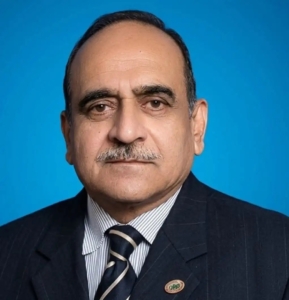
But I did not know him first as a chairman or a decorated public servant. I knew him as a teacher who happened to hold the keys to some of the country’s most consequential engineering decisions, and who chose, for reasons I am still grateful for, to hand a few of those keys to me.
I want to remember him the way I actually experienced him — not through the official biography, but through three long afternoons at his house in F-11 Sector, Islamabad, where he taught me something the textbooks never quite manage: how the price of nuclear electricity in Pakistan is actually determined.
Anyone who has sat through a lecture on tariff determination knows how dry the subject can be made to sound — EPC cost, fuel cost, capacity purchase price, energy purchase price, indexation, decommissioning liability. Dr. Butt made none of it dry. He made it a ritual.
Each session began the same way, and the way it began told you everything about the man. There was no walking straight into the numbers. First came tea — always a full spread of dry fruits, delicate sandwiches, fresh fruit, chana chaat, and cappuccino. It was in his drawing room that I had my first Cortado, and my first Mocha, both poured by a man who clearly took as much pride in introducing a good cup of coffee as he did in explaining a heat-rate calculation. Only once the plates were cleared did the real class begin.
He held nothing back. The sessions ran from ten in the morning until nearly four in the afternoon — six hours at a stretch, with no formal lunch break at all. Instead, somewhere past midday, a trolley would appear, loaded with Lahori chanay and naan, and he would keep teaching straight through it, tariff formulas in one breath and the economics of fuel fabrication cost in the next, a piece of naan in hand the whole time. I have sat in university seminars with more structure and far less learned.
What I remember most, though, is the break. Every two hours, without fail, he would stop — not because he was tired, but because he knew I smoked, and he had built an orchard directly across the road from his house for exactly this purpose. We would walk over together, and his waiter would already be there ahead of us, a fresh cappuccino on the table, an ashtray set out with wet tissue paper folded neatly beside it — a small, deliberate touch that told you this man planned for his guests down to the last detail. And it was in that orchard, not at his desk, that the real teaching happened. He would ask me, plainly, to repeat back what I had just understood. Not to test me — to correct me, gently, if I had drifted, and to make sure the idea had actually landed before we walked back inside for the next round.
I was, I suspect, an unlikely student for him to invest that kind of care in. I have never been a person drawn to nuclear energy for its own sake — the physics of it, the fission and the neutrons and the reactor cores, left me largely unmoved. What pulled me toward him was the economics: how a country decides what a unit of nuclear electricity should cost, how the capital recovery on a plant like K-2 or C-3 gets built into a tariff, how fuel cost and EPC cost and decommissioning liability all get stitched together into a number that regulators can defend and the public can pay. That was the language I wanted to learn, and he taught it to me the way he taught everything — thoroughly, patiently, and without ever once looking at the clock.
Looking back, I think that was the most VIP treatment anyone taught by him could have asked for — not a title, not a certificate, but three full days of a man who had chaired the PAEC choosing to spend his mornings, his working lunches, and his smoking breaks making sure a subject I hadn’t cared about a week earlier had become one I could speak on with confidence.
Pakistan will remember Dr. Pervez Butt for KANUPP and Chashma, for the plants he helped design and the institutions he helped build — the Pakistan Welding Institute, the nondestructive testing facility at Taxila, decades spent quietly ensuring that a technically demanding and politically sensitive programme kept working. Those achievements belong to the history books, and they are considerable.
I will remember the orchard. I will remember a Cortado poured by a man who insisted the tea come before the tariff, and a lecture that never stopped even for lunch. That was his real gift — not just what he knew, but how completely he was willing to give his time to make sure someone else knew it too.
Rest well, sir. The lesson stayed.
We welcome your contributions! Submit your blogs, opinion pieces, press releases, news story pitches, and news features to opinion@minutemirror.com.pk and minutemirrormail@gmail.com