Summary
- A Vulcan rocket operated by United Launch Alliance (ULA), a joint venture between Boeing and Lockheed Martin, failed about 10 minutes after liftoff from Florida on Sunday, leaving all 40 satellites aboard for Amazon’s Leo internet network unable to reach orbit in the company’s first total mission failure.
- The failure was a major setback for ULA as it sought to establish regular launches for Amazon’s growing satellite internet constellation.
- “Based on data received by our Launch Director, we confirm that the Vulcan vehicle launched from Space Launch Complex 41 suffered an anomaly 10 minutes into the flight and failed to deliver the Amazon mission to orbit,” ULA said in a statement.
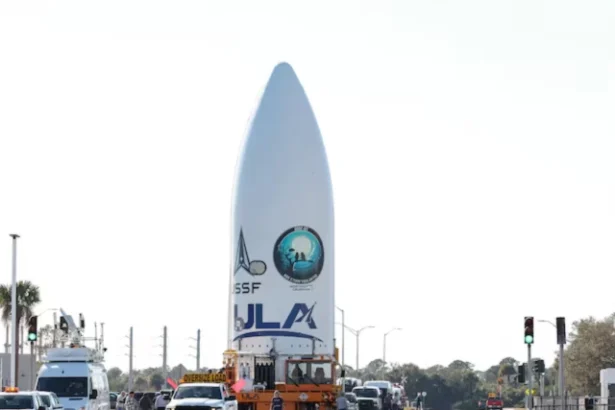
A Vulcan rocket operated by United Launch Alliance (ULA), a joint venture between Boeing and Lockheed Martin, failed about 10 minutes after liftoff from Florida on Sunday, leaving all 40 satellites aboard for Amazon’s Leo internet network unable to reach orbit in the company’s first total mission failure.
The rocket launched from Cape Canaveral Space Force Station in Florida. The failure was a major setback for ULA as it sought to establish regular launches for Amazon’s growing satellite internet constellation. It was the Vulcan’s first flight in nine months.
“Based on data received by our Launch Director, we confirm that the Vulcan vehicle launched from Space Launch Complex 41 suffered an anomaly 10 minutes into the flight and failed to deliver the Amazon mission to orbit,” ULA said in a statement.
“Every flight generates data, and every flight teaches us something. Since the anomaly just occurred, we don’t have any specific data yet to understand what occurred today,” the company added.
The failure is expected to prompt a lengthy technical investigation and could keep the rocket grounded for months.
Vulcan’s solid rocket boosters had been under scrutiny following nozzle problems on two previous flights, including a February mission for the US Space Force. Both missions successfully delivered their payloads into orbit, but the Pentagon had not yet cleared Vulcan to resume carrying national security payloads, pending a review of its performance on the Amazon mission.
Blue Origin’s New Glenn rocket suffered an explosion during a static-fire test in May. An investigation found that the problem originated in a main oxygen valve on one of its BE-4 engines. Blue Origin subsequently introduced modifications to BE-4 engines supplied to ULA for Vulcan, ULA spokeswoman Jessica Rye told Reuters in August.
It was not immediately clear whether the BE-4 engines played any role in Sunday’s failure.
ULA was formed in 2006 through a merger of Boeing’s Delta rocket programme and Lockheed Martin’s Atlas rocket programme. It had maintained a record of successful missions until Sunday’s failure.
The setback threatens to further delay Amazon’s effort to compete with SpaceX’s Starlink satellite internet network, which has more than 11,000 satellites and millions of customers worldwide.
Amazon has deployed 398 Leo satellites across 14 launches since 2025, about 12 percent of the 3,236 satellites it says are needed for global coverage. The company had hoped to begin offering initial internet services this year.
We welcome your contributions! Submit your blogs, opinion pieces, press releases, news story pitches, and news features to opinion@minutemirror.com.pk and minutemirrormail@gmail.com