Summary
- BEIJING: Chinese President Xi Jinping has reaffirmed Beijing’s determination to achieve Taiwan’s reunification with mainland China, declaring that the process is an unavoidable historical goal that cannot be reversed.
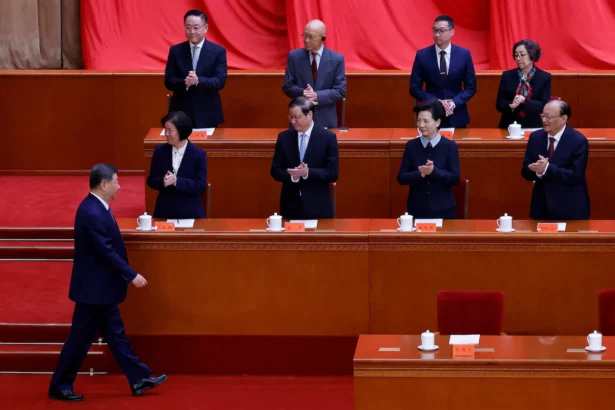
- Speaking at a ceremony in Beijing on Thursday to mark the 160th birth anniversary of revolutionary leader Sun Yat-sen, Xi described reunification as an enduring mission of the Communist Party of China.
- Xi also called on Chinese people, including those living in Taiwan, to oppose what Beijing describes as separatist activities and work towards peaceful relations across the Taiwan Strait.
BEIJING: Chinese President Xi Jinping has reaffirmed Beijing’s determination to achieve Taiwan’s reunification with mainland China, declaring that the process is an unavoidable historical goal that cannot be reversed.
Speaking at a ceremony in Beijing on Thursday to mark the 160th birth anniversary of revolutionary leader Sun Yat-sen, Xi described reunification as an enduring mission of the Communist Party of China.
“The tide of history cannot be stopped,” Xi said, adding that complete reunification of the motherland would eventually be achieved.
He reiterated China’s preference for a peaceful resolution based on the principle of “one country, two systems”, while expressing Beijing’s willingness to engage in dialogue with Taiwan under its one-China policy.
Xi also called on Chinese people, including those living in Taiwan, to oppose what Beijing describes as separatist activities and work towards peaceful relations across the Taiwan Strait.
China considers Taiwan part of its territory, although the island is governed independently and strongly rejects Beijing’s claim. The Chinese government has repeatedly proposed granting Taiwan autonomy under its one-country, two-systems framework, an arrangement rejected by major political parties on the island.
Although Xi did not mention military force in his latest remarks, Beijing has never ruled out using it to bring Taiwan under its control. Chinese military forces continue to operate around the island, maintaining pressure on Taipei.
The speech came ahead of next week’s Asia-Pacific Economic Cooperation (APEC) summit in Shenzhen, where Xi is expected to meet US President Donald Trump. It also preceded important local elections in Taiwan scheduled for later this month.
The anniversary event honoured Sun Yat-sen, who played a leading role in the 1911 revolution that ended China’s imperial monarchy and established the Republic of China.
Both Beijing and Taipei recognise Sun as an important historical figure, although they interpret his political legacy differently.
Xi praised Sun as a national hero and pioneer of China’s democratic revolution, highlighting his commitment to national unity and opposition to the country’s division.
In Taiwan, Sun is regarded as the father of the nation, and his portrait remains displayed in the presidential office.
Relations between Beijing and Taipei have remained strained under Taiwanese President Lai Ching-te, whose ruling Democratic Progressive Party supports the island’s separate identity.
China has repeatedly labelled Lai a separatist and refused to engage with his administration. Lai maintains that Taiwan’s future can only be decided by its people.
We welcome your contributions! Submit your blogs, opinion pieces, press releases, news story pitches, and news features to opinion@minutemirror.com.pk and minutemirrormail@gmail.com