Summary
- A separate PIDE analysis by economist Dr Shujaat Farooq has warned that Pakistan’s dependence on the Middle East for employment and remittances could become a major economic vulnerability during prolonged regional instability.
- According to the analysis, around 600,000 to 800,000 Pakistanis move to the Middle East for employment each year, while approximately six million Pakistanis currently work across the region.
- Farooq warned that a major regional conflict could prevent hundreds of thousands of Pakistanis from travelling to the Middle East for work while forcing a large number of existing workers to return home.
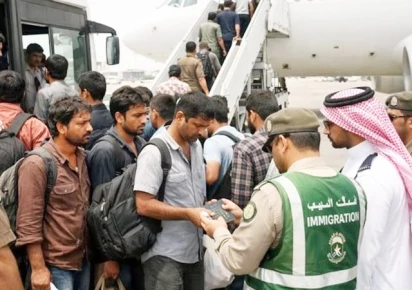
The deportation of nearly 22,000 Pakistanis from Gulf countries has renewed concerns over the country’s heavy dependence on overseas employment and remittances, with economists warning that policy changes and labour-market disruptions abroad could leave millions of families financially vulnerable.
Official figures presented in the National Assembly show that 21,951 Pakistanis were deported from Gulf states between March 1 and July 13, 2026. Saudi Arabia recorded the highest number with 15,495 deportations, followed by the United Arab Emirates with 3,803 and Oman with 1,606.
The deportations have not yet caused a significant decline in Pakistan’s overall remittance inflows. However, economists say the episode exposes a deeper structural weakness: Pakistan depends heavily on employment opportunities that are controlled by foreign governments and labour markets.
Economist Dr Abid Qaiyum Suleri said the direct financial impact of the UAE deportations remained relatively small. He estimated that the affected workers would have transferred around $42 million annually, representing less than 0.1% of Pakistan’s total remittances.
He said remittances remain highly valuable because they directly reach households, do not create public debt and do not require profit repatriation. However, excessive reliance on remittances becomes risky when they are used to compensate for weak exports, limited investment and inadequate domestic employment opportunities.
Pakistan received a record $41.6 billion in remittances during FY2026, exceeding its merchandise export earnings of $30.84 billion. Combined goods and services exports stood at around $40.88 billion.
Saudi Arabia and the UAE alone accounted for almost 45% of total remittance inflows, underlining the importance of the Gulf labour market to Pakistan’s economy.
Experts say the larger concern is not the immediate loss caused by deportations but the possibility of a broader disruption in Gulf employment.
Professor Dr Nasir Iqbal of the Pakistan Institute of Development Economics said unemployment, particularly among young Pakistanis, remains one of the main reasons workers seek employment overseas.
He argued that weak economic growth and declining real wages have made foreign employment increasingly attractive to young people. He also stressed that Pakistan should study future labour requirements in Gulf Cooperation Council countries and train workers according to those demands.
A separate PIDE analysis by economist Dr Shujaat Farooq has warned that Pakistan’s dependence on the Middle East for employment and remittances could become a major economic vulnerability during prolonged regional instability.
According to the analysis, around 600,000 to 800,000 Pakistanis move to the Middle East for employment each year, while approximately six million Pakistanis currently work across the region.
The Middle East contributes around 54% of Pakistan’s total remittance inflows, making any prolonged disruption in the region potentially significant for Pakistan’s economy.
Farooq warned that a major regional conflict could prevent hundreds of thousands of Pakistanis from travelling to the Middle East for work while forcing a large number of existing workers to return home. Such an outcome could place additional pressure on Pakistan’s already strained labour market.
The impact would likely be particularly severe in provinces such as Punjab and Khyber-Pakhtunkhwa, where a large number of overseas workers originate.
The analysis also estimated that a major disruption could reduce Pakistan’s annual remittances by $3 billion to $4 billion, potentially putting pressure on the exchange rate and worsening the current-account position.
The latest deportation figures also show a variety of reasons for workers being sent back. These include absconding, overstaying or illegal entry, jail cases, lost passports, blacklisting, drug-related cases and visa violations.
The largest category, listed as “other”, accounted for 6,662 cases, although the government has not publicly provided a detailed breakdown of these cases.
Officials have rejected the impression that Pakistanis are facing a blanket deportation campaign in the Gulf, maintaining that deportations are generally linked to violations of local laws and immigration regulations.
For individual workers, however, deportation can have severe economic consequences.
Sajid, a refrigeration technician from Karachi, travelled to Dubai in search of better earnings. After working there for several months, he lost his job following a dispute involving an air-conditioning system. The situation later resulted in his deportation.
Back in Karachi, he was forced to restart his search for employment, visiting shops and offering repair services to households.
His experience illustrates the difficult reality faced by workers who return without savings or alternative employment. A job that provided financial stability abroad can disappear suddenly, leaving the worker dependent on an already competitive domestic labour market.
Another Pakistani worker, Abdullah, had a different experience. After travelling to Dubai in search of employment, he returned home earlier than expected because of domestic circumstances. During his stay, he discovered an old glue-making machine, purchased it and brought it back to Pakistan.
He subsequently used the machine to establish a small business, turning his overseas experience into a source of income at home.
The contrasting experiences demonstrate that migration can create both risks and opportunities. While some workers return after losing their livelihoods, others bring back skills, ideas and equipment that can support entrepreneurship.
We welcome your contributions! Submit your blogs, opinion pieces, press releases, news story pitches, and news features to opinion@minutemirror.com.pk and minutemirrormail@gmail.com