Summary
- ‘Amaltas’ is a book of poetry written by Prof.
- Bilal has also written the introduction to the book, discussing the life and times of Prof.
- Ahmed’s poetry is also a kind of love poetry for his people, the “wretched of the earth, insulted and humiliated.” ‘Amaltas’ (Cassia fistula), also known as the Golden Shower Tree, is a beautiful flowering tree native to the Indian subcontinent.
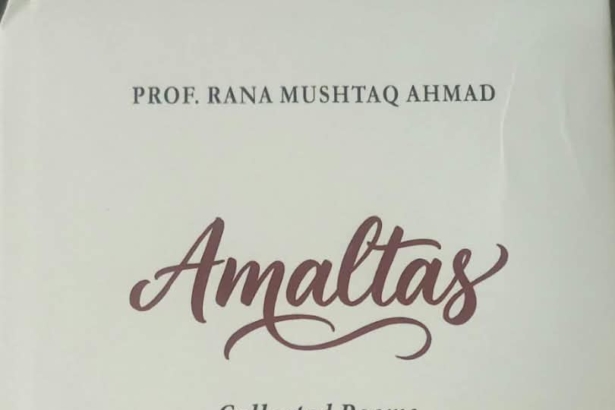
‘Amaltas’ is a book of poetry written by Prof. Rana Mustaq Ahmed, who completed his M.Sc in Zoology from Punjab University in 1963 and retired as Principal of Government College Gujjar Khan in 1998. He left this world in 1925. During his career, starting as a lecturer at Government College Lahore, he mostly served in Sahiwal, except for a five-year deputation in Nigeria beginning in 1978. Though born in Jalandhar, Punjab, India, in 1940, Sahiwal seemed to have become almost his hometown, as the book is also published there. The book has been very neatly produced and published. It is the labor of love of editors Prof. Muhammad Bilal Ashraf and Prof. Dr. Mirza Moeen ud Din, with special thanks given by Mian Muhammad Mansha and his wife, Razia Mansha.
Prof. Bilal has also written the introduction to the book, discussing the life and times of Prof. Ahmed in relation to his poetry. He summarizes his write-up:
“Ultimately, Amaltas is not just a book of verses; it is a profound reflection of a life well-lived, deeply observed, and bravely articulated. Through his diverse thematic segments and rich poetic techniques, Mushtaq Ahmad invites us to question societal norms, appreciate nature’s subtleties, and reflect on our shared human condition.”
This is true, but at the beginning of the introduction, Prof. Bilal’s ideas are debatable. He argues: “He is unlike the conventional Urdu and English poets of his era, as we do not find traces of platonic love, pangs of separation, nor the throbbing desires of meeting with the beloved.”
All poetry is love poetry, and our most reverent poet Faiz Ahmad Faiz is both a love poet and a revolutionary poet. Pablo Neruda’s love poems are often more loved than his political and revolutionary ones. It is another matter that you can write love poetry about your country and people. James Joyce, the famous Irish poet, said, “I write because I love my people.” So loving is good, and your beloved could be the revolution you want to bring. Ahmed’s poetry is also a kind of love poetry for his people, the “wretched of the earth, insulted and humiliated.”
‘Amaltas’ (Cassia fistula), also known as the Golden Shower Tree, is a beautiful flowering tree native to the Indian subcontinent. It is best known for its bright yellow flowers, which grow in long, hanging clusters and bloom during the summer. Amaltas is commonly planted along roadsides, parks, and gardens for its beauty and shade. It is also the national flower of Thailand, where it is a symbol of royalty and prosperity. When in bloom, its golden flowers make the tree a lovely sight, adding color to the summer landscape. Khushwant Singh, in his book ‘Nature Watch’ on Indian trees, beautifully describes Amaltas: “Then suddenly blossoms appear in clusters like bunches of golden grapes.”
Here, in this book, ‘Amaltas’ is a metaphor for people who bloom in a season which is not a season for blooming. It symbolizes the yearning of people whose times are untimely, their dreams, and their desire for change.
Consisting of 189 pages, the book has 106 poems about all sorts of themes. Almost all the poems are dated, starting from June 1993 to February 11, 2021. The title also mentions ‘collected poems,’ indicating that these are all of Ahmad’s poems. The poems capture the zeitgeist of his life and times. Though disciplined as a science student and educated as a zoologist, his love for poetry is unique. Immersed in his times, his understanding of his surroundings is that of a politically conscious being. Unlike typical progressives who seem to have no personal or existential crises, he has written poems about almost everything—low and high, minor and significant, common and extraordinary.
His political consciousness resists, opposes, and exposes the contradictions of a class-based society. His life spans the most eventful times of our country. He experienced the Punjab partition as a 10-year-old boy, which was one of the bloodiest and most violent phases of human history. He witnessed Ayub’s martial law, the mass movement against Ayub Khan, the fall of Dhaka, the rise and hanging of Z.A. Bhutto, Zia-ul-Haq’s unpopular and tyrannical regime, and finally General Musharraf’s pseudo ‘moderate enlightenment.’
He also wrote a love poem titled “Beloved Friend”:
‘’The day I spent with you
They are numbered and few
Yet from such a treasure
Any gadget cannot measure
Now in my twilight years
Memories flash to cheers
With nostalgia I see them
I wish never to pale them.’’
One of the most remarkable poems is about Zia-ul-Haq, titled “A Sentry”:
‘’A sentinel when becomes a ruler
Things fall apart much sooner.
Ahmed creatively uses the famous lines of W.B. Yeats:
“Things fall apart; the centre cannot hold;
Mere anarchy is loosed upon the world,”
and adds:
‘’A despot lone wrecks the state.’’
Then he writes:
“Then came over a ‘Saint General’
Brazenly committed treason
Product was he of US conspiracy
‘The Premier’ elected, he hanged
Got excused to ever be hanged.”
Writing about Pervez Musharraf in the same poem, he adds:
“Nine eleven came as a surprise
‘Master’s agenda, commando served
Aid in lieu of that deserved
Liberty we’ve lost, freedom too
The state has been made a colony, poo
The proxy war we go on fighting
Lethal fallouts we’re counting
The prophecy analysts have laid
But the sentry voices all along
Country’s defence is too strong
Still he has the face to thrust
Above all he keeps the country first.”
We cannot add more as Ahmad has expressed his thoughts creatively without becoming too loud or overly political. He remains a poet and says everything political and social through poetry.
There are also poems about Lady Diana, Gujjar Khan, Quaid-e-Azam, Lotay, Valentine’s Day, We Have Bombs, Eid Mubarak, Pakistan, Kashmir, the 21st Century, Fidel Castro, and Asma Jahangir.
The book is a kind of poetic critique of Pakistan’s 80-year journey, and Ahmad’s stance is people-oriented. Though written in English, the poems carry the ethos of the people emotionally, aesthetically, and intellectually.
Let us end with a very apt poem about the country that speaks loudest without tongue-in-cheek:
“O land of the blessed
Though obey no rule
The rich are free to loot
Virtue has lost ground
Viles’re heaped in a mound
Thou hast won a name
Deceit has all the gain
Kids are out of school
‘Paki’ stands for shame
When this is so
Can you make me know?
Where should I go?
I don’t wanna die
I wanna cry!!!”
Amaltas , Collected Poems
Prof: Rana Mushtaq Ahmad
Pages: 188
Price:Rs:2000
Anwar Sons Publishers, Sahiwal
Zubair Ahmad is a Lahore based Punjabi writer and columnist. He is poet, critic and fiction writer.
We welcome your contributions! Submit your blogs, opinion pieces, press releases, news story pitches, and news features to opinion@minutemirror.com.pk and minutemirrormail@gmail.com