Summary
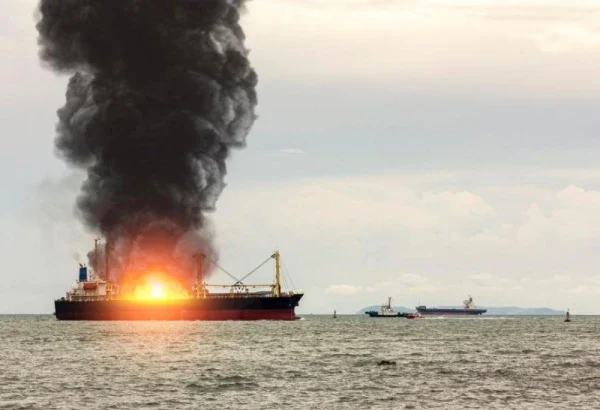
- TEHRAN: Tensions in the strategically vital Strait of Hormuz have escalated after Iran’s Islamic Revolutionary Guard Corps (IRGC) Navy claimed that another oil tanker struck a naval mine while attempting to pass through the waterway, triggering a major fire aboard the vessel.
- Iranian authorities presented the incident as another indication of the security risks facing commercial shipping in the Strait of Hormuz, where maritime movements have become increasingly sensitive amid escalating regional tensions.
- With details of the latest incident still emerging, uncertainty over maritime security in the Strait of Hormuz is likely to remain a major concern for international energy markets.
TEHRAN: Tensions in the strategically vital Strait of Hormuz have escalated after Iran’s Islamic Revolutionary Guard Corps (IRGC) Navy claimed that another oil tanker struck a naval mine while attempting to pass through the waterway, triggering a major fire aboard the vessel.
According to Iran’s state news agency IRNA, the incident occurred on Friday as the supertanker attempted to navigate the southern passage of the Strait of Hormuz, which Iranian authorities had declared an unauthorised route.
The IRGC Navy’s public relations department said the tanker was carrying more than two million barrels of crude oil when the incident took place. Iranian officials described it as the fourth incident of its kind involving vessels attempting to cross the strategically sensitive passage.
According to the Iranian military, the vessel had received repeated radio warnings against using the restricted route. However, the tanker allegedly ignored the warnings and continued its journey before striking a naval mine.
The collision reportedly caused a powerful explosion, followed by a fire that engulfed parts of the vessel.
Iranian authorities presented the incident as another indication of the security risks facing commercial shipping in the Strait of Hormuz, where maritime movements have become increasingly sensitive amid escalating regional tensions.
However, the reported incident has not been independently verified. The tanker’s identity, its ownership, the condition of its crew and the extent of the damage remained unclear in the immediate aftermath.
The latest development has raised fresh concerns about the safety of international shipping through one of the world’s most important energy corridors.
The Strait of Hormuz connects the Persian Gulf with the Gulf of Oman and the Arabian Sea, serving as a critical route for oil exports from major energy-producing countries in the Middle East.
Millions of barrels of crude oil pass through the narrow waterway, making it essential to global energy supplies. Any disruption to shipping operations in the area can have far-reaching consequences for international markets, fuel prices and energy security.
The reported mine strike could further intensify concerns among shipping companies and energy traders already monitoring the security situation in the region.
Naval mines and attacks on commercial vessels pose significant risks to oil tankers, potentially disrupting supply chains and increasing transportation and insurance costs.
With details of the latest incident still emerging, uncertainty over maritime security in the Strait of Hormuz is likely to remain a major concern for international energy markets.
We welcome your contributions! Submit your blogs, opinion pieces, press releases, news story pitches, and news features to opinion@minutemirror.com.pk and minutemirrormail@gmail.com