Summary
- NEW YORK: Argentina’s thrilling victory over England in the FIFA World Cup 2026 semi-final has been overshadowed by fresh controversy, with reports suggesting the entire squad could face disciplinary scrutiny after two players celebrated with a politically charged banner.
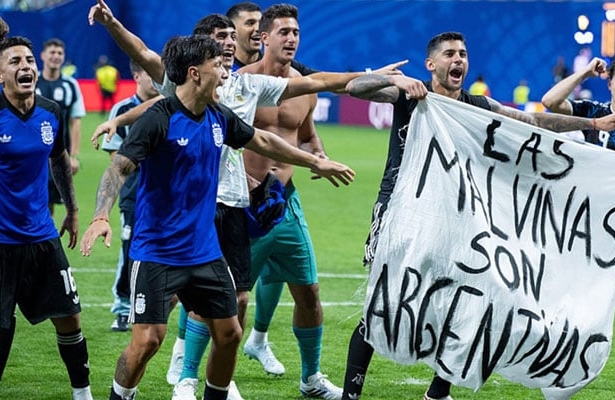
- Moments after Argentina’s dramatic 2-1 comeback victory, midfielder Giovani Lo Celso and defender Nicolás Otamendi were seen holding a banner reading, “Malvinas are part of Argentina,” sparking debate over whether the display breached FIFA regulations on political messages during official matches.
- The latest controversy comes at a crucial moment for Argentina, which has just secured a place in the FIFA World Cup 2026 final after eliminating England in dramatic fashion.
NEW YORK: Argentina’s thrilling victory over England in the FIFA World Cup 2026 semi-final has been overshadowed by fresh controversy, with reports suggesting the entire squad could face disciplinary scrutiny after two players celebrated with a politically charged banner.
Moments after Argentina’s dramatic 2-1 comeback victory, midfielder Giovani Lo Celso and defender Nicolás Otamendi were seen holding a banner reading, “Malvinas are part of Argentina,” sparking debate over whether the display breached FIFA regulations on political messages during official matches.
The banner refers to the Falkland Islands, known in Argentina as the Malvinas, a territory whose sovereignty has long been disputed between Argentina and the United Kingdom.
According to international media reports, FIFA and the International Football Association Board (IFAB) prohibit the display of political slogans, symbols or banners during matches and official celebrations. If the governing body determines that the incident violated its disciplinary code, sanctions ranging from warnings to fines or other disciplinary measures could follow.
FIFA has not publicly announced whether a formal investigation has been opened.
The controversy intensified after Argentina’s Vice President Victoria Villarruel voiced her support for the message on social media.
Responding to the incident, she wrote, “The Malvinas belong to Argentina.” She also claimed the banner had initially been prevented from entering the stadium, adding that the issue remains deeply rooted in Argentina’s national identity.
Her comments quickly fueled discussion online, with supporters and critics debating whether political expressions should have a place in international sporting events.
The dispute over the Falkland Islands dates back nearly two centuries. The South Atlantic archipelago, located about 480 kilometers off Argentina’s eastern coast, has been under British administration for many years, while Argentina continues to claim sovereignty over the territory.
The disagreement escalated into armed conflict in 1982, when Argentina’s military government invaded the islands, triggering the Falklands War. The conflict lasted from April 2 to June 14, ending with Argentina’s surrender.
According to historical records, the war claimed the lives of 649 Argentine military personnel, 255 British service members, and three civilians, leaving a lasting impact on both nations.
The latest controversy comes at a crucial moment for Argentina, which has just secured a place in the FIFA World Cup 2026 final after eliminating England in dramatic fashion.
While fans continue celebrating the team’s remarkable achievement on the field, attention has now shifted to whether FIFA will take disciplinary action over the post-match banner, adding another chapter to the long-running intersection of football and politics.
We welcome your contributions! Submit your blogs, opinion pieces, press releases, news story pitches, and news features to opinion@minutemirror.com.pk and minutemirrormail@gmail.com