Summary
- Food in destitution, essential healthcare, basic education, protection of children without support, disability assistance and temporary subsistence during involuntary unemployment should become matters of entitlement under transparent criteria, not favours obtained through political access.
- A truly Islamic polity is not one in which rulers become generous distributors of charity.
- It is one in which citizens do not require the ruler’s favour to eat, study, receive treatment, work or recover from misfortune.
The preceding part of this series ended with a limit that productive finance cannot cross. Illness, unemployment, education, disability, orphanhood and temporary distress cannot always be converted into profitable investments. Human vulnerability itself cannot become another financial product. That is where a riba-free order must move beyond banking.
A society may successfully redesign murabaha, musharakah, salam or ijarah and still remain unjust if a family facing cancer treatment must borrow at any cost, a student must enter adult life under debt, or a widow depends upon a local patron for survival. Prohibition of riba becomes socially meaningful only when basic human need is protected from financial extraction.
Pakistan does not have to invent the institutional vocabulary from zero. It already has Pakistan Bait-ul-Mal, established under the Pakistan Bait-ul-Mal Act, 1991. Its official mandate includes assistance to the destitute, widows, orphans, persons with disabilities and other needy citizens, with support extending to medical treatment, education and rehabilitation. Its official position is that assistance is available to the poorest without differentiation of religion, creed, sect or region.
This is an important foundation. It is not yet the structure required for a just financial order. Bait-ul-Mal should cease to be understood primarily as an agency dispensing discretionary relief to the “poorest of the poor”. Its larger purpose should be to guarantee a legally defined social floor.
Food in destitution, essential healthcare, basic education, protection of children without support, disability assistance and temporary subsistence during involuntary unemployment should become matters of entitlement under transparent criteria, not favours obtained through political access. This distinction is fundamental.
Charity depends upon the generosity of the giver. Entitlement rests upon the responsibility of society. It is one of the most emphasised Quranic directive on this idea. The directions given in the holy Quran need not be accepted in totality. This principle is accepted in all the classical juristic traditions. The practical discussion on this is important.
In the transitional phase, all the scholarly works envisage gradual movement rather than an overnight abolition of existing economic arrangements. Individuals progressively devote more of their resources to collective purposes while organised society assumes responsibility for the basic necessities of life.
The transition, in any pragmatic scheme, is institutional rather than merely charitable. That insight deserves attention. An Islamic polity cannot measure success by the number of ration bags distributed after deprivation has occurred. Its test is whether institutions progressively remove the conditions that force citizens into dependence upon creditors, property owners, political patrons or charitable intermediaries. Bait-ul-Mal should therefore form the first pillar of social finance: the guarantee against destitution.
The second should be waqf. Waqf historically converted wealth into enduring social capital. Whatever the juristic differences concerning its precise legal character, its institutional genius lies in removing an asset from ordinary private consumption and dedicating its benefit to a continuing purpose.
Land, buildings and income-producing properties can support hospitals, schools, hostels, water systems, vocational institutions, research centres, shelters and community infrastructure across generations.
Pakistan already possesses statutory waqf institutions. Punjab’s Auqaf Department, for example, operates under the Punjab Waqf Properties Ordinance, 1979, for the administration and regulation of waqf properties. Income arising from properties under its control is credited to the Auqaf Fund under the statutory framework. The potential is much larger than administration of shrines and mosques.
Pakistan should develop professionally governed public waqf institutions—waqf lillah—at national, provincial and local levels. Public land lawfully dedicated for community benefit, voluntarily endowed private property and other permissible assets could constitute permanent pools of social capital. Their corpus should remain protected while their income finances clearly defined public purposes.
This cannot become another avenue for bureaucratic or political capture. Every waqf property should be digitally registered. Its title, purpose, valuation, income, expenditure and beneficiaries should be publicly accessible.
Independent audit, professional management and strict conflict-of-interest rules are indispensable. No minister, shrine manager, political family or local notable should be able to convert property dedicated for public benefit into an instrument of patronage.
The third pillar is zakat. It should remain distinct from both the ordinary budget and waqf. Its compulsory redistributive character and specified purposes give it an institutional identity of its own. Combining every form of social finance into one government account would destroy these distinctions.
The fourth pillar is qard hasan. Not every person requiring temporary liquidity is destitute. A worker may face a medical emergency. A small farmer may need funds after a flood. A graduate may require equipment to begin earning. A household may need a short bridge between unemployment and a new job. Such circumstances do not necessarily call for a grant. They require finance without extraction.
Revolving qard hasan funds administered through Bait-ul-Mal, public waqf institutions and local cooperatives could provide precisely that bridge. Principal would return when the recipient regains capacity, allowing the same pool to assist another household. The institution earns no commercial return from distress; society recycles solidarity.
This connects directly with the cooperative model discussed in Part IV. The ultimate objective cannot be to create permanent classes of beneficiaries. Social protection should lead towards economic agency.
A citizen receiving emergency assistance today should, wherever possible, become tomorrow’s producer, saver and member of a cooperative financial institution. Bait-ul-Mal prevents collapse. Waqf creates enduring social assets. Qard hasan provides a bridge back to economic activity. Cooperatives enable citizens to pool savings, own institutions and finance one another.
These mechanisms should operate together rather than as isolated schemes. The structure can be visualised as a ladder. At its base is an enforceable social floor below which no citizen is allowed to fall. Above it are education, healthcare and skills supported partly through public waqf. Temporary setbacks are met through qard hasan. Productive citizens then move towards cooperative and commercial risk-sharing finance of the kind discussed in Part IV.
The direction is from dependency to capability, not from one form of dependency to another. Governance will determine whether this succeeds. Pakistan has repeatedly created institutions in the name of disadvantaged citizens and then allowed access, appointments and resources to be mediated by power. A Quranic economic order cannot reproduce that arrangement with Islamic terminology.
Beneficiary selection must be rules-based and digitally verifiable. Accounts must be public. Assets must be mapped. Independent audits should be mandatory. Local citizen representation should accompany professional management. Federal, provincial and municipal responsibilities must be clearly divided.
The Islamic character of such an order would lie not in the names of institutions but in their consequences. A child should not remain uneducated because his father is poor. A patient should not sell the family home to obtain essential treatment. An orphan should not require a patron. A widow should not surrender dignity for subsistence. A farmer hit by an exceptional calamity should not enter a debt spiral from which his family cannot escape.
A society that prevents these outcomes attacks riba at its social source. This is the larger point often missed in debates about Islamic finance. Riba does not flourish merely because lenders seek returns. It flourishes also because borrowers are frequently compelled by need. Reforming the creditor while leaving the compulsion untouched addresses only half the problem.
The alternative requires both sides of the structure developed in this series: productive finance based upon ownership, service and genuine risk; and social finance that removes essential human needs from the market for guaranteed financial returns.
A truly Islamic polity is not one in which rulers become generous distributors of charity. It is one in which citizens do not require the ruler’s favour to eat, study, receive treatment, work or recover from misfortune.
Part VI will bring these strands together and ask the final question: how can Pakistan move from judicial declarations and Islamic-banking conversion to a phased, enforceable Prohibition of Riba law [Who will draft Riba Prohibition Law? Minute Mirror, April 7, 2026] covering banking, public debt, monetary operations, productive and social finance, and the transition itself?
[To be continued]
_______________________________________________________________________
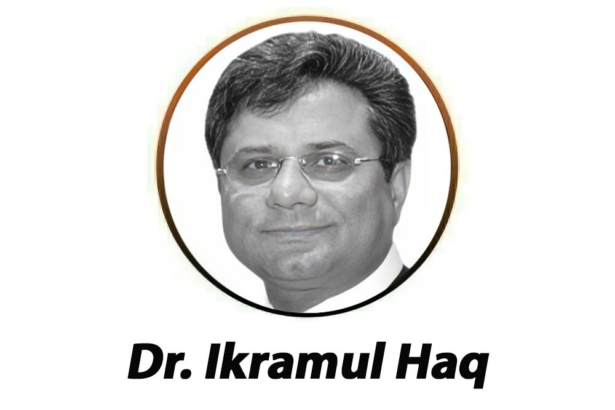
Dr. Ikramul Haq, Advocate Supreme Court, Adjunct Faculty at Lahore University of Management Sciences (LUMS), member Advisory Board and Visiting Senior Fellow of Pakistan Institute of Development Economics (PIDE), holds an LLD in tax laws. He was full-time journalist from 1979 to 1984 with Viewpoint and Dawn. He also served Civil Services of Pakistan from 1984 to 1996.
We welcome your contributions! Submit your blogs, opinion pieces, press releases, news story pitches, and news features to opinion@minutemirror.com.pk and minutemirrormail@gmail.com