Summary
- Islamabad: Students affected by the Cambridge examination paper leak controversy have announced a protest outside the IBCC office Islamabad on Wednesday, August 12, saying they have been left with no option but to take their fight to the streets after a key meeting meant to discuss their evidence was postponed until after the results.
- The group said Cambridge officials had also pulled out of an important meeting shortly before the results, ending what students described as their last major chance to settle the matter before grades were announced.
- The group said students had waited long enough and wanted Cambridge, IBCC and other institutions to understand that the voices of students could not simply be ignored.
Islamabad: Students affected by the Cambridge examination paper leak controversy have announced a protest outside the IBCC office Islamabad on Wednesday, August 12, saying they have been left with no option but to take their fight to the streets after a key meeting meant to discuss their evidence was postponed until after the results.
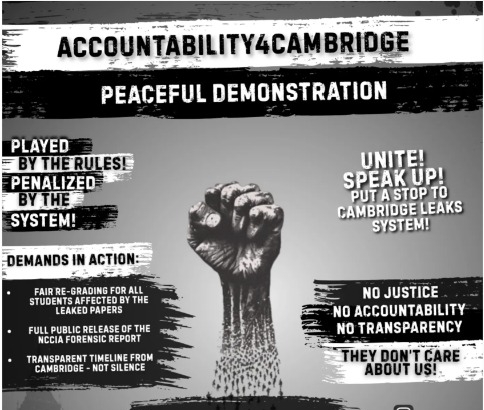
The protest has been called by Accountability4Cambridge, a student led movement campaigning over alleged leaks of Cambridge O Level and A Level examination papers during the June 2026 examination series. They said they had spent months collecting evidence, meeting government bodies and trying to get action before the results, but claimed their main meeting was postponed at the last stage.
It said the meeting was important because students planned to present findings and evidence connected with the National Cyber Crime Investigation Agency investigation. According to Accountability4Cambridge, it had already met officials including representatives of the IBCC and the British Council, but the latest meeting was postponed without a clear reason.
The group said Cambridge officials had also pulled out of an important meeting shortly before the results, ending what students described as their last major chance to settle the matter before grades were announced. The students have now called for what they describe as a peaceful demonstration outside the IBCC office.
The group said students had waited long enough and wanted Cambridge, IBCC and other institutions to understand that the voices of students could not simply be ignored. The protest call comes as new forensic findings from the NCCIA add another layer to the controversy.
A July 31 report from the National Cyber Crime Investigation Agency examined digital evidence submitted in connection with 13 disputed Cambridge examination components. The NCCIA forensic laboratory examined 24 files stored on a USB drive. According to the report, investigators found no evidence of artificial video editing, splicing, frame addition or cropping in the 24 files they examined.
However, the findings did not establish who originally leaked the examination papers. NCCIA said the videos had been shared through social media services including WhatsApp, Discord, Reddit and Telegram. Because the videos were shared through social media services, including WhatsApp, Discord, Reddit, and Telegram, important information about the original recording devices was removed.
This meant investigators could not confirm the make, model or serial number of the phones or devices that first created the Leaks. The agency also said the exact recording times could not be confirmed from the media files alone. To establish those details, investigators would need physical access to the original devices.
This is an important part of the case because the students say the evidence that examination material was circulating before papers were officially held. The NCCIA report confirmed that the files showed no signs of artificial manipulation, but it also made clear that the digital evidence alone could not legally identify the original person responsible for the leaks.
The agency found what it called double encoding in material linked to Chemistry A Level 9701/21 and IGCSE Physics. Simply put, investigators found signs that some material had been recorded from another screen before being shared again. The agency stated this indicated the circulating videos were secondary recordings rather than recordings made directly at the alleged leak’s original source.
NCCIA also found foreign time zone information and other indicators in some Physics and Sociology material. The report suggested this could indicate that some material first appeared outside Pakistan before being shared online. However, the agency did not identify the final source of the leak.
It said physical seizure and examination of the original recording devices would be necessary to meet the level of evidence required for prosecution or disciplinary action. Accountability4Cambridge has presented the forensic report as an important development in its campaign.
The group says the findings support its position that the submitted leaks were genuine rather than artificially created or edited. At the same time, the NCCIA itself stopped short of confirming when the material was originally recorded, who recorded it or who first leaked the examination papers.
The protest is also linked to anger over Cambridge’s handling of Mathematics A Level S1, also referred to as Paper 5 of syllabus 9709. According to material shared by campaigners, Cambridge had earlier said the paper had been exposed prematurely and that assessed grades would be used.
However, students and teachers later criticised a reported decision to mark candidates’ original scripts instead. Critics argued that even if leaked material reached only a limited number of students, those students could still gain an unfair advantage over candidates who sat the paper honestly.
They said a leak does not become harmless simply because the material may not have reached thousands of students. Students fear that those who saw the questions early could score unusually high marks, which could affect grading and disadvantage honest candidates.
The controversy has caused particular concern because Cambridge results can affect university admissions, scholarships and future education plans in Pakistan and abroad. Some campaigners also criticised schools and colleges for not speaking strongly enough when the alleged leaks were first being reported.
They argued that major schools have direct communication channels with Cambridge and should have raised the issue much earlier on behalf of their students. Critics said statements issued only a few days before results would not solve the problem.
They also demanded guarantees that similar incidents would not happen again when students entering A Level or moving from AS to A2 sit their examinations next year. The controversy has also started a wider discussion over whether students in Pakistan should continue depending so heavily on Cambridge examinations.
Accountability4Cambridge says its main aim is not hostility towards Cambridge. The movement wants transparency, accountability, fair treatment and compensation for affected students. The group says it has approached senators, parliamentary committees, education authorities and other stakeholders to keep the issue alive.
The latest protest call follows months of complaints over the June 2026 examination series. Accountability4Cambridge says the August 12 protest is intended to increase pressure before its expected meeting with senior Cambridge officials.
The campaigners believe action can still be taken even after results are issued. They pointed to events in 2020, claiming that student concerns and protests were followed by changes after results had already been announced.
Whether similar relief will be offered in the present controversy remains unclear. For now, students are preparing to gather outside the IBCC in Islamabad with one central demand.
We welcome your contributions! Submit your blogs, opinion pieces, press releases, news story pitches, and news features to opinion@minutemirror.com.pk and minutemirrormail@gmail.com