Summary
- OTTAWA: Canada has announced plans to impose new tariffs on a range of American products in response to steep duties introduced by US President Donald Trump on Canadian goods, marking another sharp deterioration in trade relations between the two North American neighbours.
- Carney vows to defend Canadian economy Speaking at a press conference in Ottawa, Carney said Canada would respond to the US measures in an effort to shield workers, farmers, businesses and families from the economic impact of the new duties.
- New US duties affect key Canadian exports The latest US tariffs apply to a range of Canadian exports, including wine, furniture, dairy products, cement, clothing, fishing equipment and hockey-related products.
OTTAWA: Canada has announced plans to impose new tariffs on a range of American products in response to steep duties introduced by US President Donald Trump on Canadian goods,
marking another sharp deterioration in trade relations between the two North American neighbours.
Prime Minister Mark Carney said on Saturday that Canada would adopt a “dollar-for-dollar” approach to Washington’s latest tariffs. The retaliatory measures are scheduled to take effect on September 8 and will cover products including US steel, electronics, appliances, agricultural equipment, pulp and paper and other goods.
The announcement came after three days of intensive negotiations between Canadian and US officials ended without a trade agreement. Both sides blamed the other for the failure to reach a breakthrough, raising fresh uncertainty over the future of the United States-Mexico-Canada trade framework.
Carney vows to defend Canadian economy
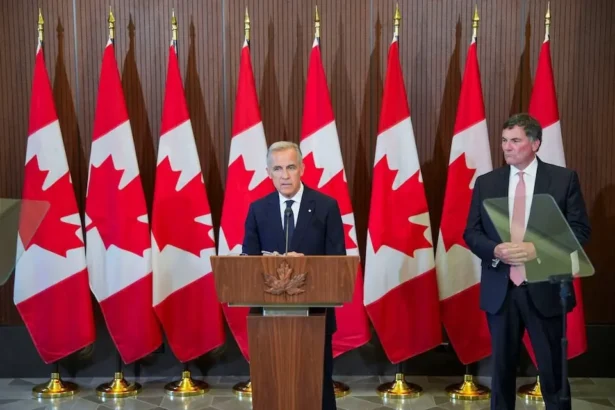
Speaking at a press conference in Ottawa, Carney said Canada would respond to the US measures in an effort to shield workers, farmers, businesses and families from the economic impact of the new duties.
Asked whether the dispute had effectively developed into a trade war, Carney responded in stark terms, saying Canada had been attacked and therefore had to defend its economic interests.
The Canadian government said its countermeasures would target a broad selection of US products. Further details, including the specific goods affected and the tariff rates, are expected to be announced in the coming days.
Carney also indicated that Ottawa would introduce support programmes for Canadian industries affected by the American duties. The assistance could remain in place for several years depending on the impact of the trade measures.
US-Canada negotiations break down
The latest dispute follows the collapse of negotiations that had been viewed as an opportunity to prevent a further escalation in tariffs.
US Trade Representative Jamieson Greer described the failed talks as a missed opportunity for Canada and said Washington would proceed with measures responding to Canadian retaliation. He also suggested that no fresh negotiations were immediately planned.
The White House and offices representing the US commerce secretary and trade representative did not immediately issue a detailed response to Canada’s announcement.
The breakdown has created additional uncertainty for businesses operating across the US-Canada border, particularly industries that depend heavily on integrated North American supply chains.
New US duties affect key Canadian exports
The latest US tariffs apply to a range of Canadian exports, including wine, furniture, dairy products, cement, clothing, fishing equipment and hockey-related products.
According to the Canadian government, the new duties affect approximately $20 billion worth of Canadian exports to the United States. Unlike some previous measures, the latest tariffs do not fully exempt products traded under the existing North American trade agreement.
The new duties represent a relatively small share of Canada’s overall exports to the US, but officials and industry representatives warn that individual sectors could face significant pressure.
Industries such as softwood lumber, wine, manufacturing and other export-oriented businesses could experience weaker demand, higher costs and potential employment losses if the dispute continues.
Candace Laing, chief executive of the Canadian Chamber of Commerce, urged companies across the country to prepare for a prolonged period of uncertainty.
Dispute over vehicles and trade conditions
One of the most difficult issues during the negotiations involved the treatment of larger vehicles.
Canadian negotiators reportedly sought to extend preferential tariff arrangements for light-duty vehicles to medium- and heavy-duty trucks. Washington opposed the proposal, according to people familiar with the negotiations.
Carney said the US position could have placed Canadian-made models at a competitive disadvantage. He specifically pointed to vehicles produced in Canada, including Ford’s F-350, F-450 and F-550 trucks and General Motors’ Silverado.
The Canadian prime minister also said some US proposals touched on issues involving Canadian culture, language and sovereignty, although he did not provide further details.
Ontario backs Ottawa’s position
Ontario Premier Doug Ford, a prominent critic of US tariffs, welcomed Carney’s decision to reject what he described as an unfavourable agreement.
Ford said the proposed terms would have harmed Ontario’s automotive, steel and manufacturing industries, adding that he supported Ottawa’s decision to retaliate rather than accept a deal that he considered damaging to the province.
Ontario is particularly exposed to disruptions in US-Canada trade because of its large manufacturing and automotive sectors and its close integration with American supply chains.
Canada seeks new international partnerships
The escalating dispute also comes as Canada seeks to reduce its economic dependence on the United States.
Nearly 70% of Canadian exports are destined for the US market, making the country particularly vulnerable to changes in American trade policy. Carney has nevertheless pledged to strengthen Canada’s relationships with other countries and explore new trade and security partnerships.
The prime minister was elected on a platform that included a tougher negotiating stance toward the Trump administration. His government has maintained that Canada should defend its economic interests while looking for opportunities to expand trade beyond its southern neighbour.
Public opinion has also strengthened Ottawa’s position, with polling indicating that many Canadians oppose making major concessions to Washington.
Conservative Party leader Pierre Poilievre, who leads the federal opposition, also called for national unity in response to the US tariffs.
We welcome your contributions! Submit your blogs, opinion pieces, press releases, news story pitches, and news features to opinion@minutemirror.com.pk and minutemirrormail@gmail.com