Summary
- The partial lunar eclipse reaches its peak at 5:12am local time, when nearly 90 percent of the Moon’s surface will be covered by Earth’s shadow.
- While it will not be a total eclipse, a significant portion of the lunar surface will still pass through Earth’s shadow.
- Since it is only a partial eclipse, some part of the Moon will remain untouched by shadow throughout the event.
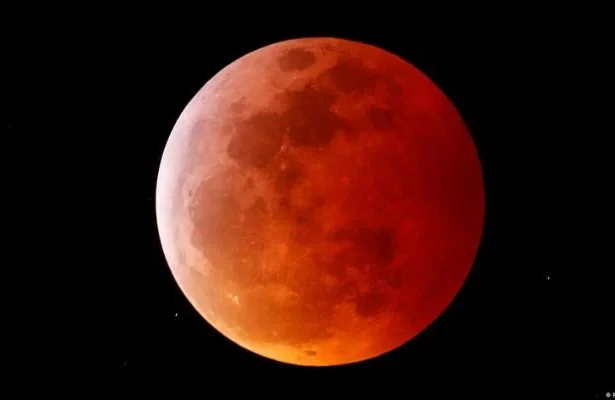
Early risers are in for a treat this week. A Blood Moon will appear in the sky on 28 August, though anyone hoping to see it will need to set an alarm well before dawn. The partial lunar eclipse reaches its peak at 5:12am local time, when nearly 90 percent of the Moon’s surface will be covered by Earth’s shadow.
This event coincides with August’s full Moon, often referred to as the Sturgeon Moon. While it will not be a total eclipse, a significant portion of the lunar surface will still pass through Earth’s shadow. During this phase, the Moon can take on a reddish glow, which is why the event has earned the popular nickname “Blood Moon.”
The eclipse officially begins at 3:33am and builds up toward its peak roughly ninety minutes later. Since it is only a partial eclipse, some part of the Moon will remain untouched by shadow throughout the event. Still, the visible portion will shift toward a coppery, reddish tone as the eclipse progresses.
That reddish colour comes down to simple physics. Sunlight passing through Earth’s atmosphere gets filtered before it reaches the Moon. Blue light, which has a shorter wavelength, scatters easily and gets blocked out, while red and orange light travels further and reaches the lunar surface. This filtering effect is what gives the Moon its dramatic, blood-like hue during the eclipse.
The good news for skywatchers is that no special gear is required. A telescope is not needed, nor is any other specialised equipment. The main challenge will be location. Viewers should look for a spot with a clear, unobstructed view toward the south-west, since the Moon will be sitting low near the horizon during the event.
Because of its low position, taller structures and trees could block the view in some areas. On the bright side, the Moon’s low angle may also create an optical illusion that makes it appear unusually large.
Lunar eclipses like this one occur more frequently than solar eclipses, but they still require a precise alignment between the Sun, Earth, and Moon to take place.
We welcome your contributions! Submit your blogs, opinion pieces, press releases, news story pitches, and news features to opinion@minutemirror.com.pk and minutemirrormail@gmail.com