Summary
- China is increasingly concerned that advances in US artificial intelligence could allow American forces to locate and target its nuclear missile systems more efficiently potentially weakening Beijing’s ability to retaliate in the event of a nuclear attack according to a report by The New York Times.
- The newspaper’s chief China correspondent, Chris Buckley reviewed more than 100 recent studies by Chinese military and civilian researchers and spoke with experts and former US officials to examine Beijing’s concerns.
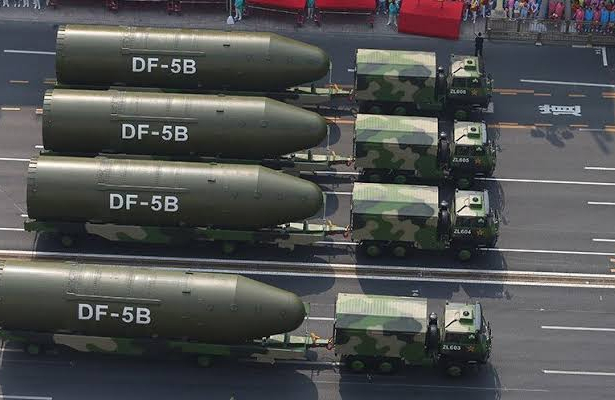
- According to the report, China fears that the use of AI to analyse intelligence and surveillance data, track military assets and support precision strikes could enable US forces to identify, follow and target Chinese mobile missile launchers much faster than human operators.
China is increasingly concerned that advances in US artificial intelligence could allow American forces to locate and target its nuclear missile systems more efficiently potentially weakening Beijing’s ability to retaliate in the event of a nuclear attack according to a report by The New York Times.
According to the report, China fears that the use of AI to analyse intelligence and surveillance data, track military assets and support precision strikes could enable US forces to identify, follow and target Chinese mobile missile launchers much faster than human operators.
Two researchers at China’s Academy of Military Sciences reportedly warned that integrating AI and related technologies into nuclear decision-making systems could reduce the traditional decision-making process from 15 to 30 minutes to just 90 seconds or less.
Gerald C. Brown, a former US State Department analyst who studied China’s nuclear strategy told the newspaper that Chinese researchers believe AI could make it significantly harder to protect nuclear weapons from enemy attacks.
Citing estimates by the Federation of American Scientists, the report said China currently possesses around 620 nuclear warheads, a figure projected to approach 1,000 by 2030. The United States and Russia each have approximately 1,800 warheads.
Beijing has reportedly taken several steps to improve the survivability of its nuclear forces. These include dispersing military assets across different locations, constructing around 320 underground missile silos in northern desert regions and testing a submarine-launched long-range missile in July.
At the same time, Chinese researchers and the People’s Liberation Army Rocket Force are examining ways to incorporate AI into their own military systems. These include technologies intended to help hypersonic and ballistic missiles alter their flight paths and evade missile defence systems.
However, some Chinese military studies have also raised concerns about the dangers of relying on AI-generated information. They warn that inaccurate or exaggerated data could create serious decision-making risks within military command-and-control systems.
Philip Reiner of the Institute for Security and Technology pointed out that although final authority to launch missiles has not been handed over to AI, the technology is increasingly being used to organise and assess information relevant to decisions about whether to launch an attack.
The findings highlight growing concerns in Beijing that advances in artificial intelligence could reshape nuclear deterrence and increase pressure on countries to make critical military decisions within increasingly shorter timeframes.
We welcome your contributions! Submit your blogs, opinion pieces, press releases, news story pitches, and news features to opinion@minutemirror.com.pk and minutemirrormail@gmail.com