


Summary
- SHENZHEN: Chinese robotics startup DexForce is betting that training humanoid robots in virtual environments could dramatically reduce development costs and accelerate the arrival of machines capable of performing complex tasks in the real world.
- The Shenzhen-based company is using artificial intelligence (AI) software to teach robots how to handle objects, navigate environments and complete industrial tasks through computer-generated simulations rather than relying entirely on expensive, time-consuming real-world training.
- Physical artificial general intelligence refers to the potential ability of robots to understand unfamiliar environments, adapt to changing conditions and complete new tasks when instructed.
SHENZHEN: Chinese robotics startup DexForce is betting that training humanoid robots in virtual environments could dramatically reduce development costs and accelerate the arrival of machines capable of performing complex tasks in the real world.
The Shenzhen-based company is using artificial intelligence (AI) software to teach robots how to handle objects, navigate environments and complete industrial tasks through computer-generated simulations rather than relying entirely on expensive, time-consuming real-world training.
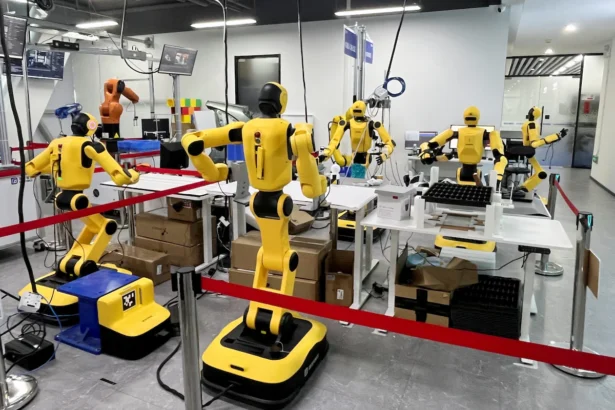
At DexForce’s headquarters, virtual robots can be seen repeatedly arranging objects on a table while the software changes the position of their arms, the colour of the surface and the objects involved. The process helps train machines to adapt to different situations before they encounter them in physical workplaces.
The approach targets one of the biggest challenges facing the humanoid robotics industry: developing machines that can reliably perform useful work in factories, offices and homes without constant human assistance.
Although Chinese companies have produced humanoid robots capable of impressive physical feats, including running and jumping, turning those demonstrations into dependable commercial applications remains a major hurdle.
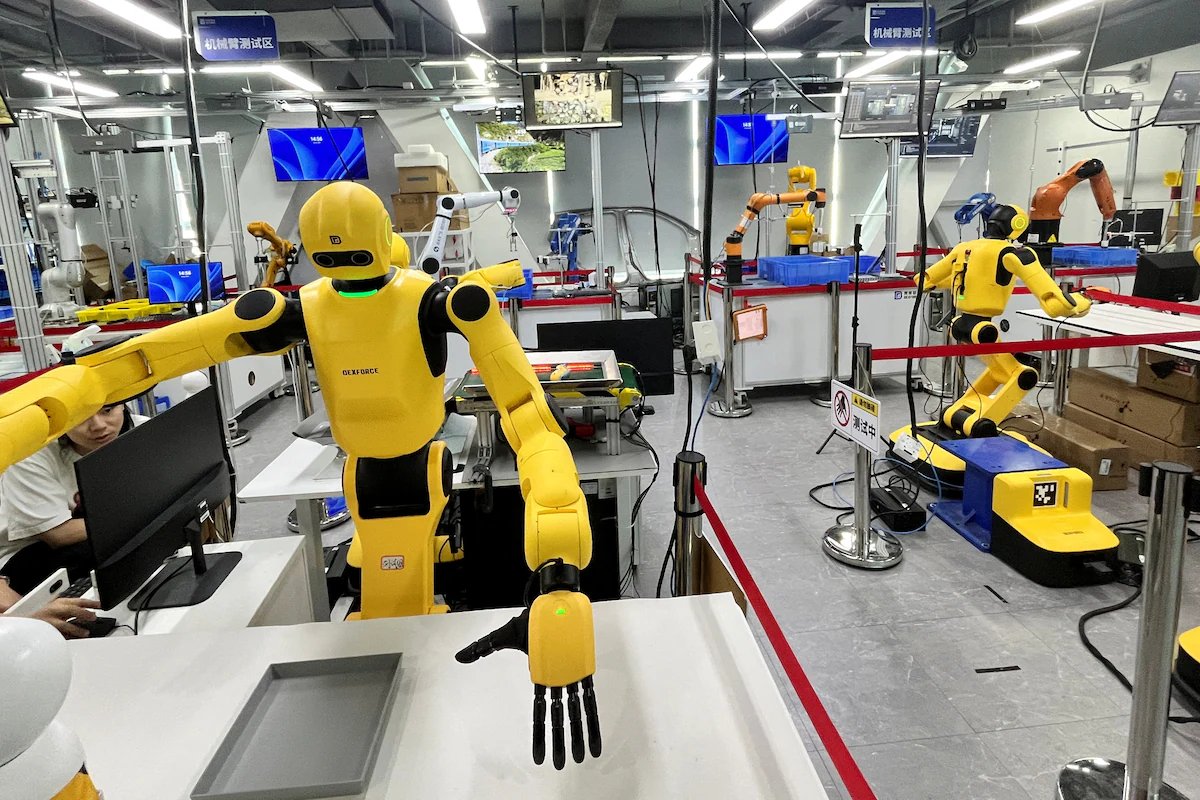
DexForce Chief Executive Jia Kui believes simulated training could help overcome that challenge and deliver a breakthrough comparable to the impact ChatGPT had on generative AI after its release in 2022.
“Trying to achieve ‘physical artificial general intelligence’ purely through real-world data collection would require 10 trillion samples,” Jia told Reuters, arguing that manually collecting examples for an unlimited range of human tasks is fundamentally inefficient.
Physical artificial general intelligence refers to the potential ability of robots to understand unfamiliar environments, adapt to changing conditions and complete new tasks when instructed.
From virtual simulations to real-world tasks
DexForce develops software that recreates physical environments digitally and models how objects move and interact. Robots learn through these simulations, with the resulting skills then transferred to physical machines.
The company says this method can be faster and cheaper than relying on human trainers to demonstrate the same movements repeatedly. In conventional training programmes, workers may need to repeat an action more than 100 times to generate sufficiently precise examples.
Many Chinese robotics manufacturers combine simulated training with real-world data collection, but access to high-quality training information remains a significant industry challenge.
Across China, dozens of robot-training centres are being developed at considerable expense, with some heavily dependent on government subsidies.
DexForce hopes its software-driven approach will help companies reduce their reliance on these costly facilities while improving robots’ ability to handle variations in their surroundings.
Major investors back robotics ambitions
Founded in 2021 by Jia, a machine-learning professor at the Chinese University of Hong Kong, Shenzhen, DexForce employs around 500 people.
The startup is backed by Lenovo Capital, the investment arm of Lenovo, Lens Technology and several state-owned funds. It recently raised 1 billion yuan, equivalent to approximately $147 million, in a Series B funding round that valued the company at more than 10 billion yuan.
Bloomberg has reported that DexForce was considering a Hong Kong initial public offering, although Jia declined to comment on the report.
The company’s software is already being used in industrial settings by manufacturers including Toyota, Samsung, Panasonic, Foxconn, Haier and Hisense.
Meanwhile, DexForce humanoid robots are being deployed to make coffee and serve customers at shopping malls and tourist attractions in more than 15 Chinese cities.
As competition intensifies in the global robotics market, the company’s success may depend on whether virtual training can consistently translate into reliable performance outside simulations.
If the approach proves effective, it could help manufacturers develop more capable robots while lowering the cost of bringing them into everyday industrial and commercial use.
We welcome your contributions! Submit your blogs, opinion pieces, press releases, news story pitches, and news features to opinion@minutemirror.com.pk and minutemirrormail@gmail.com






