Summary
- Mayor Alejandro Eder informed Caracol Radio that at least 30 buildings had completely collapsed.
- Bogota Mayor Carlos Galan reassured the public via Blu Radio that damage within the capital appeared relatively minor, consisting primarily of cracked building facades.
- Cali’s mayor, Alejandro Eder, re-emphasized that the city was managing major damage and noted that officials were deploying drones to assess structural integrity across neighborhoods.
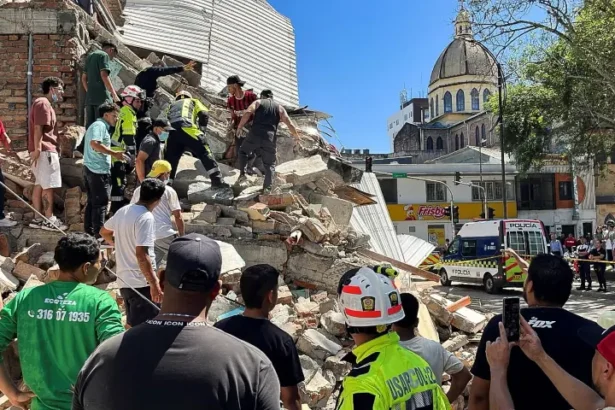
An omnipotent earthquake hit western Colombia in the early morning hours, leaving destruction, multiple fatalities and dozens of collapsed structures across several municipalities. Emergency responders and local residents are rushing to pull survivors from beneath piles of heavy rubble.
In the heart of the country’s coffee-growing region, Pereira Mayor Mauricio Salazar confirmed that 18 residents lost their lives due to the tragic event. Salazar stated,
“The situation is critical.”
He addressed Caracol Radio regarding the growing casualty toll and structural collapse.
Reports from neighboring municipalities highlighted the widespread reach of the disaster. In nearby Manizales, Mayor Jorge Eduardo Rojas reported three fatalities resulting from the shaking. Along Colombia’s Pacific coastline, the key port city of Buenaventura also suffered casualties. Mayor Ligia del Carmen Cordoba confirmed one death after a building caved in, trapping several individuals inside.
Cali, one of the nation’s largest urban centers, was among the hardest hit. The municipal authorities have yet to confirm official death tolls there, though. Mayor Alejandro Eder informed Caracol Radio that at least 30 buildings had completely collapsed. The collapse happened even with rescue crews actively operating at 10 high-priority sites across the city.
Speaking earlier to Blu Radio, Mayor Eder detailed the urgency of the ongoing efforts:
At this point, two people have already been rescued alive, one elderly woman and one young girl. There are more people trapped, he explained, emphasizing the scale of the emergency. He noted further, We have at least 12 critical points and 25 collapsed structures that we are responding to.
In order to handle the overwhelming strain on local resources, the city requested emergency disaster support from authorities in Bogota and Medellin.
Cali resident Juan Carlos Osorio described the immediate aftermath while sifting through wreckage:
The building completely collapsed. It sounded like a bomb. It was horrible, Osorio told Caracol Television. He added, All of us neighbors are working together, forming human chains. We need heavy equipment. There are many people trapped.
The immense intensity of the tremor shook neighboring nations including Ecuador, Panama, and Venezuela. However, Colombian officials confirmed that there was no threat of a tsunami. In the capital city of Bogota, the morning quake caused widespread alarm. They’re prompting frightened residents to run into the streets in their pajamas as emergency sirens echoed.
Bogota Mayor Carlos Galan reassured the public via Blu Radio that damage within the capital appeared relatively minor, consisting primarily of cracked building facades. Elsewhere, news footage revealed severe structural damage, including multi-story buildings with their outer walls completely sheared off.
In Choco province, the governor posted on X that multiple injuries and severe structural damage occurred in the departmental capital of Quibdo. News outlets broadcast images of destruction across cities in the coffee-growing region, known locally as Eje Cafetero.
66-year-old Eje Cafetero resident Martha Estrada told reporters, “There is no electricity or cell phone coverage. It was strong, really strong. Things fell in my house,” recounting the blackout and sudden movement inside her home.
Cali’s mayor, Alejandro Eder, re-emphasized that the city was managing major damage and noted that officials were deploying drones to assess structural integrity across neighborhoods. He reiterated that at least 20 buildings had collapsed with individuals trapped inside, driving the urgent appeal for specialized rescue reinforcement from Bogota and Medellin.
Residents in Bogota also recalled the intensity of the event, with 29-year-old content creator Valeria Polo remarking,
The quake was very, very strong.
To safeguard air travel, Colombia’s civil aeronautics agency announced on X that six regional airports temporarily suspended operations. The affected terminals serve Pereira, Manizales, Quibdo, Armenia, Cartago, and Buenaventura, allowing inspection crews to verify runway and building safety.
Geographically, Colombia experiences frequent seismic activity because it is situated across three ranges of the Andean mountains. Historically, however, landslides have proven to be the country’s most lethal natural hazards, such as the 1985 Armero disaster that claimed approximately 25,000 lives. Major earthquakes have also left dark marks on the region; in 1999, a 6.2 magnitude earthquake struck the coffee region, resulting in over 1,000 fatalities in Armenia and Pereira.
De La Espriella, a right-wing politician who has not previously held elected office, released a video filmed aboard a flight to Bogota following the disaster. He announced that he was suspending his scheduled activities to personally oversee emergency coordination efforts from the national capital.
This natural disaster follows severe regional seismic activity earlier in the summer, when twin earthquakes measuring 7.2 and 7.5 magnitude struck Venezuela on June 24, leaving over 6,000 dead and causing catastrophic damage along the coast near Caracas.
We welcome your contributions! Submit your blogs, opinion pieces, press releases, news story pitches, and news features to opinion@minutemirror.com.pk and minutemirrormail@gmail.com