Summary
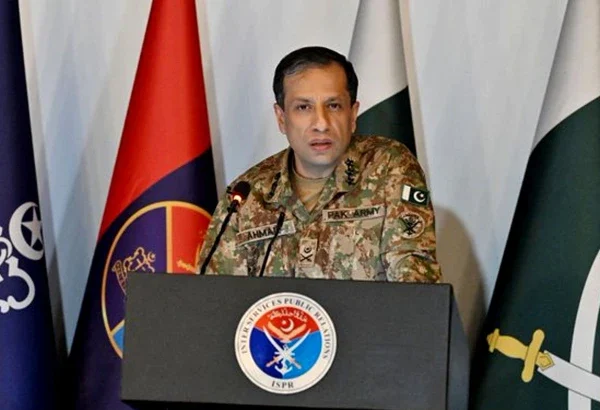
- RAWALPINDI: Director General Inter-Services Public Relations (DG ISPR) Lieutenant General Ahmed Sharif Chaudhry has described the Makkah Joint Defence Agreement between Pakistan, Saudi Arabia and Türkiye as a defensive arrangement focused on collective deterrence, security cooperation and regional stability.
- The DG ISPR further said that the agreement was not framed as a religious or sectarian alliance and stressed that its stated objectives were collective deterrence, security and regional stability.
- Pakistan’s Foreign Office said the mechanism would strengthen solidarity, collective deterrence and defence cooperation while contributing to regional peace and stability.
RAWALPINDI: Director General Inter-Services Public Relations (DG ISPR) Lieutenant General Ahmed Sharif Chaudhry has described the Makkah Joint Defence Agreement between Pakistan, Saudi Arabia and Türkiye as a defensive arrangement focused on collective deterrence, security cooperation and regional stability.
Speaking in an interview with Al Arabiya English, the DG ISPR said operational details of defence agreements were not normally made public and would be determined by the three participating countries through their established mechanisms.
He said the agreement contained no offensive or aggressive element and was not directed against any particular country. According to Lt Gen Ahmed Sharif, its principal purpose was to strengthen collective security and deterrence in the region. His description is consistent with Pakistan’s official position that the accord is defensive in nature and is not directed against any country.
The Makkah Joint Defence Agreement was signed in Makkah on August 7, 2026, by Prime Minister Shehbaz Sharif, Saudi Crown Prince and Prime Minister Mohammed bin Salman, and Turkish President Recep Tayyip Erdogan. The agreement states that an armed attack against any one of the three states will be regarded as an attack against all three, while providing for enhanced defence cooperation.
Lt Gen Ahmed Sharif said the depth of relations between Pakistan, Saudi Arabia and Türkiye was already well understood internationally. He also described the new arrangement as complementary to Pakistan’s existing strategic relationships rather than a replacement for them.
The DG ISPR further said that the agreement was not framed as a religious or sectarian alliance and stressed that its stated objectives were collective deterrence, security and regional stability.
The trilateral framework has since moved towards institutionalisation. At the first meeting of its Strategic Political and Defence Committee in Istanbul on August 31, the three countries agreed to establish a permanent secretariat in Saudi Arabia. Pakistan’s Foreign Office said the mechanism would strengthen solidarity, collective deterrence and defence cooperation while contributing to regional peace and stability.
Turning to counter-terrorism and internal security, Lt Gen Ahmed Sharif said Pakistan was continuing intelligence-based operations against militant organisations. He also referred to the security situation in Balochistan, describing militant violence as terrorism rather than an insurgency and saying that security operations would continue alongside political and economic measures aimed at development and public welfare.
The DG ISPR also referred to the presence of militant organisations in Afghanistan and Pakistan’s concerns regarding cross-border terrorism. These assertions reflect the Pakistani security establishment’s position on the regional security situation.
The interview comes amid intensified diplomatic and security engagement involving Pakistan, Saudi Arabia and Türkiye. Pakistan’s Foreign Office has repeatedly said that Islamabad remains committed to dialogue, de-escalation and peaceful resolution of regional conflicts while strengthening cooperation with its strategic partners.
The Makkah framework is now being developed through regular political and defence consultations, with the three countries seeking to translate the agreement into institutionalised cooperation. The participating states have said their broader objective is to contribute to regional security, stability and a peaceful resolution of crises.
We welcome your contributions! Submit your blogs, opinion pieces, press releases, news story pitches, and news features to opinion@minutemirror.com.pk and minutemirrormail@gmail.com