Summary
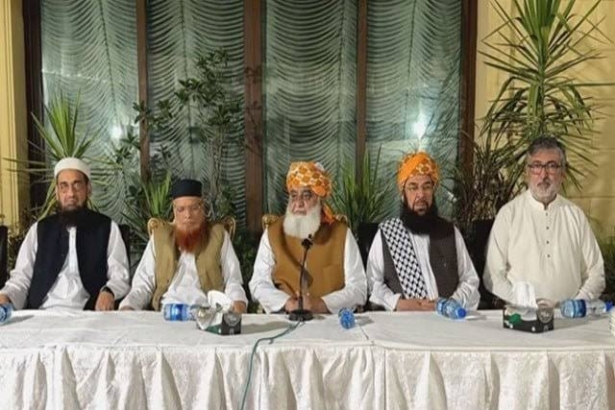
- The meeting between Jamiat Ulema-e-Islam (JUI-F) chief Maulana Fazlur Rehman and prominent religious scholar Mufti Muhammad Taqi Usmani has assumed considerable significance amid Pakistan’s evolving political and security situation, particularly at a time when Fazl’s popularity political narrative appears to be gaining traction.
- Many senior Afghan Taliban figures received their religious education from seminaries affiliated with this school of thought and hold both Maulana Fazlur Rehman and Mufti Taqi Usmani in high regard.
- Another possibility is that Mufti Taqi Usmani may be attempting to ease the growing tensions between Maulana Fazlur Rehman and the military establishment.
The meeting between Jamiat Ulema-e-Islam (JUI-F) chief Maulana Fazlur Rehman and prominent religious scholar Mufti Muhammad Taqi Usmani has assumed considerable significance amid Pakistan’s evolving political and security situation, particularly at a time when Fazl’s popularity political narrative appears to be gaining traction.
Held at the JUI-F chief’s residence in Islamabad, the meeting remained shrouded in secrecy even two days after it took place, with neither side sharing details of the discussion. However, the encounter between two of the most influential figures of the Deobandi school of thought has triggered speculation about its possible political and religious implications.
One major possibility being discussed is a potential effort to engage the Deobandi religious leadership in addressing the deteriorating security situation in Khyber Pakhtunkhwa. Restoring peace in the province, particularly in the aftermath of the imposition of governor’s rule and growing militant violence, remains a major challenge for the establishment.
Mufti Taqi Usmani enjoys considerable respect among religious circles and is regarded as a credible figure by influential quarters. He also maintains close relations with Maulana Fazlur Rehman. His association with the JUI-F chief is particularly significant given the latter’s influence within the Deobandi religious network. Fazlur Rehman is also believed to have played a role in facilitating Usmani’s unopposed election as head of Wifaq-ul-Madaris Al-Arabia Pakistan, the country’s principal board overseeing thousands of Deobandi seminaries and millions of students.
Many senior Afghan Taliban figures received their religious education from seminaries affiliated with this school of thought and hold both Maulana Fazlur Rehman and Mufti Taqi Usmani in high regard. Given these connections, the two religious leaders could potentially play a role in opening channels of communication and facilitating efforts to improve the security situation in the region.
Another possibility is that Mufti Taqi Usmani may be attempting to ease the growing tensions between Maulana Fazlur Rehman and the military establishment. Whether the meeting was initiated at Usmani’s own request or as part of a broader effort by influential quarters remains unclear.
There is speculation that Fazlur Rehman may have been advised to adopt a more cautious approach in his criticism of the establishment. Another possibility is that discussions may have touched upon the proposed 28th Constitutional Amendment, with the government or establishment seeking the JUI-F chief’s support in return for a possible political role for him in Khyber Pakhtunkhwa in the future. However, there is no confirmation of any such proposal.
The regulation of religious seminaries could also have figured prominently in the discussion. The registration, administrative oversight and regulation of madrassas have remained contentious issues in Pakistan for years. Successive governments have struggled to develop a mechanism acceptable to religious organisations while also addressing international concerns, particularly those raised by Western governments.
The JUI-F has not officially disclosed the agenda or outcome of the meeting. Some party leaders, speaking on condition of anonymity, said only that matters of mutual interest were discussed, leaving considerable room for speculation.
Interestingly, Mufti Taqi Usmani himself has adopted a notably critical position on certain actions by the country’s powerful circles in recent months. His reaction to the constitutional provision granting lifetime immunity to powerful officeholders, expressed through a strongly worded social media post, was particularly noteworthy.
This makes the meeting even more intriguing. At a time when political confrontation, security challenges and institutional tensions are shaping the national landscape, the interaction between these two influential religious figures may carry implications beyond routine religious engagement.
Whether the meeting was aimed at facilitating political reconciliation, addressing security concerns in Khyber Pakhtunkhwa or resolving the long-standing madrassa regulation issue, its significance cannot be overlooked. Until either side breaks its silence, the real purpose of this unusual encounter will remain a matter of speculation.
We welcome your contributions! Submit your blogs, opinion pieces, press releases, news story pitches, and news features to opinion@minutemirror.com.pk and minutemirrormail@gmail.com