
Summary
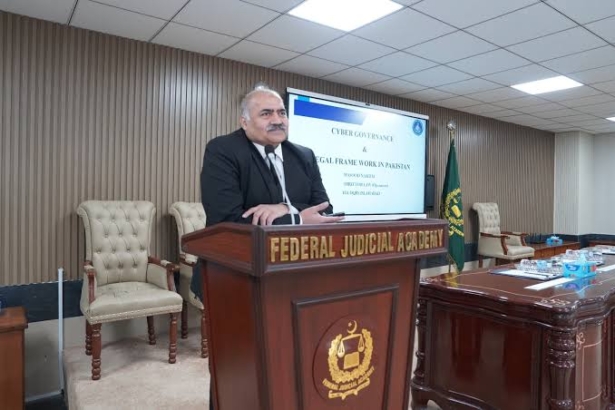
- ISLAMABAD: Federal Investigation Agency (FIA) Director Law Masood Naseem delivered a detailed session on “Digital Evidence and its Admissibility in Pakistan” for judges of banking courts from across the country at the Federal Judicial Academy (FJA), Islamabad.
- The knowledge-sharing session focused on the legal framework governing electronic evidence, modern forensic investigation techniques and the need for improved coordination between investigation and prosecution authorities to ensure effective adjudication of white-collar crimes and cyber-enabled financial offences.
- Important Judicial Precedents Naseem referred to several landmark judgments relevant to banking courts, including Supreme Court and High Court decisions addressing digital fraud, electronic records, forensic reports, mobile phone data, IP addresses and audio-video evidence.
ISLAMABAD: Federal Investigation Agency (FIA) Director Law Masood Naseem delivered a detailed session on “Digital Evidence and its Admissibility in Pakistan” for judges of banking courts from across the country at the Federal Judicial Academy (FJA), Islamabad.
The knowledge-sharing session focused on the legal framework governing electronic evidence, modern forensic investigation techniques and the need for improved coordination between investigation and prosecution authorities to ensure effective adjudication of white-collar crimes and cyber-enabled financial offences.
Addressing the participants, Naseem, an expert in financial crimes and cyber law, explained the relevant legal provisions and judicial precedents concerning the admissibility, authenticity and evidentiary value of digital records in Pakistan.
Legal Framework and Challenges in Implementation
Naseem highlighted that Pakistan’s existing legislation provides a clear legal basis for admitting digital evidence in court. However, he emphasised that the quality and credibility of the investigation remain crucial to securing convictions.
He explained that courts are more likely to rely on evidence when investigations are conducted in a transparent, impartial and legally sound manner. Conversely, procedural shortcomings, doubts about fairness or weaknesses in evidence collection may result in acquittals due to the benefit of doubt.
Qanun-e-Shahadat and Electronic Transactions Ordinance
During the session, Naseem discussed significant amendments to the Qanun-e-Shahadat Order, 1984, introduced to accommodate electronic evidence and technological advancements.
Key provisions highlighted included Article 2(e), which incorporates digital terminology; Article 48-A, concerning information generated, received or recorded through automated information systems; Article 59, which expands expert opinion regarding electronic documents and information systems; Article 78-A, dealing with electronic signatures and documents; and Article 164, which enables courts to consider evidence produced through modern devices.
He also described the Electronic Transactions Ordinance, 2002, as a landmark legislation that recognises and facilitates electronic documents. The law establishes that evidence cannot be rejected merely because it exists in electronic form, while authenticated electronic records may be admitted subject to applicable legal requirements.
The Investigation for Fair Trial Act, 2013, particularly Sections 16 to 21, was also discussed for its provisions concerning warrants, interception of communications and recording procedures.
Important Judicial Precedents
Naseem referred to several landmark judgments relevant to banking courts, including Supreme Court and High Court decisions addressing digital fraud, electronic records, forensic reports, mobile phone data, IP addresses and audio-video evidence.
He highlighted the importance of establishing both the criminal act and the accused’s intention, while emphasising that electronic evidence must be properly authenticated and examined through forensic procedures.
Importance of Scientific Digital Investigation
The FIA official stressed that digital investigation requires specialised expertise, technical knowledge and strict adherence to evidence-preservation protocols.
Unlike conventional crime scenes, digital evidence can be easily altered, damaged or lost through negligence. Investigators must therefore employ scientific methods to collect, preserve, process and securely store electronic material while maintaining its integrity and evidentiary value.
The session concluded with an interactive discussion in which banking court judges raised questions regarding CCTV footage, call detail records (CDRs), forensic reports and electronic banking records.
Officials at the Federal Judicial Academy said such training programmes aim to strengthen judicial capacity and familiarise judges with evolving forensic techniques and modern challenges in cybercrime investigations.
We welcome your contributions! Submit your blogs, opinion pieces, press releases, news story pitches, and news features to opinion@minutemirror.com.pk and minutemirrormail@gmail.com