Summary
- 19.774 trillion and expenditure of Rs.
- 10.520 trillion, against expenditure of Rs.
- 6.948 trillion was added, the primary surplus turned into the consolidated deficit of Rs.
The fiscal deficit fell to just 2.6 of GDP—the lowest in 22 years—while the primary surplus reached a record 2.9%, the highest since at least FY 2000-01— tweet by Khurram Schehzad, Adviser to Federal Finance Minister
The latest official numbers tell an impressive story. Pakistan closed fiscal year 2025–26 with a consolidated budget deficit of Rs. 3.313 trillion, equal to 2.6% of gross domestic product (GDP), and a primary surplus of 2.9%. They accompany a familiar boast: the Federal Board of Revenue (FBR) achieved a “record” collection of Rs. 13.010 trillion.
In the post cited above, Adviser to the Federal Finance Minister, Khurram Schehzad, described the outcome as the “strongest fiscal performance in 22 years”. He highlighted three consecutive primary surpluses, the “lowest fiscal deficit in 22 years”, and the highest primary surplus in at least 26 years, debt growth at a 20-year low, and declining debt-to-GDP and interest burdens.
He concluded that Pakistan was moving decisively from recurring fiscal stress towards discipline, stability and sustainable growth. The improvement is real. The conclusion is premature.
The Finance Division’s newly released Fiscal Operations for July–June 2025–26 show consolidated revenue of Rs. 19.774 trillion and expenditure of Rs. 23.087 trillion. The resulting deficit is unquestionably lower than the enormous gaps of recent years.
Fiscal consolidation has occurred and should be acknowledged. The claim of a 22-year low, however, does not survive the adviser’s own infographic.
The chart accompanying the post places the deficit at 1.7% in 2003–04 and 2.5% in 2004–05—both below 2.6%. The contemporaneous Pakistan Economic Survey 2006–07, using the series then published, recorded 2.4% for 2003–04.
Revisions may explain the discrepancy between 1.7% and 2.4%, but neither figure supports an unqualified record claim. The latest statement is also provisional. The defensible description is that 2.6% is among the lowest deficits in about two decades.
More importantly, 2.6% is the consolidated deficit. The federation did not run a deficit of Rs. 3.313 trillion. Its net revenue receipts, after transfers to provinces, were Rs. 10.520 trillion, against expenditure of Rs. 15.283 trillion.
The federal deficit was Rs. 4.763 trillion, or about 3.8% of GDP. It fell to the consolidated figure because the provinces produced a combined surplus of Rs. 1.450 trillion. Punjab alone contributed Rs. 914 billion.
Provincial surpluses assist macroeconomic management but do not extinguish the federation’s borrowing requirement. They are intergovernmental cash offsets while the federal government remains deeply indebted. The earlier article, Bankruptcy of ideas—X: Debt, Taxes & Democracy, argues that shifting cash between tiers cannot repair a debt-driven state.
An even more striking adjustment appears under “statistical discrepancy”. The detailed expenditure table reports total consolidated expenditure of Rs. 23.940 trillion. A negative statistical discrepancy of Rs. 853 billion lowers expenditure in the summary to Rs. 23.087 trillion. Without this adjustment, the gap between revenue and expenditure would be about Rs. 4.167 trillion, or approximately 3.3% of GDP.
Statistical discrepancies are not unusual in provisional accounts. An adjustment equal to more than one-quarter of the celebrated deficit nevertheless demands explanation before a historic record is proclaimed. Transparency requires reconciliation of this amount when the accounts are finalised.
The composition of expenditure further weakens the triumphal narrative. Mark-up payments reached Rs. 6.948 trillion—5.5% of GDP. Federal Public Sector Development Programme expenditure, excluding development grants to provinces, was only Rs. 727 billion. Interest was therefore about 9.6 times the federal development programme. A deficit can fall because investment and public services are compressed while inherited interest obligations continue dominating expenditure. That is fiscal compression, not fiscal transformation.
The “record” FBR’s collection claim presents a similar illusion. With inflation and nominal GDP growth, the largest rupee collection will normally recur. The relevant questions are whether revenue rose relative to GDP, the base broadened and additional taxation reduced borrowing.
FBR’s Rs. 13.010 trillion was only 10.3% of GDP. It was about Rs. 1.12 trillion below the original target of Rs. 14.13 trillion and barely exceeded the subsequently revised figure of approximately Rs. 12.983 trillion. The goalpost was moved, and arrival at the moved goalpost was described as a record.
Analysis of Pakistan’s withholding-based system [Tax Proposals for Budget 2027—III: Withholdingisation: Weapon of destruction, Minute Mirror, May 25, 2026 and FBR’s Performance FY 2024-25 (Part II): Income Tax or Expropriatory Taxation, Minute Mirror, April 14, 2026] has repeatedly shown why aggregate collection cannot be equated with administrative performance.
During FY 2024–25, withholding and advance collection accounted for about 96% of income tax, leaving only a small fraction attributable to returns and enforcement.
Employers, banks, utilities, importers and businesses collect much of FBR’s revenue on behalf of the state. Extraction at source is not evidence that concealed income has been discovered or that privileged sectors have entered the tax net.
The latest statement also exposes reliance on non-tax revenue. Federal non-tax receipts reached Rs. 5.178 trillion. These included Rs. 2.428 trillion transferred as State Bank of Pakistan surplus and Rs.1.567 trillion collected as petroleum levy. Together, the two sources provided almost Rs. 4 trillion.
As explained in Bankruptcy of ideas—VII: The Petroleum (Levy) State, the petrolem levy operates as inflationary and regressive extraction. It raises transport, agricultural, industrial and household costs. It also remains outside the divisible pool, allowing the federation to retain revenue that would otherwise be shared under the National Finance Commission framework. A large central-bank transfer and an ever-rising fuel levy cannot substitute for fair, broad-based taxation.
Debt servicing supplies the decisive test. Cash mark-up payments of Rs. 6.948 trillion absorbed 53.4% of FBR collection and about 66% of federal net revenue receipts. Domestic interest alone was Rs. 6.030 trillion; foreign interest was Rs. 917 billion. These figures do not include refinancing of maturing domestic principal.
The financing table reports gross external financing of Rs. 3.805 trillion and external debt repayments of Rs. 2.627 trillion. Programme loans alone amounted to Rs. 2.054 trillion. The federal deficit required net financing of Rs. 4.763 trillion: Rs. 1.178 trillion externally and Rs. 3.585 trillion domestically. State Bank financing reached Rs. 3.202 trillion. These amounts reveal continued dependence on creditors and domestic banks. Slower debt growth is welcome; continuing debt dependence is not fiscal sovereignty.
The primary surplus of Rs. 3.634 trillion, or 2.9% of GDP, must also be interpreted correctly. It shows that revenue exceeded non-interest expenditure. It simultaneously exposes the debt trap: after interest of Rs. 6.948 trillion was added, the primary surplus turned into the consolidated deficit of Rs. 3.313 trillion.
Present taxpayers and public expenditure were squeezed to meet obligations created by past borrowing. This conclusion is consistent with earlier work on fiscal illusion and the wider argument developed in A perpetual fiscal debacle.
Pakistan’s fiscal disorder is not caused merely by insufficient taxation. It arises from unproductive expenditure, tax expenditures, state-owned-enterprise losses, energy-sector inefficiencies, privileges, weak local government and borrowing without development.
Genuine success would require a sustained decline in federal borrowing; interest growing more slowly than revenue; reduced reliance on programme loans and banks; tax-to-GDP growth through broadening rather than withholding; transparent accounting for refunds, arrears and discrepancies; and protection of development and social services. This is ultimately a question of constitutional political economy.
Fiscal policy determines who bears public burdens, which institutions receive resources and whether borrowing finances future productive capacity or present privilege.
A lower accounting ratio has limited democratic value when citizens receive fewer public goods while creditors acquire an ever-larger prior claim over national revenue.
The proper verdict is measured but firm. The adviser is right that fiscal consolidation occurred, three consecutive primary surpluses matter, and the latest surplus is exceptional. His infographic does not establish a 22-year-low deficit, while the claim that record FBR collection proves structural reform remains a myth.
Pakistan still borrowed trillions, paid nearly Rs. 7 trillion in interest, relied on loans and non-tax extraction, and reached 2.6% after provincial surpluses and a large negative statistical discrepancy.
A state cannot borrow to service debt, suppress development, tax the already taxed and then declare fiscal victory because the resulting deficit ratio is smaller. The arithmetic has improved. The fiscal order has not been reconstructed.
_______________________________________________________________________
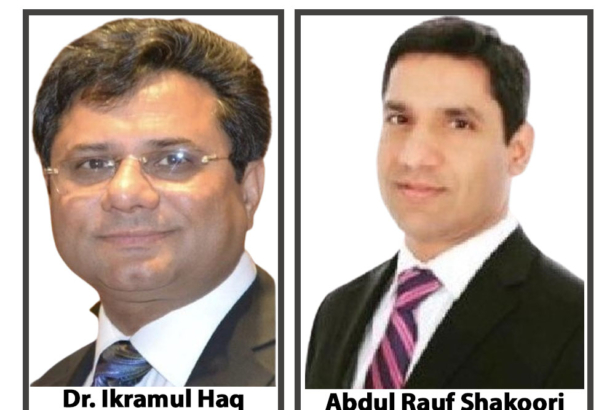
Dr. Ikramul Haq, Advocate Supreme Court, specializes in constitutional, corporate, environment, media, ML/CFT related laws, IT, intellectual property, arbitration and international tax laws. He holds an LLD in tax laws with specialization in transfer pricing.
He was full-time journalist from 1979 to 1984 with Viewpoint and Dawn. He served Civil Services of Pakistan from 1984 to 1996.
He established Huzaima & Ikram in 1996 and is presently its chief partner. He studied journalism, English literature and law. He is Chief Editor of Taxation. He is country editor and correspondent of International Bureau of Fiscal Documentation (IBFD) and member of International Fiscal Association (IFA). He is Visiting Faculty at Lahore University of Management Sciences (LUMS) and member Advisory Board and Visiting Senior Fellow of Pakistan Institute of Development Economics (PIDE).
He has coauthored with Huzaima Bukhari many books that include, Tax Reforms in Pakistan: Historic & Critical Review, Towards Broad, Flat, Low-rate, and Predictable Taxes (third edition, 2024), Pakistan: Enigma of Taxation, Towards Flat, Low-rate, Broad and Predictable Taxes (revised/enlarged edition of December 2020), Law & Practice of Income Tax, Law , Practice of Sales Tax, Law and Practice of Corporate Law, Law & Practice of Federal Excise, Law & Practice of Sales Tax on Services, Federal Tax Laws of Pakistan, Provincial Tax Laws, Practical Handbook of Income Tax, Tax Laws of Pakistan, Principles of Income Tax with Glossary and Master Tax Guide, Income Tax Digest 1886-2011 (with judicial analysis).
He is author of Commentary on Avoidance of Double Taxation Agreements, Pakistan: From Hash to Heroin, its sequel Pakistan: Drug-trap to Debt-trap and Practical Handbook of Income Tax. Two books of poetry are Phull Kikkaran De (Punjabi 2023) and Nai Ufaq (Urdu 1979 with Siraj Munir and Shahid Jamal).
He regularly writes columns/article/papers for many Pakistani newspapers and international journals and has contributed over 3000 articles on a variety of issues of public interest, printed in various journals, magazines and newspapers at home and abroad.
_______________________________________________________________
Abdul Rauf Shakoori, Advocate High Court, is a subject-matter expert on AML-CFT, Compliance, Cyber Crime and Risk Management. He has been providing AML-CFT advisory and training services to financial institutions (banks, DNFBPs, Investment companies, Money Service Businesses, insurance companies and securities), government institutions including law enforcement agencies located in North America (USA & CANADA), Middle East and Pakistan.
His areas of expertise include legal, strategic planning, cross-border transactions including but not limited to joint ventures (JVs), mergers & acquisitions (M&A), takeovers, privatizations, overseas expansions, USA Patriot Act, Banking Secrecy Act, Office of Foreign Assets Control (OFAC).
Over his career he has demonstrated excellent leadership, communication, analytical, and problem-solving skills and have also developed and delivered training courses in the areas of AML/CFT, Compliance, Fraud & Financial Crime Risk Management, Bank Secrecy, Cyber Crimes & Internet Threats against Banks, E–Channels Fraud Prevention, Security and Investigation of Financial Crimes. The courses have been delivered as practical workshops with case study driven scenarios and exams to ensure knowledge transfer.
His notable publications are Rauf’s Compilation of Corporate Laws of Pakistan, Rauf’s Company Law and Practice of Pakistan and Rauf’s Research on Labour Laws and Income Tax and others.
His articles include: Revenue collection: Contemporary targets vs. orthodox approach, It is time to say goodbye to our past, US double standards, Was Due Process Flouted While Convicting Nawaz Sharif?, FATF and unjustly grey listed Pakistan, Corruption is no excuse for Incompetence, Next step for Pakistan, Pakistan’s compliance with FATF mandates, a work in progress, Pakistan’s strategy to address FATF Mandates was Inadequate, Pakistan’s Evolving FATF Compliance, Transparency Curtails Corruption, Pakistan’s Long Road towards FATF Compliance, Pakistan’s Archaic Approach to Addressing FATF Mandates, FATF: Challenges for June deadline, Pakistan: Combating the illicit flow of money, Regulating Crypto: An uphill task for Pakistan. Pakistan’s economy – Chicanery of numbers. Pakistan: Reclaiming its space on FATF whitelist. Sacred Games: Kulbhushan Jadhav Case. National FATF secretariat and Financial Monitoring Unit. The FATF challenge. Pakistan: Crucial FATF hearing. Pakistan: Dissecting FATF Failure, Environmental crimes: An emerging challenge, Countering corrupt practices .
The recent publication, coauthored by these writes with Huzaima Bukhari is:
Pakistan Tackling FATF: Challenges & Solutions, available at:
https://aacp.com.pk/book-detail/pakistan-tackling-fatf-challenges-and-solutions-35
https://www.amazon.com/dp/B08RXH8W46
We welcome your contributions! Submit your blogs, opinion pieces, press releases, news story pitches, and news features to opinion@minutemirror.com.pk and minutemirrormail@gmail.com