Summary
- KATHMANDU/BEIJING: Torrential flooding and landslides along the Nepal-China border have killed at least nine people and caused widespread destruction, with authorities warning that the death toll could rise as rescue teams struggle to reach remote areas.
- Officials said the Bhote Koshi River rose dangerously above its normal level, inundating communities along its banks.
- Prime Minister Balendra Shah ordered authorities to move residents from vulnerable low-lying areas to safer locations and urged communities along the river to remain vigilant.
KATHMANDU/BEIJING: Torrential flooding and landslides along the Nepal-China border have killed at least nine people and caused widespread destruction, with authorities warning that the death toll could rise as rescue teams struggle to reach remote areas.
The disaster struck mountainous areas of Nepal and China’s Tibet region on Wednesday after heavy rainfall triggered powerful floods and mudslides. Roads, bridges, homes and infrastructure were swept away, while several villages were severely affected.
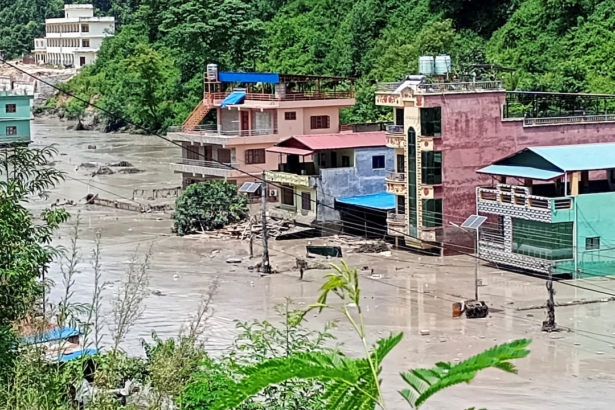
In Nepal’s Rasuwa district, the settlements of Syapru Besi and Timure were among the worst-hit areas. Officials said the Bhote Koshi River rose dangerously above its normal level, inundating communities along its banks.
District administrator Narendra Pariyar warned of further casualties and property losses and urged residents living near the river to immediately move towards safer and higher ground.
“The devastation is everywhere,” a local health worker said, describing entire riverside settlements as having been swept away. He also said several of his relatives were missing.
Television footage showed houses collapsing into floodwaters, vehicles being carried away and bridges damaged by the force of the water. Witnesses reported that some villages were overwhelmed within a short period.
Rescue operations have been hampered by difficult weather and terrain. Helicopters could not land in some affected areas because the river remained dangerously swollen. Nepalese authorities said aerial rescue efforts would become possible once water levels fell.
Police and military personnel have been deployed to support rescue and evacuation operations. Prime Minister Balendra Shah ordered authorities to move residents from vulnerable low-lying areas to safer locations and urged communities along the river to remain vigilant.
Tibet region also hit
Across the border, officials in Tibet reported serious damage after a mudslide affected the Gyirong border area. Chinese authorities warned of potentially significant casualties, with several people reportedly missing.
The landslide disrupted roads, communications and power connections in the region. Chinese President Xi Jinping called for extensive search-and-rescue efforts and urged authorities to strengthen monitoring and early-warning systems to reduce the risk of further disasters.
The floods have also disrupted Nepal’s electricity supply. The country’s energy ministry said around 430 megawatts of power generation had been affected, mainly involving hydropower projects. The figure represents more than 12% of Nepal’s total installed hydropower capacity.
Concerns over recurring disasters
The latest disaster has raised concerns because the same Bhote Koshi River experienced a deadly flood last year. That incident killed nine people and left 24 others missing, while a major bridge connecting Nepal and China was destroyed, disrupting trade and transportation for months.
The previous flooding was linked to the sudden drainage of a glacier lake in Tibet, according to regional climate monitoring authorities.
Officials have yet to establish the exact cause of Wednesday’s flooding. However, the combination of intense rainfall, swollen rivers and unstable mountainous terrain has increased the risk of additional landslides and flooding.
We welcome your contributions! Submit your blogs, opinion pieces, press releases, news story pitches, and news features to opinion@minutemirror.com.pk and minutemirrormail@gmail.com